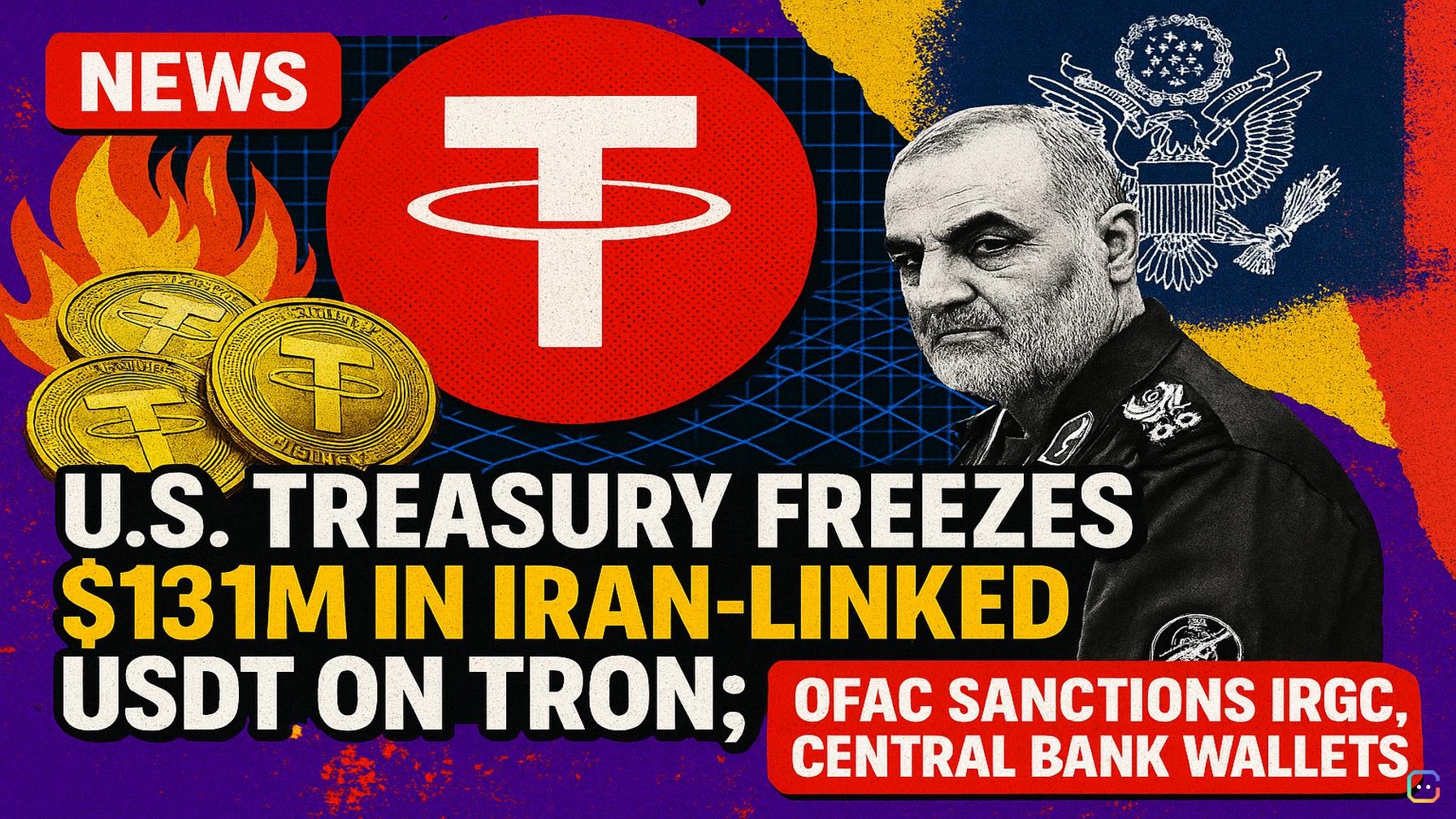
The U.S. Treasury on Tuesday froze more than $131 million in Iran-linked stablecoins, stepping up pressure on Tehran’s use of digital assets to evade sanctions.
What happened
- The Treasury’s Office of Foreign Assets Control (OFAC) sanctioned multiple cryptocurrency wallets tied to both Iran’s Central Bank and the Islamic Revolutionary Guard Corps (IRGC). As a result, stablecoin issuer Tether froze roughly $131 million across four addresses on the Tron blockchain.
- Treasury Secretary Scott Bessent confirmed the action on X (formerly Twitter), saying the U.S. will “aggressively follow the money and deny the Iranian regime access” to illicit funds.
- In a related move, OFAC also sanctioned seven individuals connected to a global weapons procurement network for Iran’s armed forces and the IRGC, including a Tehran-based drone-parts supplier, a Nigerian intermediary, and Russian nationals linked to a Moscow aviation firm.
How the freeze works—and why it matters
- The frozen tokens are USDT, a dollar-pegged stablecoin issued by Tether. Because Tether controls token issuance, it can freeze specific wallet addresses at the software level, preventing those funds from being moved even though they reside on a public blockchain.
- On-chain analyst Specter identified the four Tron addresses before the Treasury’s announcement and traced most of the funds to withdrawals from DTC Pay and Bitso, a Latin American exchange, before landing in the sanctioned wallets.
Blockchain transparency as an enforcement tool
- Public blockchains like Tron leave permanent transaction trails. That transparency, combined with analytics firms and U.S. enforcement, makes tracing and disrupting illicit flows possible. “Law enforcement can track and trace the flow of funds to build cases—and potentially seize them” when actors try to cash out through regulated exchanges, TRM Labs’ Ari Redford told Bloomberg in April.
- The more centralized a crypto service or token is, the easier it is to censor or freeze—an Achilles’ heel for actors relying on centralized issuers like Tether.
Bigger picture: Iran’s crypto strategy and the U.S. response
- Iran has leaned on crypto to skirt sanctions for years: it legalized Bitcoin mining in 2019, used USDT to stabilize a collapsing rial and to settle trade, and built an on-chain payments infrastructure.
- Analytics firms differ on the scale: Chainalysis attributed nearly $8 billion in Iranian crypto volume in 2026, while TRM estimates it was closer to $10 billion—with IRGC-linked addresses accounting for more than half of the country’s inflows in the last quarter of that year.
- The freeze is the latest in “Operation Economic Fury,” a campaign targeting Iranian crypto channels. In April, Tether froze $344 million in USDT tied to two Tron addresses linked to Iran’s central bank. By May, Bessent said the U.S. had seized roughly $1 billion in Iranian crypto since the campaign began. In June, Treasury sanctioned Iran’s four largest exchanges, including Nobitex, which handled over half of Iran’s digital-asset volume in 2025.
Tether’s role and enforcement partnerships
- Tether says it now works with more than 340 law enforcement agencies in 65 countries and has frozen over $4.4 billion in assets since coordinating with authorities—more than $2.1 billion of which was tied to U.S. enforcement actions.
Why this matters for crypto users and policymakers
- The episode underscores the double-edged nature of blockchain finance: public ledgers enable tracing and enforcement, but centralized issuers and on/off ramps remain critical choke points. For regulators, it’s proof that coordinated technical and legal measures can disrupt sanctioned actors. For bad actors, it’s a reminder that on-chain activity leaves an auditable trail—and that reliance on centralized stablecoins can be a vulnerability.
Read more AI-generated news on: undefined/news