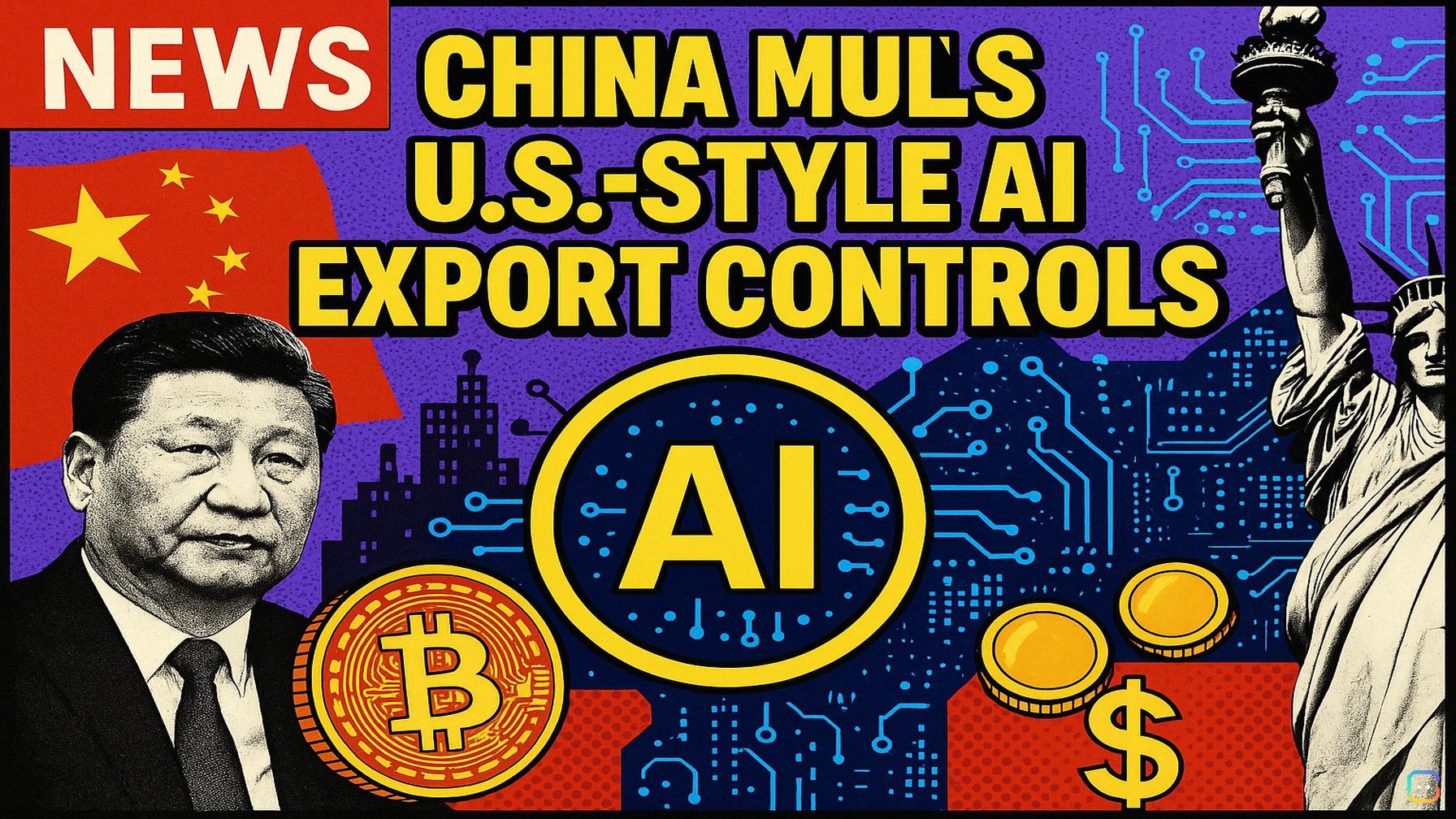
Headline: China Could Follow U.S. Lead With Quiet AI Export Controls — What Crypto Builders Should Watch
The U.S. used an “AI kill switch” in June. China now looks to be sketching its own version.
What’s happening
- Reuters reports Beijing has spent weeks privately briefing major AI firms — including Alibaba, ByteDance and startup Z.ai — about proposals to limit who outside China can use its most advanced AI models, even some that haven’t been released yet. The meetings were reportedly convened by China’s Ministry of Commerce and cited anonymous sources.
- Discussions have covered restrictions on both closed-source models and “open-weight” models (the type developers can download, run and modify locally). Officials also floated making unauthorized disclosure or theft of AI tech a national security offense, and considered new limits on which investors may fund domestic AI startups.
- No final rules, timeline or scope are set. Two sources told Reuters the measures might apply only to future models, not those already public.
A proposed three-tier system
- A May roundtable of legal experts summarized in a Supreme People’s Court journal reportedly sketched a three-tier regime:
1. Basic open-source tools — simple government filing required.
2. More advanced tech — security review before release.
3. Frontier models — barred from public release or restricted to domestic use only.
- If enacted, that would overturn the openness that powered China’s recent AI growth.
Why this matters to crypto and the wider tech world
- China’s open-weight models have become a global alternative to costly U.S. frontier systems. Alibaba’s Qwen models are widely shared on Hugging Face, ByteDance’s Doubao dominates in China, and Z.ai’s GLM-5.2 has attracted U.S. research attention for strong benchmarks and cheap API pricing.
- Chinese open-weight models surged from under 2% of token usage on OpenRouter in late 2024 to roughly 61% by mid-2026. Many projects — including those in crypto relying on cheap, customizable AI for oracles, bots, analytics, and smart-agent tooling — have leaned on that openness.
- If Beijing restricts overseas access to frontier models, the “escape valve” for teams avoiding U.S. constraints closes. That could raise costs and centralization risks for any crypto project dependent on third-party AI providers.
U.S. precedent and the security angle
- Washington already took an unprecedented step in June when the Commerce Department ordered Anthropic on June 12 to suspend foreign-national access to Claude Fable 5 and Mythos 5. Anthropic pulled the models globally (because API endpoints aren’t easily fenced by passport), then restored them June 30 after retraining safety classifiers and the Commerce Department lifting the restriction. Analysts noted it was the first time U.S. export controls were applied to deployed AI models rather than chips.
- OpenAI similarly released certain GPT-5.6 models to a small group of government-vetted partners at Washington’s request. President Trump’s June 2 executive order asked developers to voluntarily submit frontier models for a federal cybersecurity review; a framework defining “covered frontier models” is due August 1.
- Chinese officials reportedly worried that Anthropic’s Mythos could be reverse-engineered and used against Chinese infrastructure, and some social-media allegations claimed Anthropic included spyware-like behavior in tools targeting Chinese users. Those security concerns — coupled with domestic voices calling for a homegrown defensive AI — helped spur the internal talks. Qihoo 360 founder Zhou Hongyi publicly unveiled Tulong Feng, a domestic AI vulnerability agent, at ISC.AI 2026.
Regulatory tightening already under way
- Beijing has been tightening the perimeter: regulators ordered Meta to unwind a $2 billion Manus deal in April under foreign investment security review rules, required Moonshot AI and StepFun to seek approval before taking U.S. capital, and issued a broader regulatory package in early June increasing scrutiny on cross-border tech and data flows.
- Chinese firms are already pre-empting rules: ByteDance and Alibaba moved to remove or delay certain humanlike agent features ahead of rules taking effect July 15.
Structural dilemmas
- Analysts (including Lawfare) point out a paradox: nationality- or geography-based controls hurt the very researchers and engineers needed to secure and maintain systems. The U.S. AI labor force is heavily foreign-trained; the same dynamic would complicate China’s controls in reverse.
- For open-source ecosystems, the stakes are high: many small labs, devs and decentralized projects rely on global access to open-weight models. A shift to stricter export or domestic-only regimes would reshape supply, pricing, and trust.
What crypto teams should watch next
- The August 1 U.S. framework on “frontier models” and China’s July 15 regulatory timeline.
- Any formal rules from China’s Ministry of Commerce or national security apparatus that define export limits for open-weight models.
- How access restrictions would be enforced in practice (API gating, licensing, investor restrictions) and how exchanges, oracle operators, node runners and AI-based dApps adapt.
- Signs of market movement: further delistings, localization of model hosting, or onshoring of model development and inference infrastructure.
Context from global leaders
- European and allied leaders have already expressed concern about concentration risk: France warned it might stop buying U.S. AI products if access could be cut off on short notice, and Canada’s prime minister called concentrated AI dependence a “strategic mistake.” Those statements assumed an unconstrained alternative existed; tighter Chinese export policy would challenge that assumption.
Bottom line
China’s quiet talks signal it’s weighing a U.S.-style regime for controlling access to advanced AI. For crypto builders and the broader open-source ecosystem, the potential loss of borderless access to Chinese open-weight models would reshape costs, vendor choices and decentralization strategies. Monitor the upcoming regulatory milestones and be ready to diversify AI dependencies.
Read more AI-generated news on: undefined/news