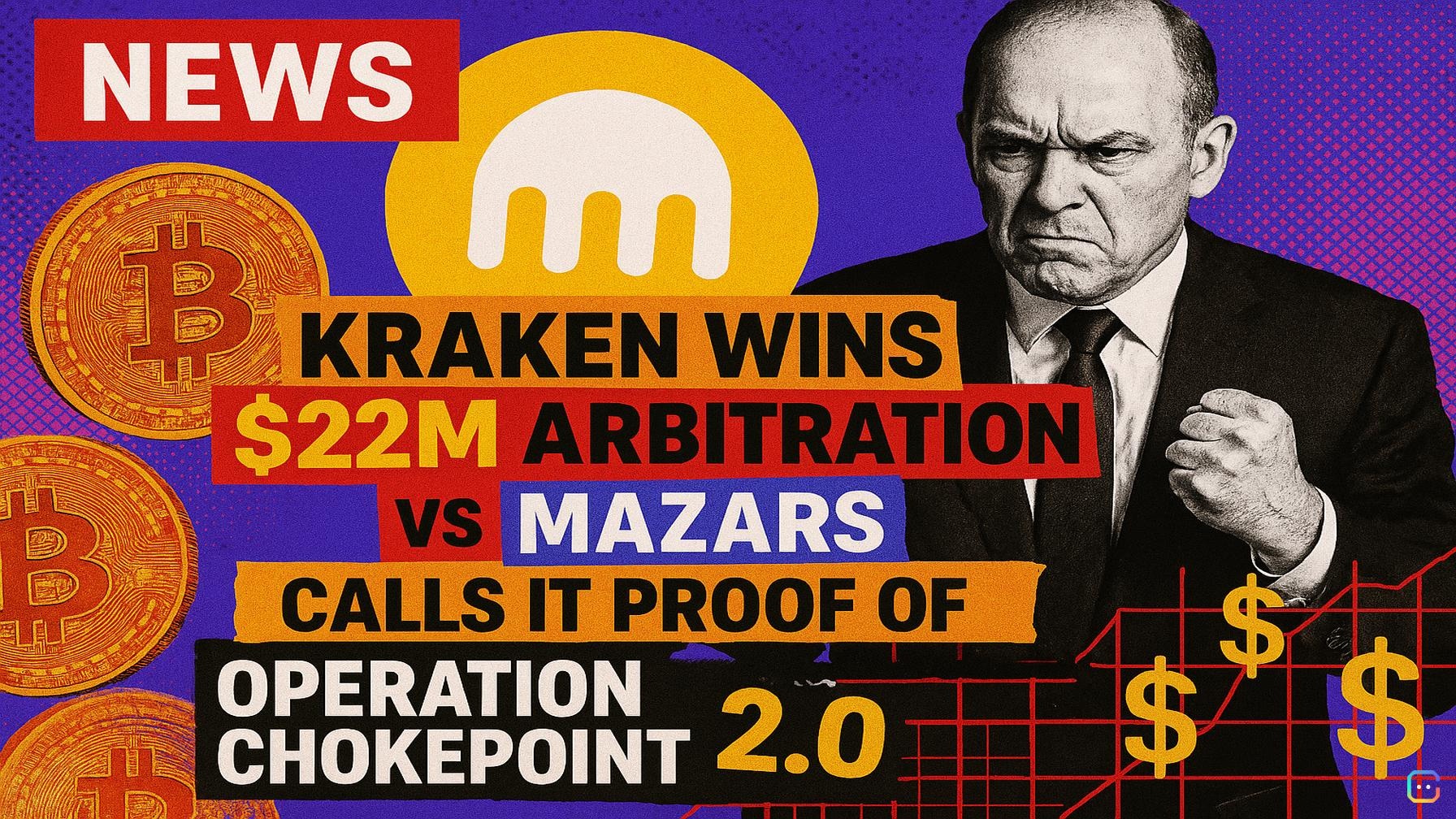
Kraken wins $22M arbitration; co-CEO calls it proof of “Operation Chokepoint 2.0” impact
Kraken has secured a $22 million arbitration award against its former auditor Mazars USA — and the exchange’s leadership says the case exposes a broader, industry-wide pressure campaign that cut crypto firms off from essential financial services.
What happened
- Parent company Payward asked the Delaware Court of Chancery to enter judgment on the arbitration award after prevailing against Mazars over the auditor’s abrupt withdrawal from Kraken’s nearly completed 2022 audit.
- Kraken co-CEO Arjun Sethi says Mazars pulled out despite finding no fraud, flagging no management concerns and reporting no disagreements with Kraken. According to Sethi, the withdrawal damaged the exchange by disrupting banking relationships, licensing efforts and other services that depend on completed independent audits.
- “An audit is not a favor. It is oxygen,” Sethi wrote, arguing that audits are critical infrastructure for financial firms and that lawful crypto companies were effectively shut out of basic services during the period.
Operation Chokepoint 2.0 — Kraken’s framing
Sethi attributed Mazars’ exit to what the crypto industry calls “Operation Chokepoint 2.0”: an alleged, coordinated effort to pressure banks, auditors and other service providers to distance themselves from digital-asset firms. To bolster that claim, his letter cites several 2023 developments — joint guidance from U.S. banking regulators, the Securities and Exchange Commission’s now-rescinded Staff Accounting Bulletin No. 121, and the failures of crypto-focused banking infrastructure such as Silvergate and Signature Bank’s Signet payment system.
Sethi also invoked broader principles in his statement — “America’s greatest competitive advantage isn’t capital or technology. It’s the rule of law” — and urged Congress to pass the CLARITY Act to give digital-asset firms clearer statutory operating rules rather than leaving them subject to enforcement-driven uncertainty.
Kraken’s leadership reaction
Co-CEO Dave Ripley added on X that the $22 million award compensates Kraken for part of the financial harm inflicted by what he called a coordinated campaign to cut crypto off from banking, auditors and other essential services.
Regulatory context
The legal fight comes as U.S. regulators revisit bank oversight tied to crypto. In February, the Federal Reserve sought public feedback on a proposal to remove “reputation risk” from bank supervision — a follow-up to a 2025 directive instructing supervisors not to pressure banks into closing customer accounts over reputational concerns. Critics say such changes could curb the practices often associated with Chokepoint 2.0.
Business momentum despite legal fight
While the case proceeds through Delaware courts, Kraken has continued expanding its institutional and trading offerings:
- It launched the ability for eligible non-U.S. users to post selected tokenized stocks and ETFs as collateral for futures and margin trading on Kraken Pro, covering 10 xStocks including SPYx, QQQx, AAPLx, GOOGLx, TSLAx, NVDAx, HOODx, MSTRx, GLDx and CRCLx.
- In May, Payward partnered with Franklin Templeton to introduce tokenized money market products for collateral and cash management on Kraken.
- In June, Kraken and Maple rolled out an institutional crypto lending structure using a bankruptcy-remote vehicle for crypto-backed loans.
IPO plans and timing
Kraken, founded in 2011, has been preparing for a public listing: the company disclosed it confidentially submitted a draft Form S-1 to the SEC in November 2025. However, reports in May indicated the IPO might be delayed until 2027 amid softer crypto markets and ongoing cost-cutting.
Why it matters
The arbitration win is a tangible payout for Kraken, but company leaders frame it as part of a larger fight over access to banking and professional services for crypto firms. The outcome — and the concurrent regulatory shifts — could influence how banks, auditors and other providers assess crypto clients going forward, and whether lawmakers move to give the industry clearer statutory guardrails.
Read more AI-generated news on: undefined/news