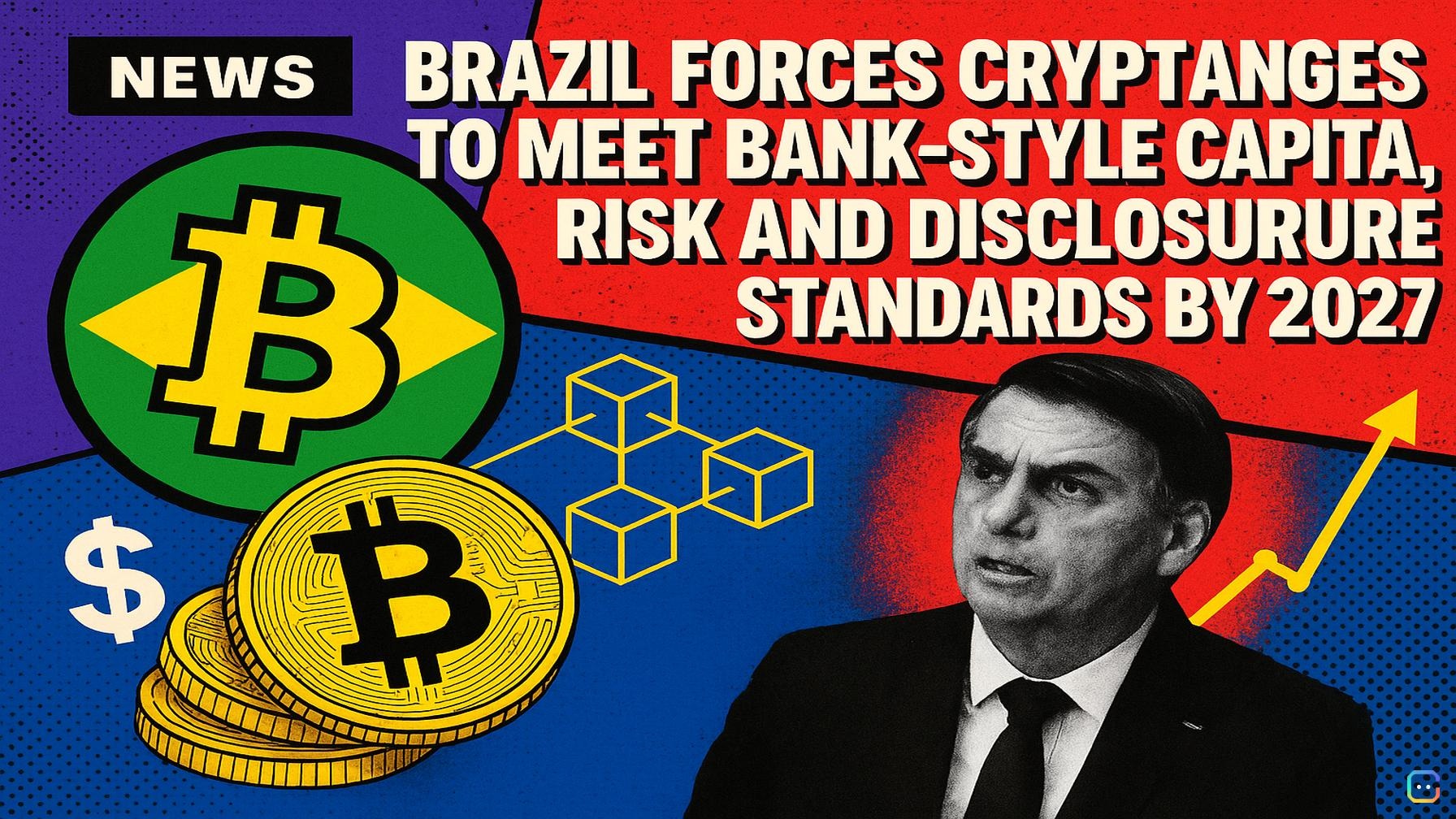
Brazil tightens crypto rules: exchanges must meet bank-style capital, risk and disclosure standards from 2027
Brazil’s Central Bank has approved a package of prudential rules that will bring virtual asset service providers (VASPs) — including crypto brokers, custodians and transfer platforms — closer to the regulatory standards that apply to securities brokers and distributors. The measures were approved on July 1 and take effect Jan. 1, 2027, as part of Brazil’s phased rollout of its cryptoasset legal framework.
What the new rules require
- Minimum capital reserves: VASPs will need to hold defined capital buffers.
- Formal risk management: Firms must adopt documented risk-management policies and procedures.
- Regular disclosures: Companies will be required to periodically disclose their financial and operational condition to supervisors and the market.
- Classification and supervision: Crypto brokerage, custody and transfer activities will be classified as Type 3 institutions, applying those standards to the institution and its economic group on the premise that similar-risk activities should face similar rules.
Transition timeline and segmentation
- Immediate effect on rulebook: Rules approved July 1, effective Jan. 1, 2027.
- Phased supervisory shift: All VASPs will be placed into Segment 4 (S4) of Brazil’s banking supervision framework by June 30, 2028, giving firms additional time to meet full prudential obligations.
- Simplified regime excluded: Institutions in Segment 5 (S5) — the lighter-touch regime for smaller financial firms — will be barred from offering virtual asset services because the Central Bank judges those activities incompatible with simplified supervision.
How this fits with earlier measures
The new prudential requirements add to a wave of crypto rules Brazil has rolled out since late 2025:
- Nov. 2025: The Central Bank published initial operating rules for VASPs covering governance, AML controls, foreign-exchange participation and operational requirements.
- June (recent): Crypto firms seeking initial authorization or license renewals must submit independent audit reports prepared by auditors registered with Brazil’s securities regulator; audits assess AML/CTF controls, customer asset segregation, internal risk management, and compliance programs.
- Earlier in 2026: Brazil’s National Monetary Council required crypto platforms to respect confidentiality standards similar to bank secrecy rules (Complementary Law 105).
- May 2026: The Central Bank barred regulated cross-border electronic FX providers from using crypto assets to settle international payments, while still permitting digital assets to be traded and transferred outside the supervised payment system.
- Recently: Federal prosecutors reiterated that cryptocurrency donations are banned in election campaigns because donors must be clearly identified under campaign finance rules.
Why it matters
The Central Bank says the measures aim to strengthen the financial system and reduce risks for customers and the market. For exchanges and other VASPs, the rules raise compliance costs and operational standards — likely accelerating professionalization and possibly consolidation in Brazil’s crypto sector. Firms that move quickly to bolster capital, governance and audit practices should be better positioned to operate under the tighter regime; smaller operators may be forced to exit or merge if they cannot meet the new thresholds.
What to watch next
- How regulators will calibrate capital requirements and supervisory inspections in practice.
- The pace at which smaller S4 entrants upgrade systems versus exiting the market.
- Whether these steps encourage greater institutional participation by reducing perceived counterparty and operational risk.
This marks another step in Brazil’s steady march toward a bank-like regulatory model for crypto, balancing market development with tighter consumer and system protections.
Read more AI-generated news on: undefined/news