Pope Leo XIV has made AI the Vatican’s first major tech manifesto — and its message will resonate across Silicon Valley and the crypto world.
On May 25, at the Vatican’s Synod Hall, the pope released Magnifica Humanitas ("Magnificent Humanity"), a 245-paragraph encyclical devoted entirely to artificial intelligence. He had signed the document on May 15 — the 135th anniversary of Rerum Novarum, the 1891 encyclical that shaped modern Catholic social teaching on labor — underlining how he sees AI as the defining moral issue of his papacy, comparable to the Industrial Revolution.
Key takeaways
- Technology is not neutral: The encyclical bluntly rejects the idea that algorithms are impartial, arguing that "technology is never neutral" because it inherits the values, blind spots, and incentives of its creators. That opacity, Pope Leo warns, can hide choices that shape life-changing outcomes.
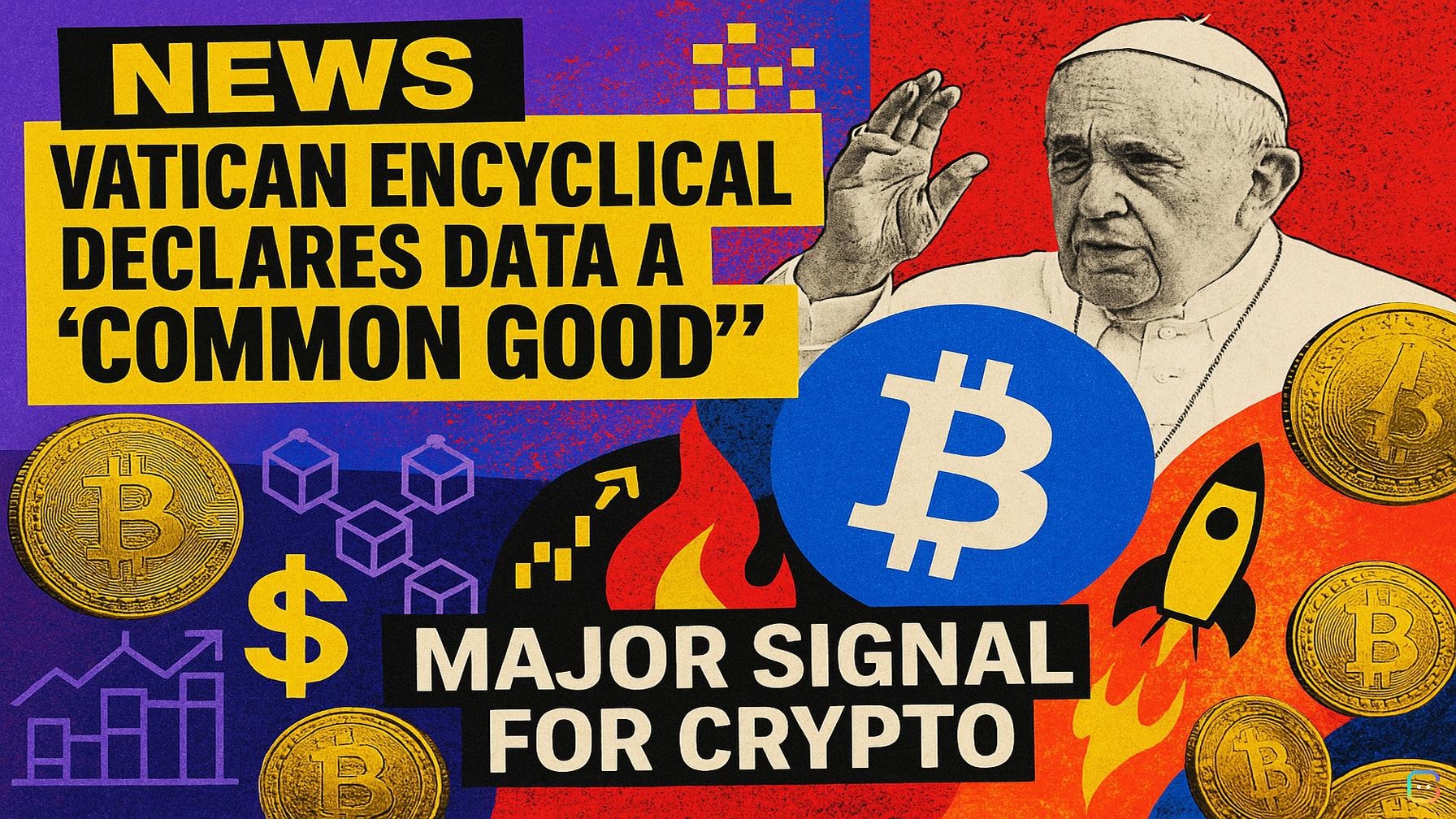
- Data as a common good: Extending Catholic doctrine about natural resources, Leo declares data a shared human resource. "Data is the product of many contributors and should not be treated as something to be sold off or entrusted to a select few," the document states, pushing back on the commercial concentration of digital assets.
- Governance and subsidiarity: Leo applies the principle of subsidiarity — that decisions should be made as locally as possible — to tech governance. The encyclical calls not only for top-down regulation but for transparent algorithms, independent community audits, and legal avenues for people to challenge automated decisions that affect jobs, credit, or justice.
- Human limits and transhumanism: The pope criticizes transhumanist drives to engineer away human vulnerability, arguing that finitude underpins empathy, moral judgment, and care. Systems designed to "optimize" those traits risk efficiently excluding the most vulnerable.
- Limits of machine "understanding": The document stresses that AI systems "do not possess a body, do not feel joy or pain," and lack the lived experience behind genuine understanding. That matters when machines make or recommend sensitive decisions: their apparent objectivity masks embedded choices and values.
- Threats catalogued: The encyclical covers a wide set of harms — from warfare and autonomous weapons to dehumanization, data colonialism, child safety, mass unemployment, disinformation, and technocracy. Leo warns that unchecked platform governance can become a form of digital authoritarianism.
A tech executive on stage
Christopher Olah, co-founder of Anthropic and head of its interpretability research team, shared the stage with the pope at the Synod Hall presentation, alongside two cardinals and two theologians. Olah echoed an unusually candid line for an AI executive: major labs operate within incentives and constraints that sometimes conflict with "doing the right thing," and outside scrutiny — from governments, religious institutions, and civil society — is essential. He also flagged AI-driven labor displacement as a near-term moral crisis if it occurs at scale.
Institutional follow-up
The encyclical formalizes a stance Pope Leo has been advancing since his election. The Vatican has already been moving on policy: it approved a new internal AI commission on May 16, drawing representatives from seven departments to coordinate AI governance across the Holy See. Leo also addressed Silicon Valley executives at the Vatican in November 2025, arguing that more ethical AI is insufficient if its moral frame is set only by those who control data and compute.
Why crypto watchers should pay attention
The pope’s framing — data as a common good, governance distributed rather than concentrated, transparency and community audits — dovetails with core themes in the crypto and Web3 world: data sovereignty, decentralization, self-sovereign identity, and on-chain governance. Magnifica Humanitas won’t prescribe technical solutions, but it amplifies moral and political pressure for alternatives to locked, corporate-controlled data silos.
Questions the encyclical raises for the industry: How can crypto-native primitives (decentralized identifiers, tokenized incentives, verifiable audits) help realize a data commons? What role should DAOs, standards bodies, and interoperable identity systems play in giving individuals legal and practical power to contest automated decisions? And how will governments reconcile calls for communal stewardship of data with existing property and commercial models?
Pope Leo XIV’s encyclical is neither a policy playbook nor a tech roadmap, but it is a major moral statement that reframes data and algorithms as societal—not merely commercial—questions. For builders and regulators in crypto and beyond, it’s a signal that debates over ownership, transparency, and governance of digital resources are moving decisively into the moral mainstream.
Read more AI-generated news on: undefined/news