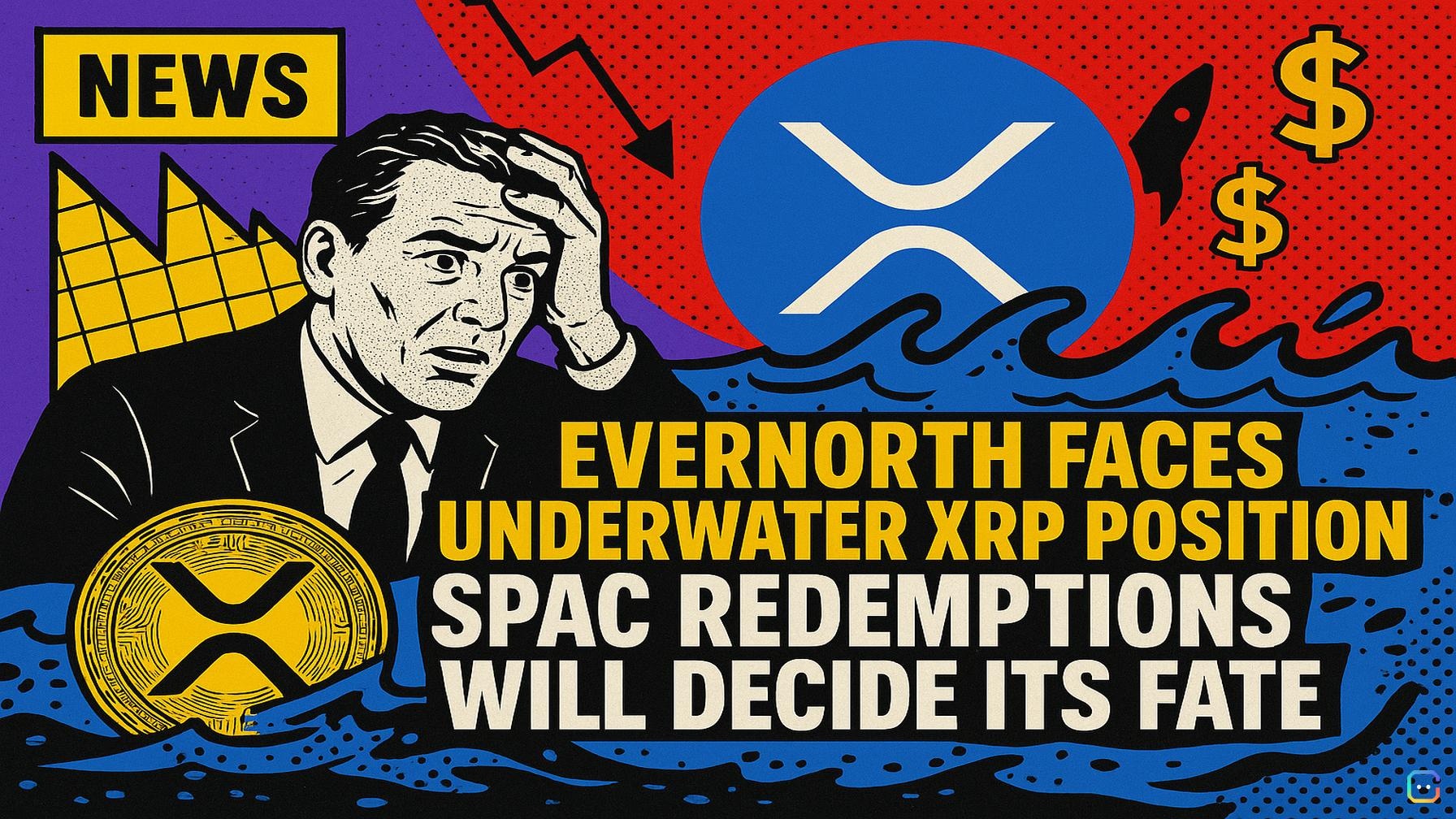
Evernorth looks set to list “underwater” — and the SPAC vote and redemptions will decide how big the company actually is.
What’s happening
- Evernorth, a Ripple-backed digital-asset treasury company, filed Amendment No. 1 to its Form S‑4, moving it closer to a Nasdaq listing under ticker XRPN. But the company’s flagship position is already trading well below what it paid for it.
- The vehicle says it accumulated roughly 473 million XRP at an average cost of about $2.54 per token. XRP is trading near $1.10, leaving Evernorth with an unrealized loss of more than 50% and a material impairment recorded in its 2025 accounts.
- The capital backing the deal is real and heavyweight: about $1 billion in commitments from Ripple (which contributed ~127 million XRP), SBI, Pantera, Kraken and others. That credibility is central to the bull case — but it doesn’t erase the arithmetic SPACs force on public shareholders.
Why the SPAC mechanics matter — the redemption is the story
- This is classic SPAC structure: public holders of the SPAC can vote to approve the business combination and separately redeem their shares for pro rata cash from the trust (usually IPO price plus interest). In practice, holders can and do redeem even when they vote yes.
- For Evernorth, the choice for SPAC shareholders is stark: take cash at trust value, or accept equity in a company whose token holdings sit at a >50% unrealized deficit. Arbitrage funds and many institutional SPAC investors typically take the cash. That behavior is already visible: pro forma cash available to the combined company has fallen across filings from roughly $1.1 billion toward about $870 million — the visible effect of expected redemptions and adjustments before closing.
What that means for the listing
- Redemptions don’t necessarily kill the deal, but they shrink it. A smaller Evernorth would:
- Hold a less meaningful XRP stake,
- Have a thinner public float that discourages institutional participation,
- Lose the balance-sheet scale needed to issue equity accretively — the flywheel that made treasury vehicles work in the past.
- The broader treasury-company model depends on the stock trading at a premium to NAV so the company can issue shares accretively and buy more tokens. That premium has largely evaporated across the sector this year. Evernorth’s handicap is that it would be asking investors to buy a wrapper around an underwater position at a time the market is reluctant to pay premiums for even winning positions.
A sober look at demand and supply
- The ETFs and products that already offered institutions exposure to XRP aren’t exactly a tailwind: coverage of the spot-XRP ETF complex found cumulative inflows around $1.49 billion against ~ $997 million in net assets, leaving an unrealized deficit near $493 million — and flows decayed roughly 99% from launch. In short, a lot of institutional demand was tested in simpler products and largely cooled off.
- That said, the committed investors here are credible and strategic. Ripple, SBI, Pantera, and Kraken are not casual backers. Their participation — and Ripple’s conversion of tokens into a large equity stake — is a signal of conviction that could matter if those backers hold and the vehicle keeps scale.
Key things to watch (and when they’ll arrive)
- Redemption figure at closing: the single most informative number. It converts investor conviction into dollars and sets the company’s initial scale. Compare any announced redemptions to the roughly $870 million pro forma and the original ~$1.1 billion.
- Will committed investors backstop redemptions? Expect disclosures about forward purchase agreements, private placements, or non-redemption deals if the sponsors try to preserve scale.
- Opening trade relative to NAV: the market’s first verdict on whether the wrapper is worth a premium. Trading below NAV on day one typically forecloses the accretive issuance flywheel.
- Filings on lock-ups and Ripple’s disclosed position: details on any lock-up or sale plan for Ripple’s ~127 million-XRP contribution will be in the registration materials, and they’ll matter for future supply dynamics.
- Any change in accumulation strategy: whether Evernorth uses remaining capital to average down or pauses buying will materially change the cost basis and narrative.
Context and the honest frame
- Treasury vehicles succeeded when they could buy assets at reasonable prices and trade at premiums that allowed accretive share issuance. This sector has shown it can work going up and that it struggles badly in reverse when premiums compress.
- The bull case for Evernorth is straightforward and internally consistent: a treasury assembled near a cycle low, backed by credible capital, is well-positioned to benefit from a token recovery. But it requires that recovery — and enough shareholders declining cash at the gate so the company is large enough to wait for one.
- The decisive moment for Evernorth is now: the shareholder redemption choices and the market’s opening trade will reveal whether it lists as a meaningful, billion-dollar vehicle or as something much smaller.
Bottom line
Evernorth is a high-profile test of the SPAC-to-treasury formula in a market that has already shown limited appetite for paying premiums on token wrappers. The committed capital and backers give the deal life, but the SPAC redemption mechanics put the company’s scale and strategy on the line before a single share trades.
This is educational analysis, not investment advice. The transaction’s terms, timing, and completion are uncertain; figures reflect filings available as of July 29, 2026. Always do your own research.
Read more AI-generated news on: undefined/news