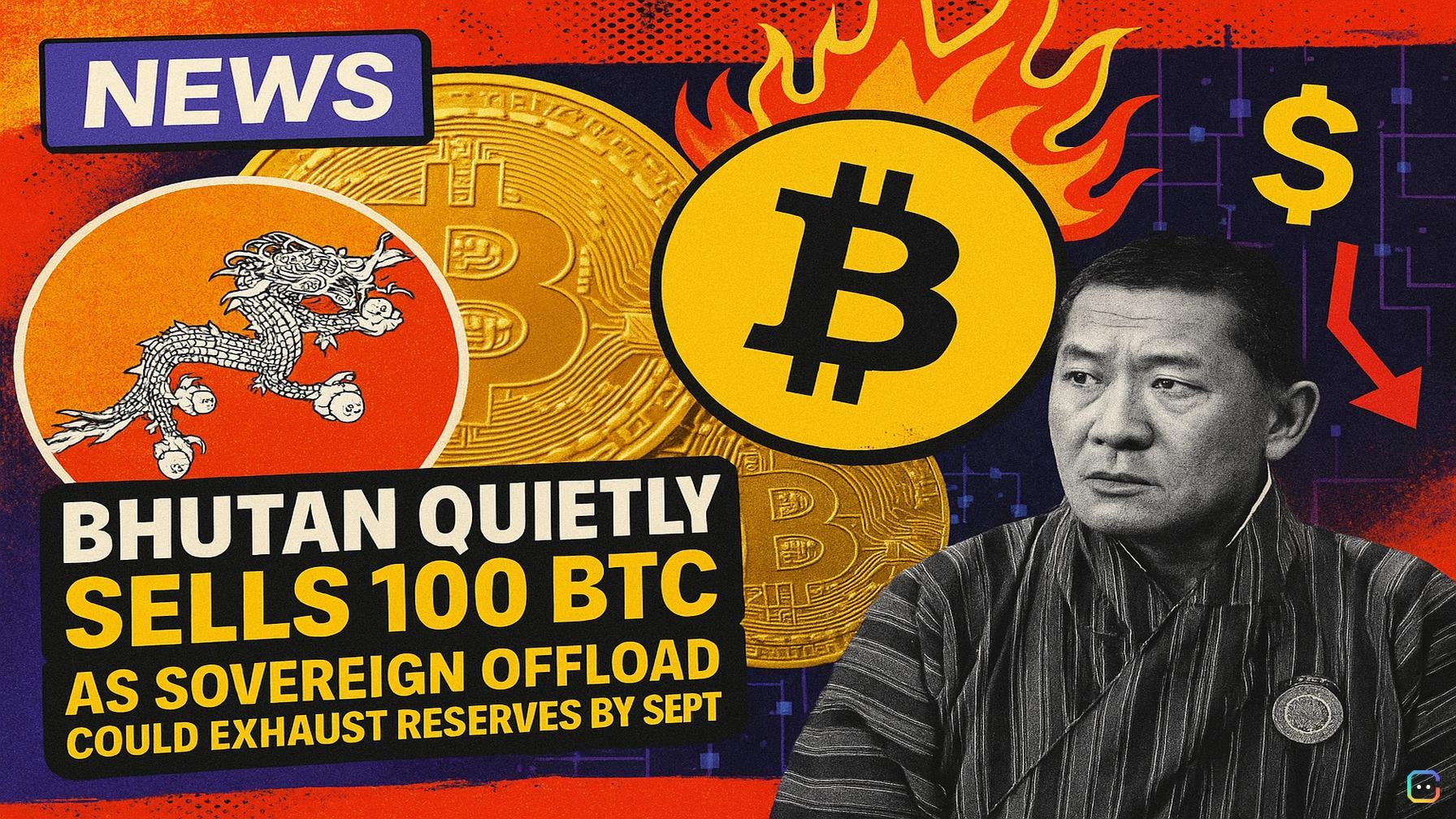
Bhutan quietly moved another chunk of its Bitcoin stash this week, transferring 100 BTC — roughly $8.1 million — in a continuation of a larger sovereign sell-off that has been accelerating since late 2024.
Blockchain analytics firm Arkham Intelligence flagged the transfer on May 12, warning that at the current rate of disposals the kingdom could exhaust its holdings by the end of September. Arkham estimates Bhutan has sold about $230.39 million of Bitcoin so far this year and is offloading roughly $50 million a month.
A stark drop in reserves
On-chain data show Bhutan’s Bitcoin reserves have plunged from nearly 13,000 BTC in late 2024 to about 3,100 BTC today, leaving the country with roughly $252 million in Bitcoin holdings. The sales began in earnest with a 2,077 BTC ($163 million) move in late 2024 and have continued in bursts, including a roughly $100 million tranche in September 2025.
Decrypt reached out to Druk Holding Investments and Gelephu Mindfulness City for comment.
Treasury strategy, not bearishness
Analysts say the sell-off looks driven by treasury management rather than a capitulation on crypto. Lacie Zhang, research analyst at Bitget Wallet, told Decrypt the transfers reflect “an active sovereign treasury strategy rather than a bearish signal.” Unlike many sovereign Bitcoin caches that originated from seizures, Bhutan built its position through state-backed mining that began in 2019 using surplus hydropower — a low marginal cost of production.
“These sales are being used to monetize gains generated through state-backed Bitcoin mining, helping fund national development and diversify reserves while maintaining long-term exposure to the asset,” Zhang said. She framed Bhutan’s approach as an evolution in reserve management: Bitcoin is becoming a liquid strategic asset to be “held and optimized” — profits realized during strong patches and capital reallocated as needed.
Uneven sales pattern
Not everyone expects a straight-line sell-off. Markus Levin, co-founder of XYO, told Decrypt the disposals have been uneven. “Arkham's October timeline assumes they keep selling at the same pace. They haven't — it's been bursts, not a steady drain,” he said. Levin added that, given Bhutan mined much of its Bitcoin at “near-zero cost,” the sales are profitable and can be a timely way to fund public projects: “They have schools to build, salaries to pay, and a new city to fund. Bitcoin HODLing is a luxury for entities that don't have citizens.”
Market context
Bitcoin is trading around $80,500, down about 0.3% in the past 24 hours and more than 36% below its all-time high of $126,080, according to CoinGecko. Analysts note that selling into this price environment still represents realized gains for Bhutan because of its low-cost production.
Gelephu Mindfulness City and broader crypto push
Bhutan has been one of the most crypto-forward governments globally, naming Bitcoin, Ethereum and BNB as strategic reserves for Gelephu Mindfulness City (GMC), a Special Administrative Region in southern Bhutan. In December the kingdom pledged up to 10,000 BTC — then worth roughly $1 billion — to GMC’s development.
As it sells BTC, Bhutan is also pressing ahead with crypto-friendly infrastructure. Gelephu Mindfulness City recently unveiled an accelerated licensing pathway for regulated firms from jurisdictions such as Singapore, ADGM and Hong Kong, allowing fast-track approvals and integrated banking via DK Bank. DK Bank will offer multi-currency accounts across nine currencies — including USD, EUR, SGD and INR — with fees waived for at least the first six months for GMC-licensed firms. “Our goal is to create a trusted platform for digital assets and financial innovation, where regulation, infrastructure, and execution are aligned from the outset,” Jigdrel Singay, GMC board member and digital assets lead, said in a statement.
Why it matters
Bhutan’s program highlights a subtle but important shift: sovereigns may increasingly treat Bitcoin as a source of liquidity and a tool for reserve optimization rather than a purely long-term store of value. If other nations follow suit, it could reshape how state actors interact with crypto — balancing long-term exposure with active monetization to support national development goals.
Read more AI-generated news on: undefined/news