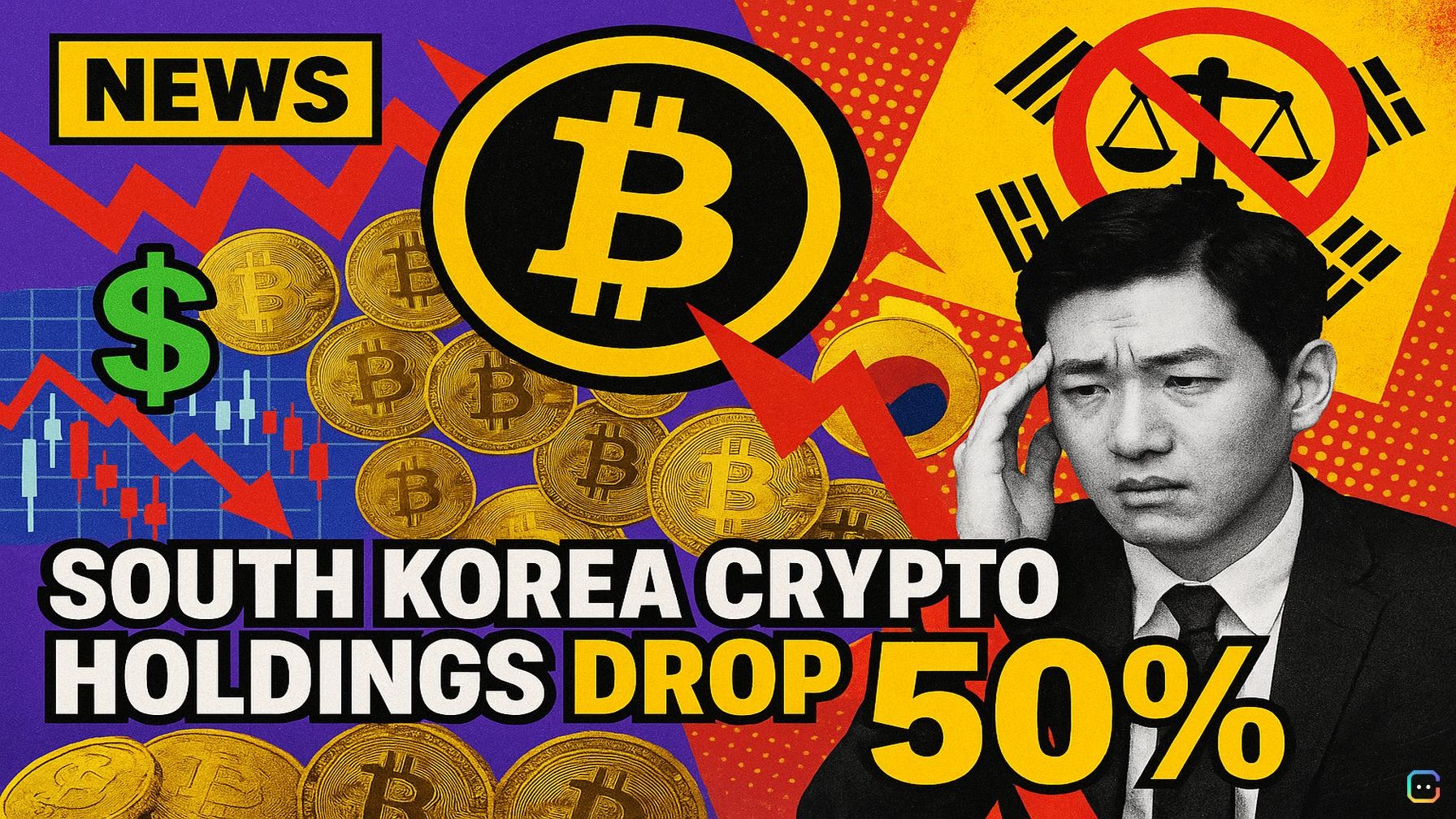
Headline: South Korean crypto holdings plunge 50% as retail money chases stocks — regulators tighten rules
South Korean investors have slashed their crypto exposure by roughly half over the past year as capital flows back into equities and trading activity on local platforms tumbles, according to Bank of Korea figures disclosed to Rep. Cha Gyu-geun.
Key facts
- Total crypto holdings on domestic exchanges fell from 121.8 trillion won (about $83.3 billion) at the end of January 2025 to 60.6 trillion won ($41.4 billion) by the end of February 2026 — a drop of more than 50%.
- Daily trading volume across major Korean exchanges (Upbit, Bithumb, Korbit, Coinone and Gopax) plunged to roughly $3 billion in February 2026 from $11.6 billion in December 2024, signaling a sharp fall in retail activity.
- Won deposits held at exchanges declined from 10.7 trillion won at the end of 2024 to 7.8 trillion won by February 2026, pointing to weaker cash demand for crypto trades.
- Stablecoins behaved differently: holdings climbed from $60 million in July 2024 to $597 million in December 2024, then collapsed to $41 million by February 2026. Stablecoins accounted for nearly half of South Korea’s crypto outflows in Q1 2025 as users moved funds to overseas platforms — a trend drawing regulatory scrutiny.
Why it’s happening
Analysts point to a combination of factors: a strong stock market rally that attracted retail investors back to equities, falling crypto prices that reduced on-exchange asset values, and an active migration of funds offshore via stablecoins. The result is markedly lower liquidity and retail engagement on local exchanges.
Regulatory response and market infrastructure
The shift has prompted tighter oversight. From August, South Korea plans to flag transactions over 10 million won that involve overseas exchanges or private wallets as potentially suspicious under tougher anti-money-laundering (AML) rules. Regulators are explicitly watching cross-border crypto flows more closely.
At the same time, the country is building regulated blockchain infrastructure. Crypto.news reported that Samsung SDS will develop the Korea Securities Depository’s token securities platform ahead of South Korea’s tokenized securities framework, which takes effect in February 2027. The twin trajectory — tougher oversight plus formalized token infrastructure — underscores Seoul’s attempt to curb risky outflows while enabling a regulated digital-asset market.
Bottom line
Korean retail crypto markets are contracting rapidly as traders pivot to stocks and shift funds offshore. Expect ongoing regulatory pressure on cross-border transfers and continued development of institutional-grade, onshore token infrastructure as Seoul balances control with market modernization.
Read more AI-generated news on: undefined/news