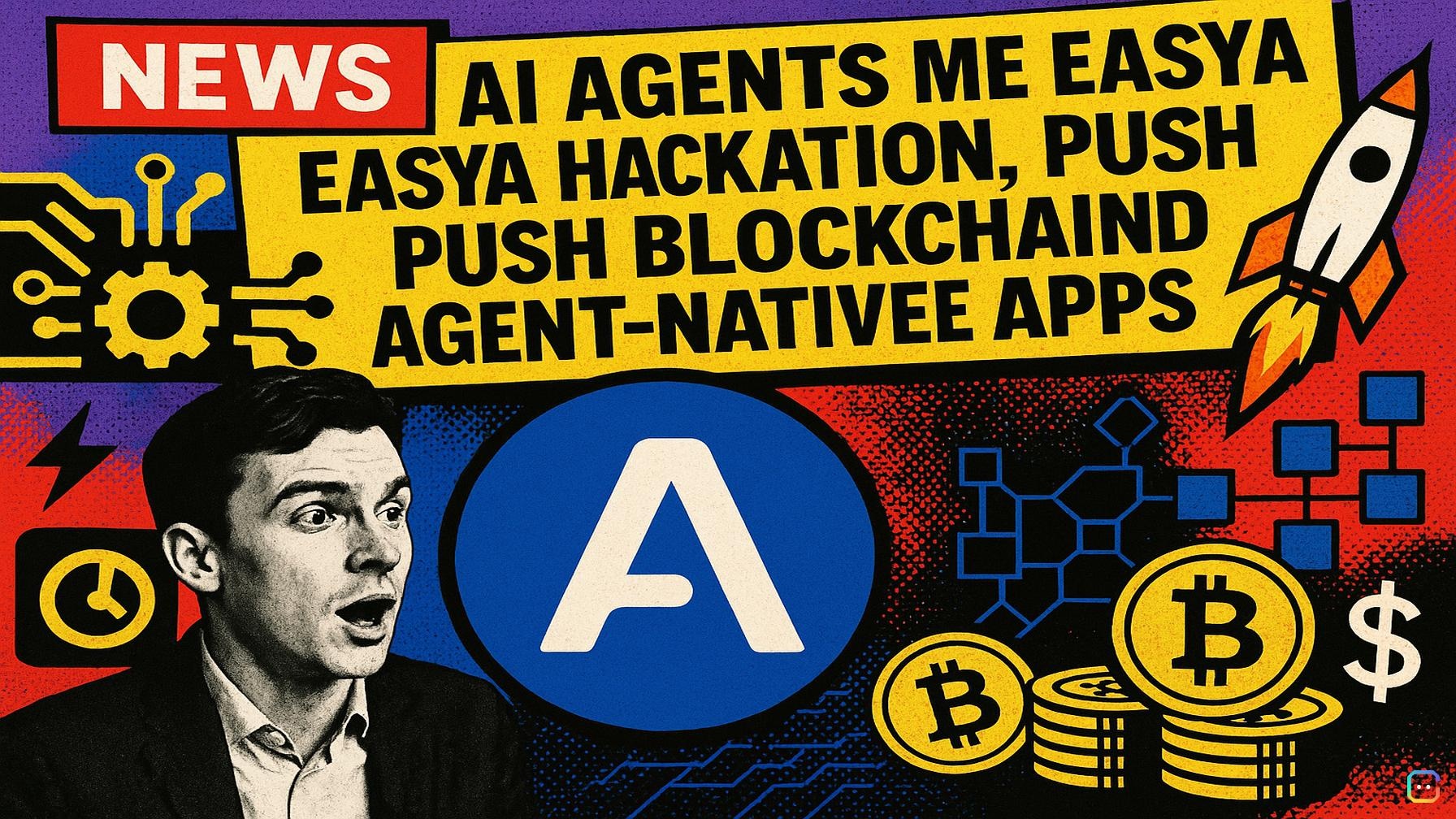
AI agents stole the show at the EasyA hackathon inside Consensus Miami, turning what looked like a typical crypto developer sprint into a full-blown startup launchpad.
Nearly 1,000 builders packed the Miami Beach venue — teams from Base and Solana ecosystems alongside engineers from Microsoft and Google — all racing to prove one thesis: the future of blockchain is increasingly about AI-native applications and autonomous agents, not just infrastructure.
“Year of the Application Layer”
That shift has been brewing since EasyA’s Hong Kong event earlier this year, when organizers dubbed 2026 the “Year of the Application Layer.” Organizers Dom and Philip Kwok say that’s intentional: EasyA began as a small Austin hackathon during Consensus 2023 and has rapidly evolved into one of crypto’s most watched builder gatherings. The goal is explicit. “We want billion-dollar companies coming out of EasyA,” Dom told CoinDesk. EasyA alumni include a Harvard team that became Cognition AI (the Kwoks peg its value at about $10 billion), Axal (bitcoin-backed stablecoin yield products), and multiple teams that went through Y Combinator, raised from top VCs, and processed hundreds of millions in transactions.
This year the gravity centered on agentic AI. Sponsors leaned into that trend: Coinbase backed x402-related challenges (an emerging framework for agent payments and on-chain interactions), while Solana and Solana Mobile pushed mobile-first consumer experiences. The result: projects that stretch AI agents from chat assistants into real-world coordination, commerce and hardware control.
What teams built
Some demos read like a sci-fi roadmap for agent-driven products. Praxis (aka FlyPraxis) presented blockchain-connected drones controlled by smartphones, pitched by organizers as “the next Palantir on the blockchain.” Another team showed software that turns text prompts into physical 3D objects — “put in a prompt and say, ‘Build me a microscope,’ and it will actually build it,” Phil Kwok said — illustrating the move toward embodied AI.
Winners: agents plus payments, hardware, and consumer UX
Judges favored teams that used AI agents to coordinate real-world tasks, automate workflows, and enable autonomous commerce — whether through hardware, payment rails, or consumer apps. Prize amounts varied by track and exact distributions are still being finalized.
Kickstart Track ($50,000)
- First: FlyPraxis — a real-time drone intelligence platform for military operators, combining AI coordination and live battlefield data to manage autonomous drone systems. Marketed as “Palantir, but in real time.”
- Second: HIIEHIIE — an AI-driven platform that converts text prompts into buildable hardware, handling physics, component sourcing, 3D CAD generation and assembly docs to shrink prototyping timelines.
- Third: Clan World — an AI-native coordination and community application exploring decentralized workflows and social coordination.
Solana Mobile Track ($30,000 + $75,000 in Solana phones)
- First: Parabola — a mobile-native decentralized prediction and estimation market on Solana that uses a distribution-based AMM for speculation on real-world events.
- Second: Snakr — an AI food-intelligence app that scans products for health risks, recalls and problematic ingredients; users add missing product data and earn Solana rewards.
- Third: Rhythym — a mobile routine-support app targeting users with executive dysfunction, integrating with Solana’s Seeker phone, Nova 2 Lite and x402 to create AI-assisted daily workflows.
Coinbase / AWS Track ($45,000)
- First: Dairy Price API x402 — a pay-per-call commodity pricing and forecasting service enabling AI agents to access dairy market data without traditional API keys; payments settle in USDC via x402 on Base.
- Second: AgentPay — a payment coordination system that gives users one-tap approval over AI-agent transactions and uses AWS risk validation to prevent irresponsible spending.
- Third: Giggy — a marketplace where users hire AI agents for research work, with payments held in crypto escrow on Base and agents able to pay for premium APIs via x402.
- Runner-up: Chainlens — an x402-compatible trust and verification layer that connects agents to authenticated APIs and releases payments only after validated responses.
Why it matters
EasyA’s Miami edition showcased a clear pivot in crypto developer priorities: teams are building consumer-facing, agent-powered products that combine on-chain payment rails, verified APIs, mobile experiences and autonomous coordination. With major sponsors experimenting with x402 and mobile integrations, the event signaled where venture dollars and developer attention are moving next — toward practical, agentic applications that can scale beyond niche tooling into mainstream products and companies.
Read more: AI-powered agents dominate the EasyA x Consensus Hong Kong hackathon.
Read more AI-generated news on: undefined/news