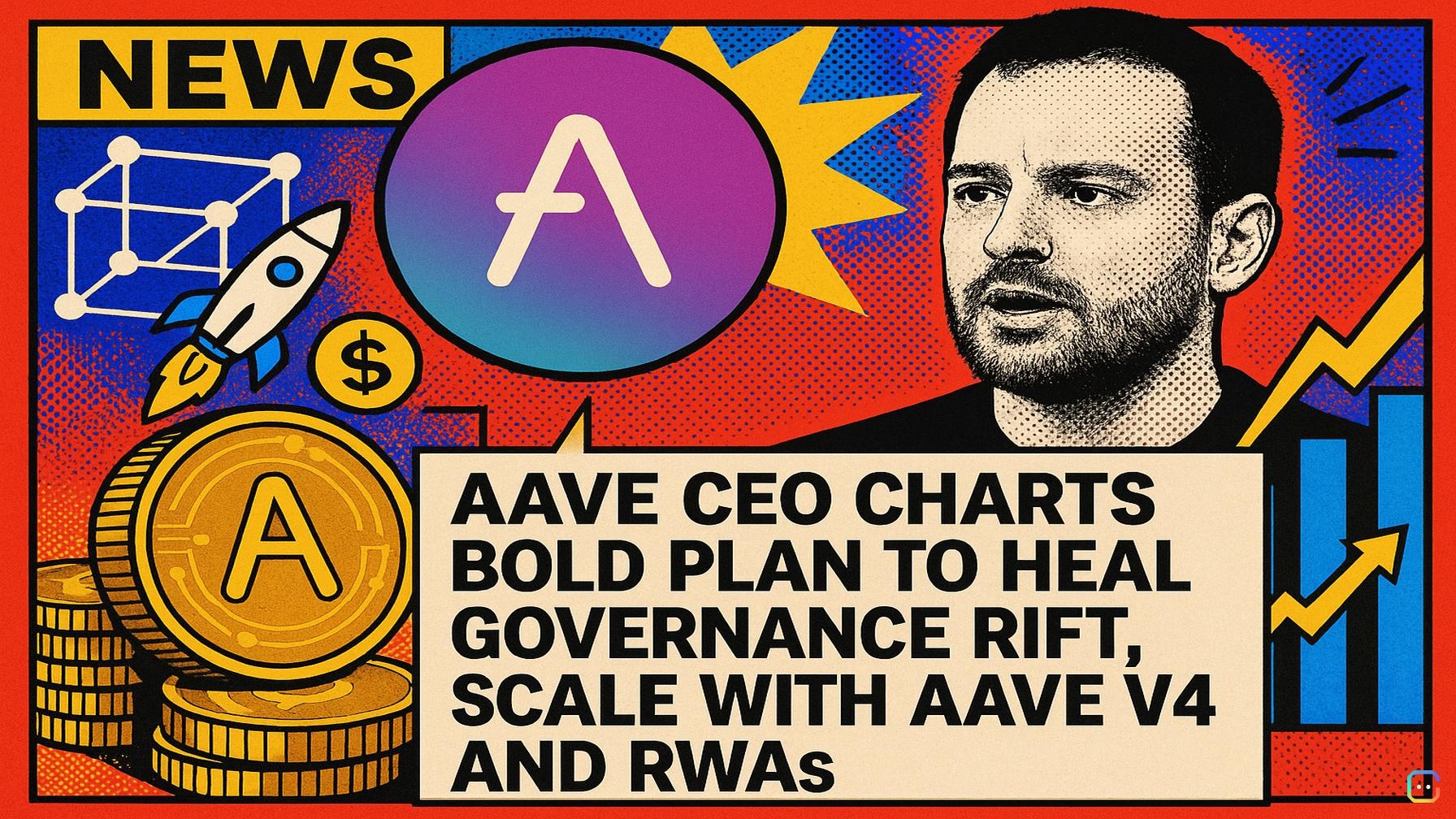
Aave founder and CEO Stani Kulechov has laid out a roadmap to resolve recent governance friction and accelerate the protocol’s next growth phase — focusing on operational clarity, new product approaches, and a push into real‑world assets (RWAs) and institutional markets.
The tensions flared after a DAO proposal asked whether the community should take full control of Aave’s brand and front‑end assets. That motion failed decisively: 55% voted against, 41% abstained and just 3.5% voted in favor — underscoring lingering questions about value capture and alignment between Aave Labs and token holders.
Kulechov framed the moment as a crossroads. He argued Aave’s future can’t be limited to today’s crypto‑native lending use cases (largely ETH, BTC and leverage‑driven strategies correlated with market cycles). Recalling the project’s origins as ETHLend in 2017, he said the original vision was broader: “to use smart contracts to power lending across virtually all asset classes and use cases,” and he sees a path to scale Aave far beyond its current footprint.
Ambitious targets: Kulechov envisions the Aave App ultimately onboarding tens of millions of users and supporting a vastly expanded asset base — projecting up to a $500 trillion opportunity if the protocol captures institutional and RWA flows.
Aave V4: the technical backbone
A central element of Kulechov’s plan is Aave V4, a modular architecture designed to safely integrate new lending models and asset classes. The modular design aims to let developers innovate — supporting both crypto‑native products and RWA‑backed use cases — while preserving protocol integrity and enabling faster iteration in a developer‑friendly environment.
Operational model: autonomous product teams, not DAO micromanagement
On the governance and execution side, Kulechov argued that consumer‑grade products meant to reach millions should be built by independent, highly autonomous teams operating on top of the permissionless Aave Protocol — rather than being directly funded or micromanaged by the DAO. His rationale: world‑class consumer products are “built by highly opinionated teams with the autonomy to move quickly,” and while decentralized governance fits protocol economics, it’s not optimal for rapid product decisions.
Revenue alignment and guardrails
To address concerns about value capture, Kulechov pledged that revenue generated outside the core protocol will be shared with token holders. He also said forthcoming governance proposals will include explicit guardrails around branding and revenue alignment to clarify how off‑protocol products and the DAO will interact.
Call for collaboration
Kulechov closed by reiterating his confidence in Aave’s potential and urging the community to collaborate on the next phase of growth — balancing decentralization with practical structures to deliver consumer products, onboard institutional flows, and grow value for token holders.
Bottom line: Kulechov’s response frames the governance dispute as an inflection point — one that will test Aave’s ability to marry decentralized governance with a product execution model capable of scaling into mainstream and institutional markets.
Read more AI-generated news on: undefined/news