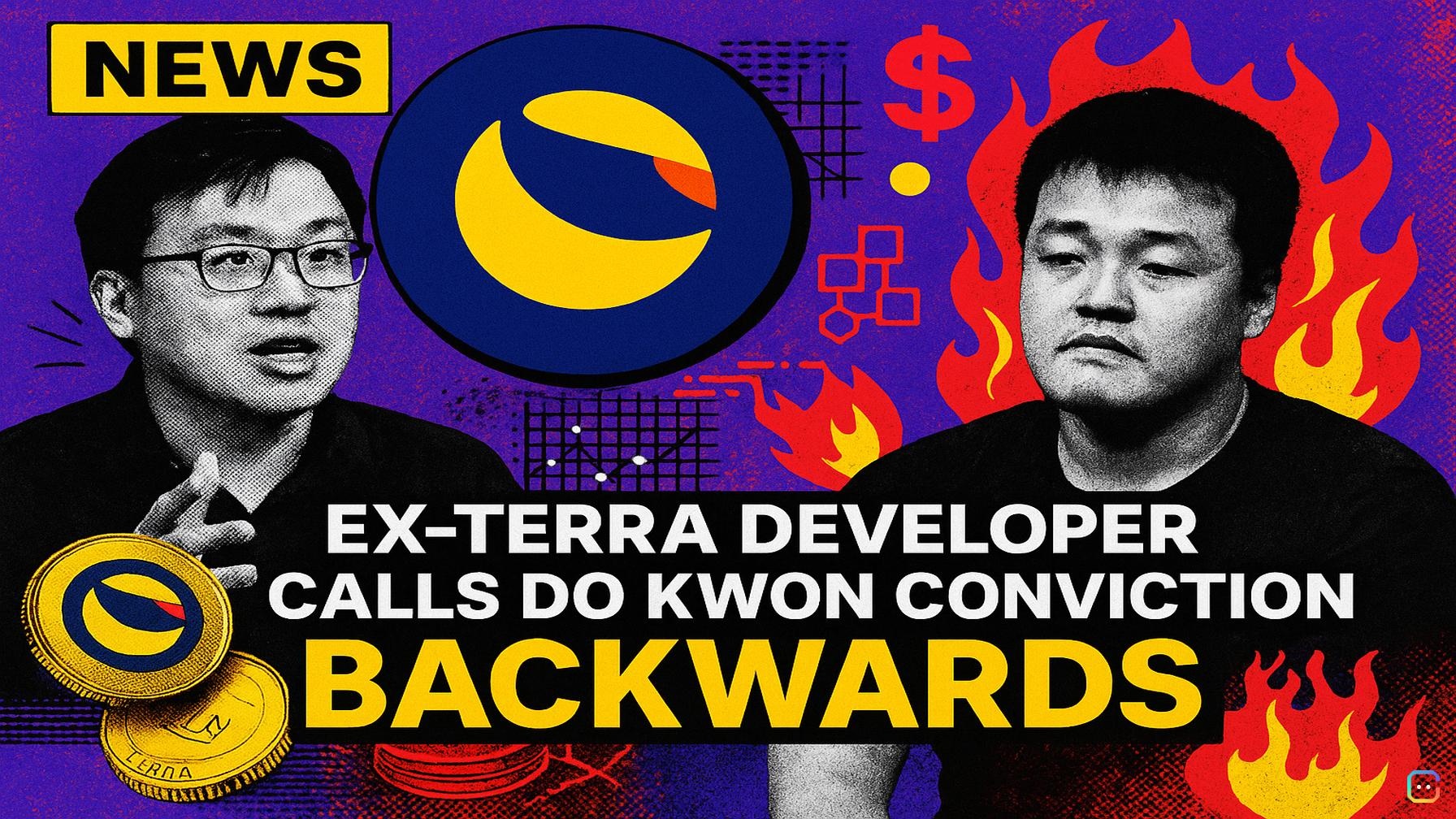
Former Terraform Labs developer Will Chen has fired a detailed critique at the legal theory that convicted Do Kwon, arguing in a Dec. 13 X thread that prosecutors built the fraud case on a “backwards” logic — days before a court sentenced Kwon to 15 years in prison on Dec. 15.
Chen framed his comments as a procedural critique, not a personal defense. “I wanted Do to fail. I wanted him punished,” he wrote, adding that he had confronted Kwon directly about perceived arrogance and recklessness. “I’m not here to defend Do Kwon the person. But the legal case is broken.”
What prosecutors argued
- The government’s key allegation focused on Terra’s May 2021 depeg: prosecutors said Kwon publicly claimed Terra’s algorithmic design could “self-heal” without reserves, while privately relying on Jump Trading to buy UST and shore up the peg. That, prosecutors argued, made his public statements deceptive and therefore fraudulent.
Chen’s central counterargument
- Chen says the logic is inverted. Fraud typically involves claiming safety that doesn’t exist, inducing investors to rely on that false safety and lose money when the risk materializes. In the Terra case, Chen argues, Kwon allegedly understated — not overstated — Terra’s defenses by not publicizing Jump’s backstop. “You don’t defraud someone by hiding additional safety mechanisms. The direction is backwards,” he wrote.
- He stressed that if Jump’s involvement had been disclosed, investors would likely have felt more, not less, secure.
On private remarks and knowledge vs. uncertainty
- Prosecutors seized on a private remark attributed to Kwon — that Terra “might’ve been fucked without Jump” — as evidence he knew the mechanism was broken. Chen rejects that reading: “Might’ve been fucked is uncertainty about an unknowable counterfactual. Knew it would have failed is a claim of definite knowledge.”
- He argued the only way to prove the algorithm would not have recovered was to let it run without intervention — an approach inconsistent with running a live financial system. During the period in question, Chen said, “the algorithm was working... Arbitrage was happening. UST was being burned for LUNA. Jump was also buying. Both things were true.”
Non-disclosure as strategy, not deception
- Chen contends non-disclosure of backstops can be strategic: publicizing exact defense capacity can make an attack easier to plan and price. He likened it to “strategic ambiguity” used by central banks: making defense capabilities transparent could have let attackers calculate exactly how to overwhelm them.
Causation and the information environment
- Chen also challenged whether prosecutors proved investor reliance and causation. He notes Terra’s risks were widely discussed: the white paper described failure modes, the code was open-source, and critics publicly debated the design for years. “Do’s statements were one signal in an incredibly noisy channel,” he wrote.
- Importantly, Chen draws a distinction between the May 2021 depeg and Terra’s final collapse in May 2022. By 2022, he points out, new information had entered the market — notably the Luna Foundation Guard’s public launch in January 2022 and visible on-chain reserves — which, in Chen’s view, breaks the causal chain linking the 2021 non-disclosure to 2022 losses.
On damages and precedent
- Chen took particular issue with the scale of losses attributed to Kwon: Kwon pleaded guilty to causing $40 billion in loss, a figure Chen said misrepresents what “loss” means. Using a simple example, he explained that paper gains evaporating do not equate to actual, provable theft or direct damages. “Market cap decline is not fraud loss,” he wrote, warning that counting peak-to-trough market-cap evaporation as damages “sets a terrible legal precedent for the industry.”
Acknowledging other claims
- Chen conceded that some government allegations have more merit. He said the “Chai” claims have elements of an actual fraud case (though he argued the government’s portrayal was overstated) and called Anchor — which advertised a roughly 20% yield — “harder to defend,” describing the yield marketing as reckless if reserves were being depleted. Still, he argued, the collapse’s catastrophic losses were driven by the depeg: “If UST had held, people would’ve just earned less interest. They wouldn’t have lost their principal.”
Contrast with SBF
- Drawing a sharp distinction from the FTX saga, Chen said Sam Bankman-Fried “literally stole customer deposits and used them for other purposes,” which is why SBF victims can be repaid — the money still exists somewhere. By contrast, Chen emphasized, Terra’s collapse destroyed value in a crash rather than diverting funds to other accounts, making restitution fundamentally different.
A warning about precedent
- Chen closed by warning about the implications for founders and builders: “If founder confidence plus project failure equals fraud, we’ve criminalized entrepreneurship.” He argued that Kwon’s guilty plea effectively locked in the government’s framing and deprived him of a contested defense that might have narrowed the legal theory and scope of damages.
Judge Engelmayer and the plea
- Chen described Judge Paul A. Engelmayer as “sympathetic” and “extremely methodical,” but said Kwon’s guilty plea left him unable to contest the government’s narrative afterward: “Do taking the guilty plea means admitting to the government’s charges as is. There’s no debating afterward.”
Market note
- At press time, LUNC traded at $0.00004080.
Chen’s thread injects a developer’s perspective into an already contentious case, raising questions about how fraud should be defined and proven in crypto’s complex, noisy markets — and how legal precedent could shape future crypto entrepreneurship.
Read more AI-generated news on: undefined/news