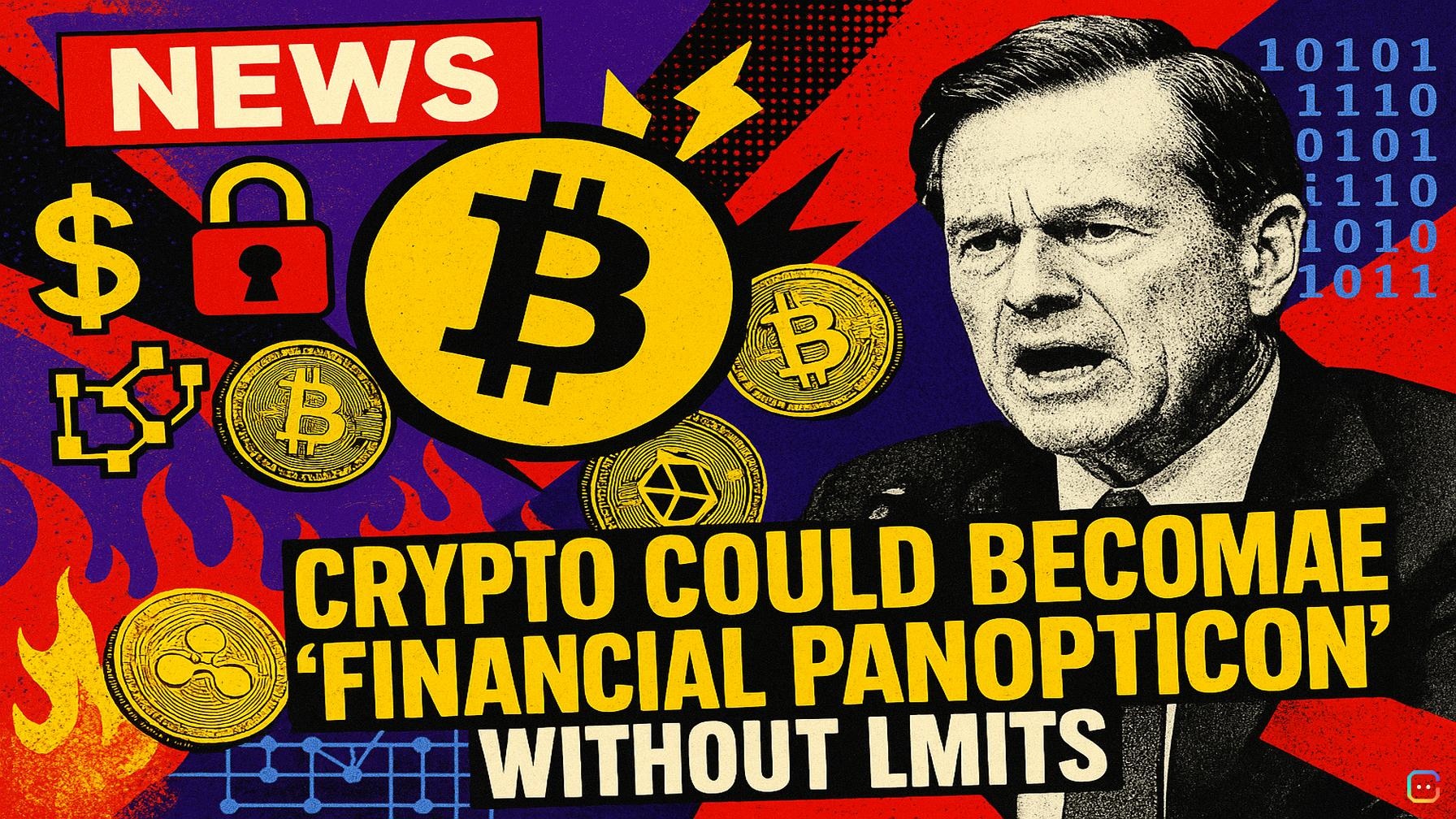
WASHINGTON — U.S. Securities and Exchange Commission Chair Paul Atkins warned Monday that, without clear limits, the federal government could harness crypto’s transparency to create an unprecedented surveillance apparatus — and he urged policymakers to act before that happens.
Speaking at the SEC’s sixth crypto-focused roundtable this year, held at agency headquarters, Atkins said blockchain’s strengths — traceability and immutable records — also create a risk. “It's no great leap to imagine a steady migration toward a future where the government in a constellation of intermediaries can peer into almost every dimension of the individual's financial lives,” he told attendees. Left unchecked, he said, that trend threatens the privacy foundations of American liberty.
Atkins pointed to past efforts such as the consolidated audit trail (CAT) and post-2008 reporting rules as examples of government tools that expanded data collection in ways that “increasingly put the liberty of American investors at risk.” He warned blockchain could become “history's most powerful financial surveillance architecture” if policy does not block so‑called bulk surveillance of lawful transactions.
Regulatory responsibility for crypto is split across agencies. Enforcement activity around privacy-focused services has often come from the Department of Justice and the Treasury Department — notably FinCEN and its sanctions programs — but the SEC is preparing its own rule proposals to govern aspects of the market. Atkins said the SEC will move forward with elements of the Trump administration’s “Project Crypto,” an agenda that includes narrowly defining which digital assets are securities, setting standards for tokenizing securities, and creating an “innovation exemption” to let firms pilot new products more easily.
Atkins also reiterated his desire for closer coordination with the Commodity Futures Trading Commission to produce a more integrated, user-friendly regulatory framework. He favors a regulated ecosystem where investors can operate through convenient, “one-stop” outlets without obvious jurisdictional seams. That stance contrasts with his predecessor, Gary Gensler: Atkins has repeatedly argued that most digital assets fall outside the securities box and therefore lie beyond the SEC’s reach.
The agency’s internal crypto policy debate continues. SEC Commissioner Hester Peirce, who leads the SEC’s crypto task force, warned against imposing Bank Secrecy Act–style obligations on software developers who don’t custody user assets or control transactions. The broader federal posture is in flux: Trump-era appointees have signaled a shift away from aggressively prosecuting some software developers, even as earlier enforcement actions — such as cases tied to privacy tools like Tornado Cash — resulted in convictions of crypto insiders.
Atkins closed with a stark caution about the direction of future rulemaking: “If the instinct of the government is to treat every wallet like a broker, every piece of software as an exchange, every transaction as a reportable event, and every protocol as a convenient surveillance node,” he said, “then the government will transform this ecosystem into a financial panopticon.” (The “panopticon” is a metaphor for constant, centralized observation, originally coined in debates about institutional surveillance.)
The remarks signal a balancing act ahead: policymakers want to curb illicit finance in crypto while avoiding designs that would erode privacy for ordinary users. As the SEC prepares rule proposals and coordinates with other agencies, the outcome will shape how much transparency — and how much oversight — becomes standard in crypto markets.
Read more AI-generated news on: undefined/news