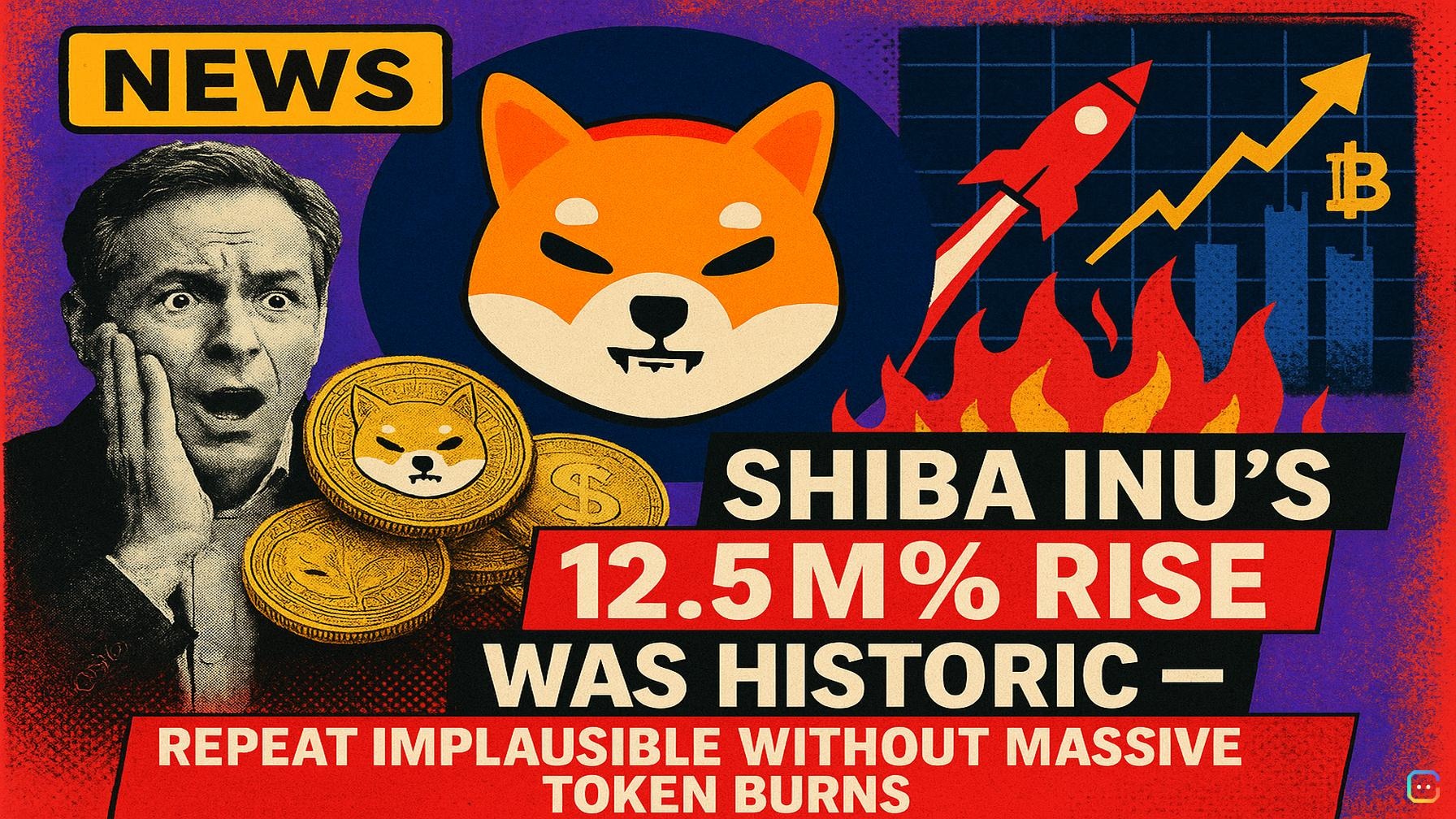
Shiba Inu’s (SHIB) recent price action has been muted, but don’t count the meme coin out: over the past few years it has posted one of the most eye‑watering moves in crypto. CoinGecko data shows SHIB has climbed by roughly 12.5 million percent since Nov. 28, 2020 — gains that turned obscure tokens into household names and speculative fortunes.
What drove that explosive run? One of the clearest catalysts was Ethereum co‑founder Vitalik Buterin’s massive token burn. Buterin was sent half of SHIB’s supply and opted to burn about 90% of what he received, temporarily tightening supply and sparking a sharp price reaction. Even so, SHIB still carries an enormous total supply — roughly 589 trillion tokens — which is a persistent headwind for future per‑token price appreciation.
To put the scale into perspective: a repeat of that 12.56 million percent surge would take SHIB to about $0.893 per token. At current supply levels, that price would imply a market capitalization on the order of $525.9 trillion — a figure far larger than the combined GDP of the world’s major economies. That math makes a repeat of the 2020–21 trajectory effectively implausible unless the project undergoes dramatic supply reduction.
Some analysts have put extreme price targets into a long time frame. Telegaon projects SHIB wouldn’t reach roughly $0.893 until after 2050 — more than 25 years away — underscoring how unlikely such a leap is without major token burns or protocol changes that materially shrink circulating supply.
Bottom line: SHIB’s past returns are extraordinary, but repeating them under the current supply structure would be virtually impossible. For SHIB to generate similar percentage gains again, the community or token holders would need to meaningfully reduce supply — an outcome that can’t be assumed. Investors should weigh the token’s historical performance against these structural realities when forming expectations.
Read more AI-generated news on: undefined/news