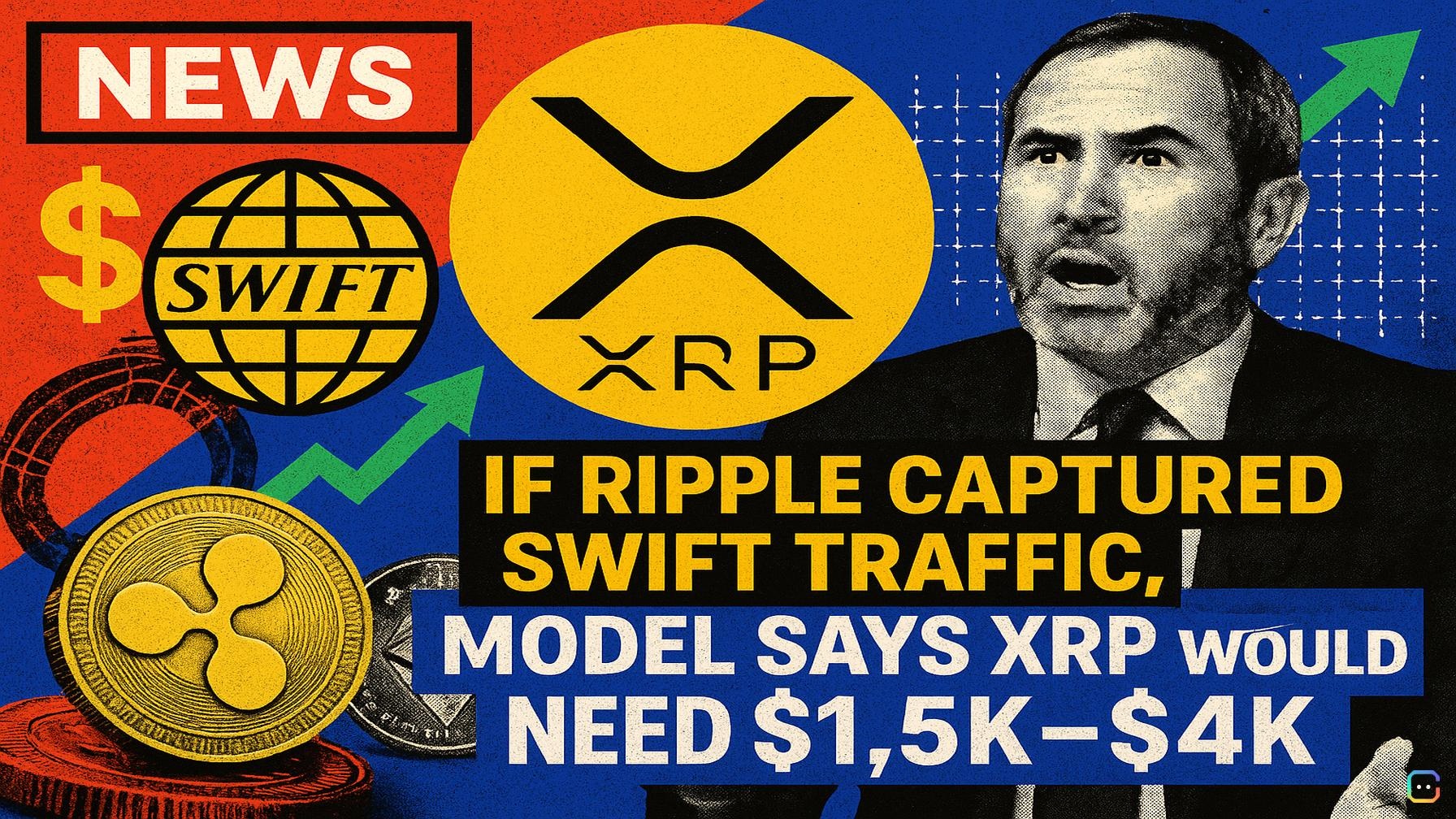
What if Ripple’s rails picked up a meaningful slice of SWIFT’s traffic? Crypto commentator The Remi Relief — known for very bullish XRP forecasts — ran the numbers and landed on eye-popping prices that would be required to support that level of institutional usage.
The starting point: SWIFT moves roughly $150 trillion in cross-border transactions each year. Applying a hypothetical 50% capture of that volume to the XRP Ledger, The Remi Relief’s model estimates that about $250 billion would need to be available as active XRP liquidity at any given time to prevent crippling slippage (the price disruption that occurs when large orders hit thin order books). Under those assumptions, the model implies an XRP price somewhere in the $1,500–$2,000 range. If XRP somehow captured 100% of SWIFT flows, the projection scales to roughly $3,000–$4,000 per token.
Those are headline numbers, but they rest on a single, crucial premise: that the XRP Ledger actually handles a substantial portion of SWIFT’s transaction flow. That scenario is not purely hypothetical — Ripple has been actively building toward institutional adoption. Since 2025 the company has expanded its institutional footprint, including a $1.25 billion acquisition of Hidden Road, and earlier deals such as GTreasury that helped broaden Ripple Treasury’s offerings. Today Ripple cites partnerships with roughly 300 institutions, and at least 30 of the more than 50 banks named in SWIFT’s new retail payments framework reportedly maintain links to Ripple’s network.
Ripple Treasury now positions corporates to choose between legacy SWIFT rails and blockchain-powered settlement — offering near-instant settlement using XRP or RLUSD — which is exactly the kind of product that could win corporate volume if adoption follows. At the same time, SWIFT itself is moving: the network has said it will add a blockchain-based shared ledger and, by early 2026, more than 50 banks across 16 countries were collaborating on a design focused on 24/7 cross-border payments.
In short, infrastructure and commercial ties are being built on both sides. But translating that into the multi-thousand-dollar XRP price tags in The Remi Relief’s model requires accepting several big assumptions: that a large share of SWIFT volume shifts to the XRP Ledger, that XRP becomes the dominant on-ledger liquidity asset, and that liquidity providers and markets evolve to match the model’s steady-state requirements. It also sidelines other variables such as competing settlement rails, regulatory dynamics, differing liquidity sources, and how market participants actually manage on-chain liquidity in practice.
Bottom line: the projection is a useful thought experiment that puts scale into perspective — it shows how institutional adoption could dramatically change the liquidity profile required for on-chain settlement — but it’s not a forecast so much as a conditional “if this happens” scenario. The real question for investors and institutions is whether Ripple (and the broader market) can bridge the gap between building institutional rails and capturing large swaths of global payment volume.
Read more AI-generated news on: undefined/news