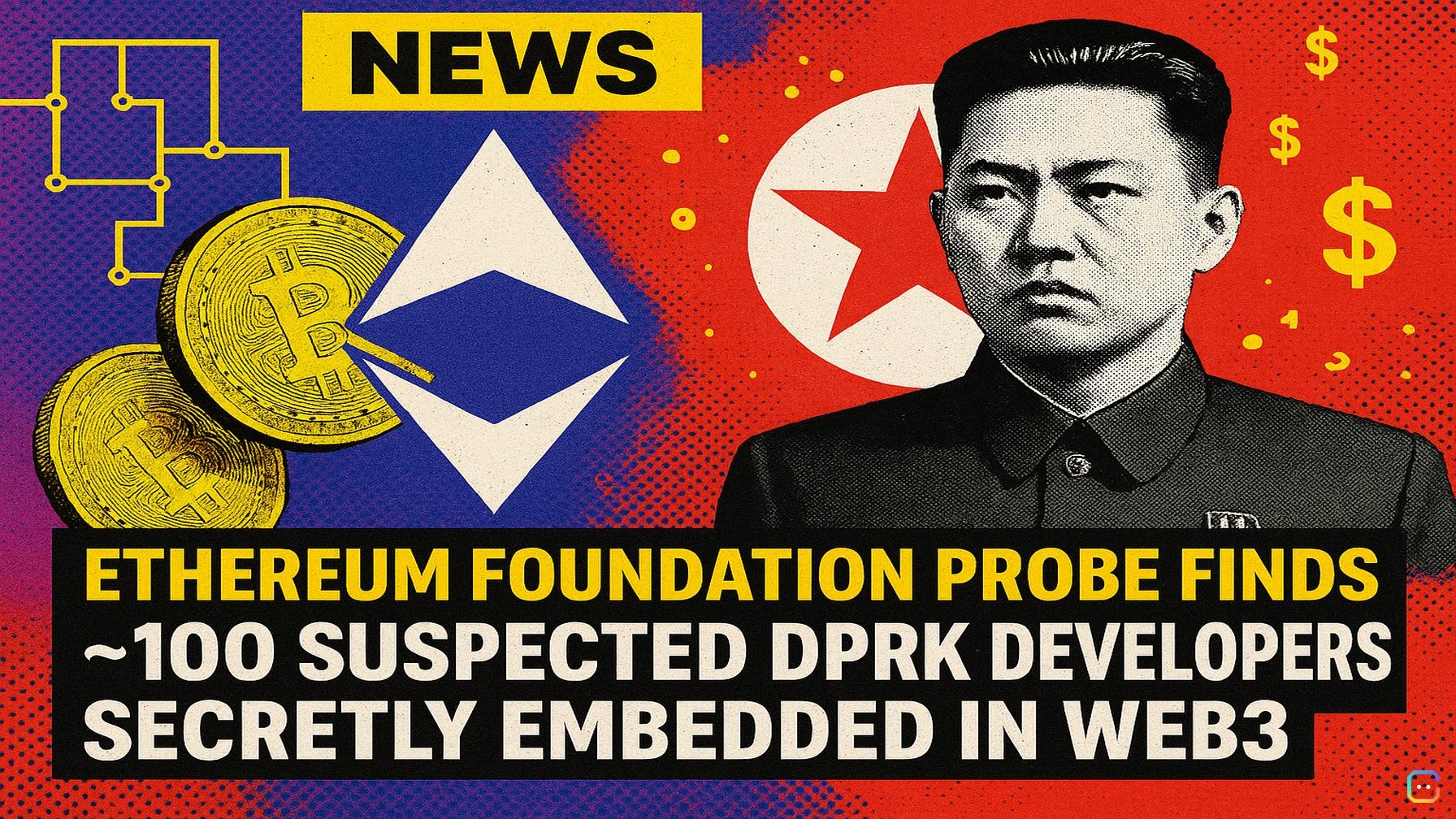
Headline: Ethereum Foundation-backed probe spots 100 suspected DPRK developers quietly embedded across crypto
A six-month, Ethereum Foundation–funded investigation has identified roughly 100 individuals tied to the Democratic People’s Republic of Korea (DPRK) who were operating inside Web3 teams under false identities, highlighting persistent and pragmatic security risks across the industry.
What was done
- The ETH Rangers initiative—launched late 2024 to support public-goods security research—funded a stipend program for independent investigators. One recipient used that funding to create the Ketman Project, a security-focused effort that hunted for “fake developers” in Web3 organizations.
- Over six months the Ketman Project flagged about 100 suspected DPRK IT workers and contacted 53 crypto projects that may have unwittingly employed them. The Ethereum Foundation called the work “directly address[ing] one of the most pressing operational security threats facing the Ethereum ecosystem today.”
What the investigation found
- The probe’s findings add to growing evidence that DPRK-linked developers have been embedding themselves across crypto for years, frequently blending into teams through legitimate technical contributions coupled with fabricated or layered identities.
- Security researcher and MetaMask developer Taylor Monahan has previously said DPRK-linked contributors date back to the early DeFi era, with more than 40 platforms having relied on such contributors at various times. She notes that claims like “seven years of blockchain dev experience” are often accurate—the deception is in the identity and intent, not necessarily the skills.
- Independent investigator ZachXBT emphasized the low-tech, persistent nature of many operations: “basic and in no way sophisticated,” but “relentless.”
Tactics and real-world impacts
- Analysts say these campaigns rely heavily on social engineering, identity layering and persistence rather than exotic technical exploits. Typical outreach vectors include job applications, LinkedIn, email, and remote interviews—methods that allow operatives to gradually build trust.
- The report points to serious consequences: R3ACH analysts estimate DPRK-linked activity has been associated with roughly $7 billion in stolen crypto since 2017, including high-profile incidents such as the $625 million Ronin Bridge exploit, the $235 million WazirX breach and the $1.4 billion Bybit incident.
- Recent attacks underscore the risk. Drift Protocol’s $280 million exploit has been linked to a North Korean-affiliated group that used intermediaries and carefully constructed professional identities to gain credibility before striking.
How these operatives hide in plain sight
- Ketman’s research surfaced practical indicators for spotting suspicious developer accounts: repeated use of the same avatars or profile metadata across multiple GitHub accounts, accidentally exposing unrelated email addresses during screen sharing, and system language or locale settings that contradict a claimed nationality.
- To help the industry detect such behavior, the Ketman Project released an open-source tool to flag suspicious GitHub activity and co-authored an industry framework for identifying DPRK-linked IT workers in partnership with the Security Alliance.
Why it matters
- The investigation highlights a persistent operational-security vector for crypto projects: threat actors who weaponize legitimate technical talent and standard hiring channels. Even skilled teams can be exposed if vetting focuses solely on code contributions rather than identity and behavioral signals.
- The Ethereum Foundation’s support of independent research through ETH Rangers points to a broader recognition that defending public-good infrastructure requires ongoing investment in both tooling and human-centered threat analysis.
Bottom line
Projects should strengthen onboarding, vetting and monitoring practices—combining technical audits with better identity and behavioral checks—while the industry adopts shared detection tools and frameworks to blunt these low-tech but high-impact infiltration strategies.
Read more AI-generated news on: undefined/news