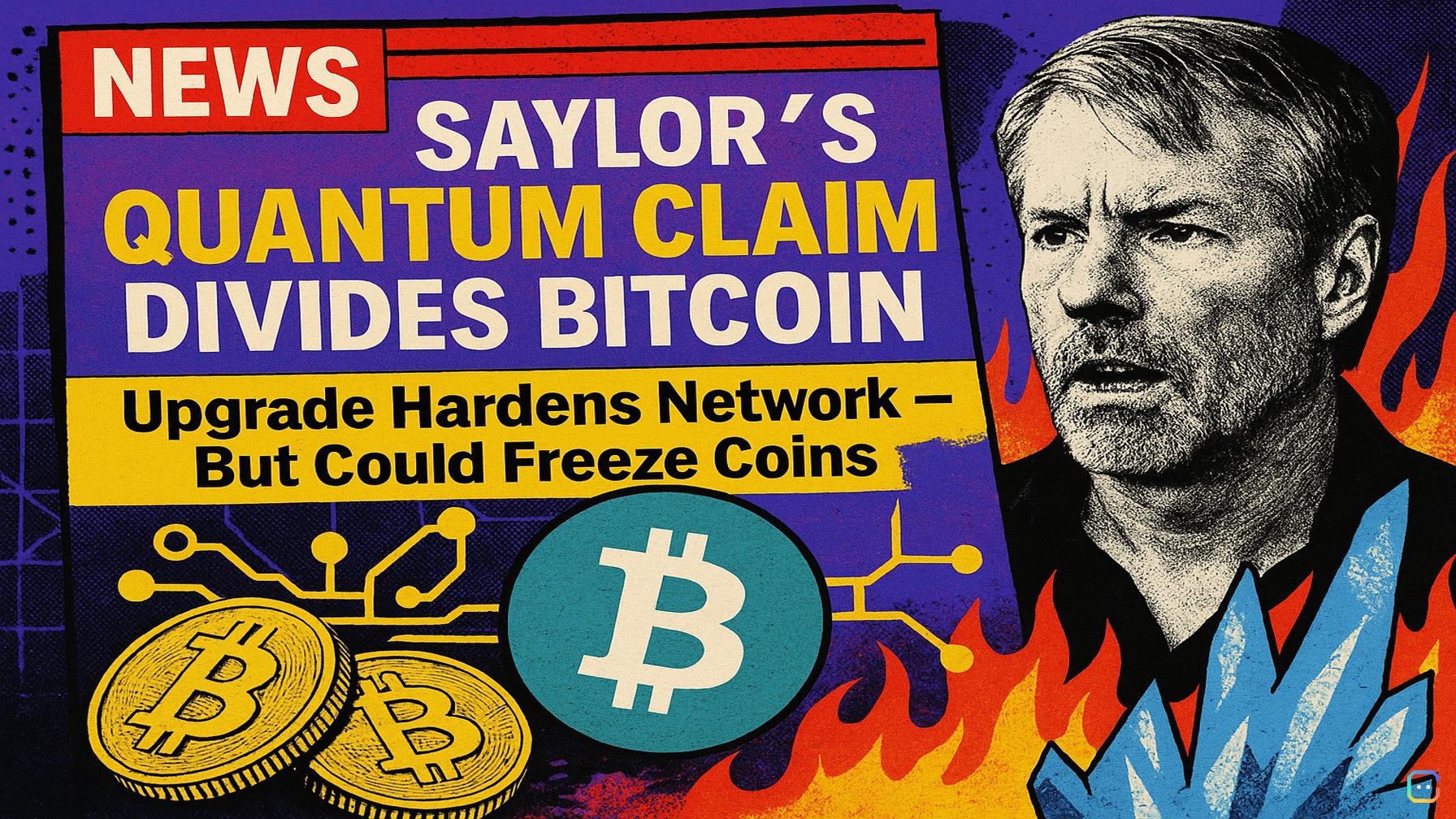
Michael Saylor set off a heated debate on X this week by tossing a compact piece of Bitcoin game theory into the ring: “The Bitcoin Quantum Leap: Quantum computing won’t break Bitcoin—it will harden it,” he wrote. “The network upgrades, active coins migrate, lost coins stay frozen. Security goes up. Supply comes down. Bitcoin grows stronger.”
That short manifesto pushed the discussion beyond crypto theory into the messier terrain of social consensus and incentives.
What Saylor and supporters mean
- The core technical claim: if a quantum computer ever becomes capable of breaking today’s signature schemes (ECDSA/Schnorr), Bitcoin can be upgraded to quantum‑resistant output types. Active coins—addresses whose owners transact to new, quantum‑safe outputs—would continue to circulate. UTXOs whose keys are truly lost, abandoned, or otherwise inaccessible would effectively become frozen, reducing effective supply and raising security.
- Jameson Lopp, a long‑time proponent of practical quantum readiness, backed the idea: “I agree, lost coins should stay frozen. Glad to hear you’ll support my BIP!” (Lopp is referring to a draft Bitcoin Improvement Proposal he and others have worked on.)
The proposal on the table
Lopp and co‑authors (Christian Papathanasiou, Ian Smith, Joe Ross, Steve Vaile, Pierre‑Luc Dallaire‑Demers) sketch a three‑phase migration:
1. A soft fork that steers—or forces—new transactions into quantum‑resistant output types.
2. A later rule change that makes legacy ECDSA/Schnorr spends invalid after a long deadline.
3. An optional recovery phase to allow rightful owners of unmigrated coins to prove control and reclaim them.
Why people pushed back
- The flashpoint is the idea of “frozen” coins. Critics argue this is not just a technical fix but a social and legal question: who decides which UTXOs are truly lost versus “just old”? Wicked (@w_s_bitcoin) warned, “We have no right to freeze another man’s bitcoin,” and suggested attempts to lock legacy coins could trigger a contentious chain split. He even floated a narrative where Satoshi’s early exposed keys might be a “bounty” for quantum attackers—complicating any attempt to distinguish stolen coins from forgotten ones.
- Wicked’s practical objection: there’s no cryptographic way to prove that an old UTXO was stolen rather than later spent by its rightful owner, so any mechanism that blocks unmigrated coins risks freezing legitimately reclaimed funds.
Node realism vs. social politics
- Lopp reframed the idea as a node‑level defense: “Every node runner has the right to refuse to accept coins they believe are most likely to have been stolen by a quantum attacker,” meaning nodes could independently filter suspicious inputs to protect the circulating supply. He acknowledged the messiness: “Correct, the best you can do is come up with an extremely lengthy migration window.”
- That migration window is intended to be very long to give legitimate owners time to migrate, but lengthy windows also lengthen uncertainty and political friction.
Broader crypto community reaction
- Nic Carter (Castle Island Ventures) pushed for details: which core developers would be involved, who would MicroStrategy fund to work on forks, which quantum researchers are in the loop? In short: show the operational plan.
- BitMEX Research questioned the “hard fork” framing: the group argued you might not need a hard fork; a soft‑fork route could achieve much of the change, though still painfully. Others noted you can, in practice, freeze coins with a soft fork—if there is enough social consensus to enforce it.
- Skeptics pointed out how unlikely that consensus is. “The idea that there would be social consensus over locking unmoved coins is crazy,” one user wrote.
- More measured voices like Willem Schroe (Botanix CEO) stressed the timeline: “Yes, there are quantum developments but nothing remotely close to a breakthrough. That said, our current cryptographic solutions are not even remotely close to ready or battle‑tested so quantum resistance work is definitely worth it. Very small risk but would have a big impact.”
Why this matters (now and later)
This debate isn’t about an imminent quantum apocalypse—experts broadly agree we’re not on the doorstep of such a breakthrough. It’s about a governance problem: what kind of Bitcoin does the community want to be when faced with a real existential threat that can’t be solved by wishful thinking? The technical path to quantum resistance is complex but conceivable; the political path—getting nodes, miners, businesses, and users to agree on how to treat unmigrated coins—may be harder.
Price check: at press time Bitcoin was trading at $86,761.
Read more AI-generated news on: undefined/news