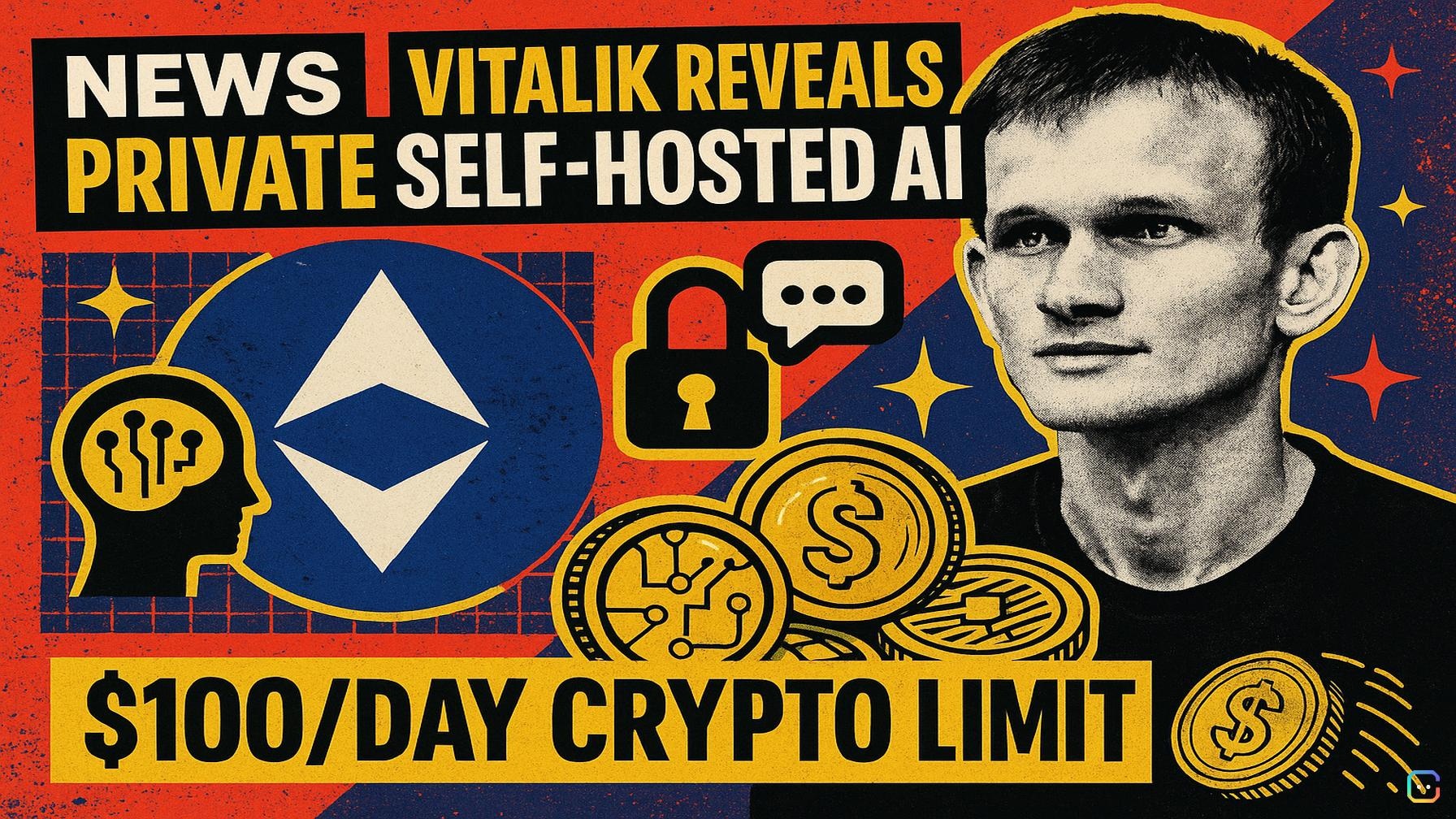
Ethereum co-founder Vitalik Buterin has published a hands-on breakdown of his personal AI setup — a self-hosted, “private” and “secure” system he says keeps both his data and crypto safe from autonomous agents.
What he’s running
- Buterin runs an open-source Qwen3.5:35B model locally via llama-server on a laptop equipped with an Nvidia 5090 GPU, which he says delivers about 90 tokens/second — fast enough for interactive use.
- To reduce external queries (and the privacy leaks they can create), he stores a complete local dump of Wikipedia and technical documentation so the model can answer many questions offline.
Safety and guardrails
- He built and open-sourced a messaging daemon that allows his AI agents to read Signal messages and emails freely but prevents them from sending outbound messages except to himself unless a human explicitly approves outgoing communications.
- On the crypto side, Buterin connects AI tools to his Ethereum wallet through strict limits: autonomous transactions should be capped (he suggests $100/day), with anything above that requiring manual confirmation. As he put it, “The new two-factor authentication is the human and the LLM.”
Why this matters to crypto
- These practices extend the same risk-minimizing philosophy he already uses for funds: roughly 90% of his holdings are kept in a multisig Safe wallet with keys distributed among trusted contacts so no single actor can move funds unilaterally.
- The post is a practical complement to his earlier February Ethereum-AI roadmap (which outlined private AI use, agent markets and governance), providing concrete implementation details rather than just theory.
Context and warnings
- Buterin frames this work against a backdrop of growing threats: security researchers found about 15% of skills built for OpenClaw — now the fastest-growing GitHub repository in history — contained malicious instructions, with some silently exfiltrating user data.
- He warned that mainstreaming cloud-based AI without privacy-first defaults risks reversing recent gains in end-to-end encryption and local-first software: “I come from a mindset of being deeply scared … we are on the verge of taking 10 steps backward by normalizing feeding your entire life to cloud-based AI.”
Takeaways for builders
- Buterin recommends developers of AI-linked Ethereum wallet tools adopt similar architectures: local model hosting when possible, restricted outbound channels, caps on autonomous transactions, and human-in-the-loop confirmation for higher-value actions.
- His post is both a blueprint and a caution: local-first AI can be practical today, but only if developers bake in strict guardrails around messaging and financial actions.
The write-up offers a rare, concrete look at how a high-profile crypto figure is operationalizing privacy and security as AI agents become more capable — a model other teams in the space can follow or adapt.
Read more AI-generated news on: undefined/news