Headline: Glassnode finds Tokyo traders get a 200ms speed edge on Hyperliquid — geography still matters in DeFi
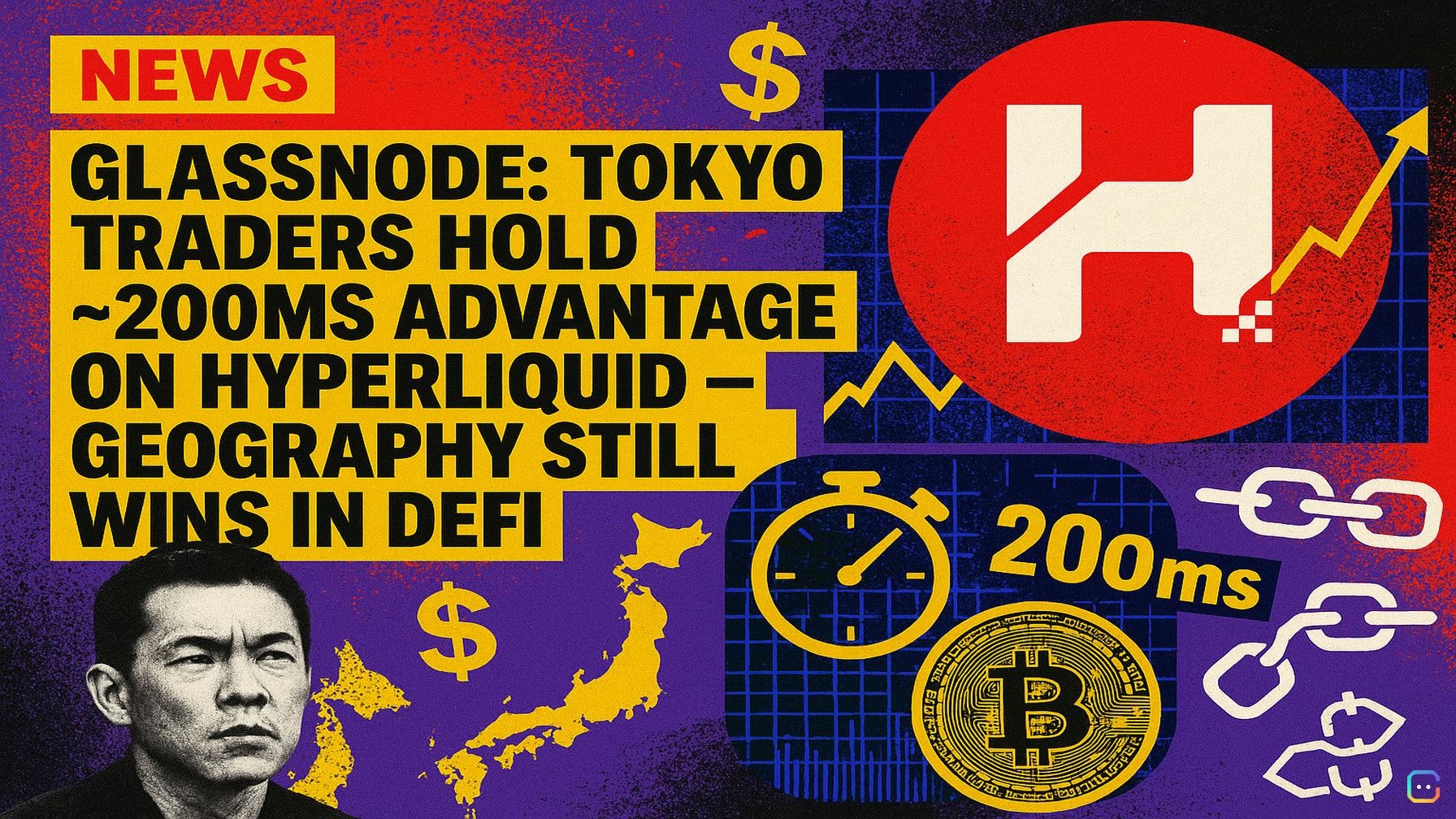
Glassnode research has put hard numbers on a problem crypto’s decentralization rhetoric often overlooks: physical proximity to infrastructure still confers a measurable trading advantage. Traders near Hyperliquid’s validators in Tokyo can reach the matching engine far faster than counterparts in Europe or the U.S., creating execution and latency asymmetries that affect fills, spreads and liquidity.
What the data shows
- Hyperliquid’s 24 validators are clustered in Amazon Web Services’ ap-northeast-1 region (Tokyo), spread across multiple availability zones. The protocol’s API layer routes through AWS CloudFront, but the validators themselves sit in a single Japanese cloud region.
- Glassnode and Hyperlatency measurements show Tokyo-based users can get trades to validators in as little as 2–3 milliseconds for network transit. From an AWS Tokyo node the median order round-trip (place + confirm) is about 884 ms — roughly 879 ms of server-side processing and ~5 ms of network transit.
- By contrast, an order from Ashburn, Virginia records a total round-trip of about 1,079 ms — roughly a 200 ms advantage for Tokyo on a roughly one-second fill. That margin compounds on an exchange that regularly handles more than $4 billion in daily perpetuals volume.
- Critics note variability: some complex order instructions routed from Tokyo have hit ~400 ms roundtrips, showing not all Tokyo orders uniformly enjoy sub-10 ms transit.
Why this matters
Decentralized protocols promise open access and permissionless markets, but time-ordered systems inherently favor those who can reach matching layers sooner. A Tokyo trading desk can post and change orders hundreds of milliseconds ahead of desks in Hong Kong, Singapore or the U.S., gaining priority in the queue, tighter spreads and higher probability of fills — a clear proximity advantage.
Tokyo’s central role in crypto infrastructure
Tokyo’s dominance is not new. Centralized exchanges and infrastructure providers have long co-located in AWS ap-northeast-1 to capture Asian flow and benefit from Japanese regulatory clarity developed after the Mt. Gox collapse. At Token2049 last year, Blockdaemon CEO Konstantin Richter told CoinDesk that Japan’s regulatory overhaul has made the country “institutionally scalable” for infrastructure, and BitMEX CEO Stephan Lutz said shifting data centers to Tokyo produced a material liquidity boost — roughly 180% on main contracts and up to 400% in some alt markets — which he attributed primarily to latency reduction rather than market-maker recruitment.
Risk concentration and systemic fragility
Hyperliquid isn’t unique: Binance, KuCoin and others also run significant infrastructure in ap-northeast-1. An AWS outage in April 2025 caused cross-platform service degradation, underscoring how much crypto plumbing depends on a single cloud region and one provider (about 36% of Ethereum nodes run on AWS, per available data). That concentration creates both latency advantages and systemic single points of failure.
Traditional finance has remedies — crypto does not
Traditional markets have spent decades engineering away proximity advantages: NYSE and Deutsche Börse physically equalize cable lengths to nanoseconds, IEX inserts a 350-microsecond “speed bump” to neutralize co-location benefits, and Europe’s MiFID II mandates clock sync to 100 microseconds plus audited cable-equalization. Decentralized markets currently lack comparable, widely adopted mechanisms — so the latency arms race that reshaped Wall Street is increasingly arriving in DeFi.
The takeaway
Hyperliquid’s growth shows traders tolerate — and can profit from — these asymmetries today. But as on-chain and off-chain processing speeds compress and institutional capital flows deeper into DeFi, geographic proximity and infrastructure decisions will increasingly shape liquidity and market fairness. In practice, the ideals of decentralization and equal participation are colliding with the physics of the internet — and that collision is running through Tokyo.
Read more AI-generated news on: undefined/news