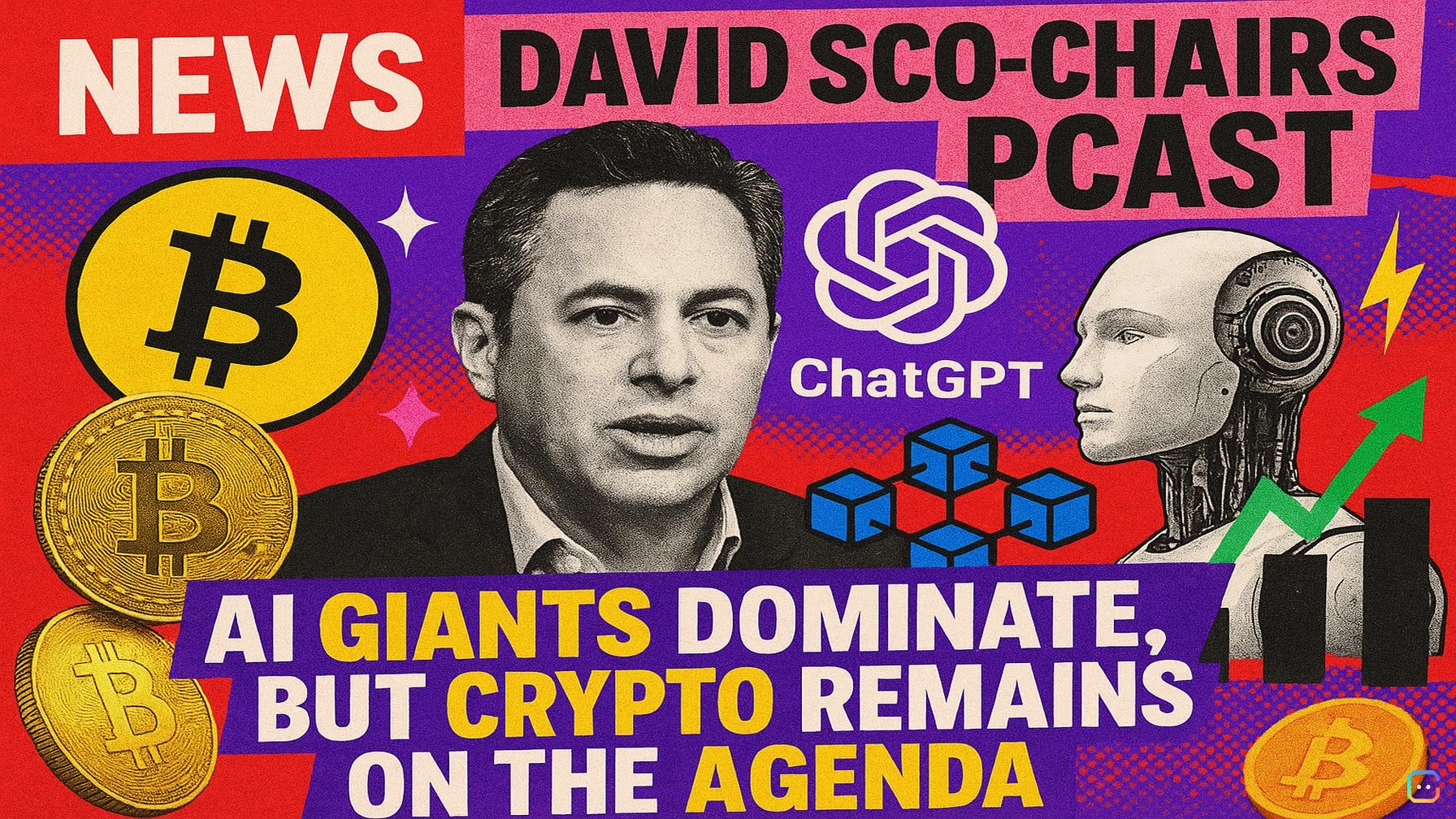
A who’s who of tech executives — including Nvidia’s Jensen Huang, Meta’s Mark Zuckerberg and AMD’s Lisa Su — will now help shape U.S. technology policy as members of the President’s Council of Advisors on Science and Technology (PCAST). Venture capitalist David Sacks, who spent the past several months acting as the Trump administration’s de facto crypto and AI point person, has been named co-chair of the council.
What PCAST does: the council will produce formal recommendations for federal regulators across a broad range of tech industries. Sacks’ elevation means he moves from a fast-paced, behind-the-scenes “czar” role into a formal advisory post that could amplify his influence across policy areas.
Who’s on the council: the membership reads like an enterprise- and AI-heavy tech roster — among the 13 members are Oracle’s Larry Ellison, Dell’s Michael Dell and Andreessen Horowitz co-founder Marc Andreessen. Notably, the only member with deep crypto roots is Fred Ehrsam, co-founder of Coinbase and crypto investment firm Paradigm. That composition signals PCAST’s attention will likely tilt toward AI and enterprise tech, at least initially.
Sacks’ ongoing influence: although his 130-day tenure as the White House’s crypto and AI czar has officially ended, a senior adviser reportedly told media Sacks “will always be his crypto and AI czar.” In interviews Sacks has already raised a major near-term priority: the lack of a unified national approach to AI regulation. “You’ve got 50 different states regulating this in 50 different ways,” he told Bloomberg, calling that patchwork a compliance burden for companies. He said President Trump favors a single national framework — one rulebook for all states.
Past work and legislative priorities: while serving as the administration’s tech point person, Sacks led the President’s Working Group on Digital Asset Markets, which produced a 166-page report outlining how crypto markets should be regulated. He also helped shape a national AI framework released on March 20 intended to balance innovation with protections for children and intellectual property. Reports credit him with pushing the GENIUS Act (a stablecoin-focused bill) and continuing to back the broader CLARITY Act on crypto market structure that is still moving through Congress.
What to watch: Sacks says PCAST will take a more deliberative, committee-style approach — members will study issues together and send recommendations to regulators, rather than relying on the rapid, direct access he had in his prior role. For crypto communities, that shift has two implications: policy could become more consensus-driven (slower, but potentially broader in scope), and with limited crypto-native voices on the council, outcomes will depend heavily on Sacks’ ability to marshal allies and translate industry priorities into formal recommendations.
Bottom line: PCAST now blends powerful enterprise and AI interests with a small but visible crypto footprint. Expect the council’s early work to emphasize national AI rulemaking and enterprise tech concerns, but Sacks’ continued engagement means crypto policy — from stablecoins to market structure — will likely remain on the agenda.
Read more AI-generated news on: undefined/news