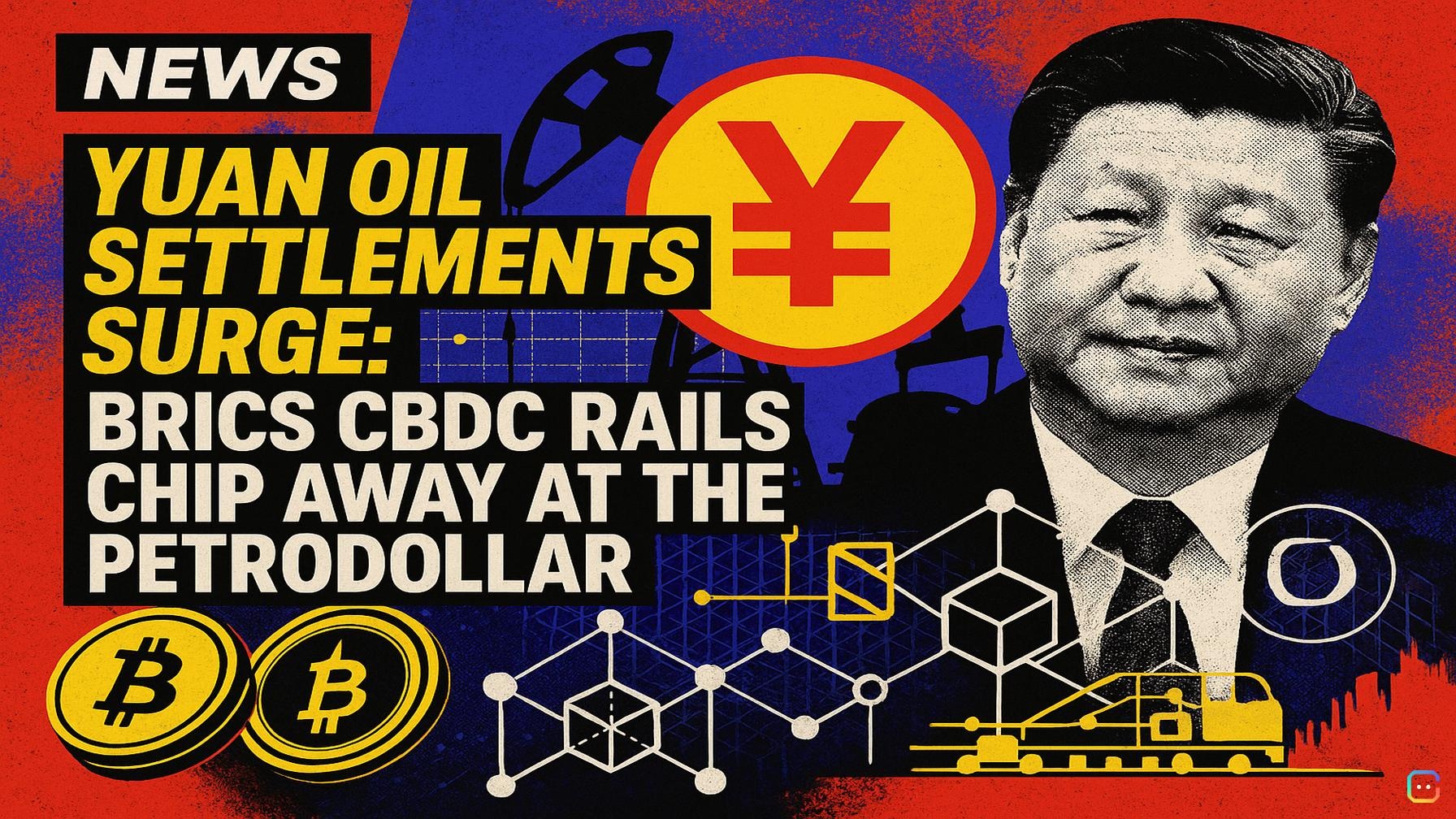
The global energy trade is shifting out of the dollar’s shadow — and it’s happening faster than many policymakers expected. A wave of BRICS-driven yuan settlement and alternative payment rails is already moving real barrels, rerouting revenue flows, and testing the long-assumed dominance of the petrodollar.
What’s happening now
- India: In March 2026 Indian refiners bought roughly 60 million barrels of Russian crude, with a significant portion settled in Chinese yuan rather than dollars. Indian Oil Corporation reportedly paid directly in yuan for two or three cargoes, avoiding any intermediary conversion — the largest single-month surge in India’s non‑dollar oil settlements to date.
- Iran: Tehran has begun demanding yuan for tolls at the Strait of Hormuz, one of the world’s busiest oil chokepoints that normally handles about 20% of global crude flows. An Iranian parliamentarian said tolls have reached roughly $2 million per voyage, and lawmakers are working to enshrine yuan-denominated charges in law.
- BRICS payment rails: Alternative systems are already processing huge volumes that bypass the dollar. The mBridge cross-border CBDC platform — which continued operating after the Bank for International Settlements stepped away — has processed about RMB 387.2 billion (roughly $55 billion), 95% in digital yuan. China’s CIPS clearing network reportedly settled the equivalent of $245 trillion in yuan transactions in 2025.
Why it matters
These are not hypothetical shifts on balance sheets — they’re moving cargo and cash now. For years analysts debated the decline of the petrodollar; the recent spike in yuan-settled oil and tolls suggests the debate is turning into a tangible reordering of trade finance. Central banks’ behavior underpins that trend: the dollar’s share of global reserves has fallen from about 71% in 2008 to 56.3%, while central banks have bought more than 1,000 metric tons of gold per year for three straight years.
Geopolitics and narratives accelerating change
Russian President Vladimir Putin has bluntly accused the US of “weaponiz[ing] the dollar,” and other analysts echo a similar rationale. David Lubin of Chatham House said the perception of the dollar being used as a political tool is prompting some countries to seek exit routes from dollar exposure.
But there are limits and frictions
The dollar remains central in global FX markets: the BIS’s 2025 Triennial Survey showed the dollar was on one side of 89.2% of all foreign-exchange transactions (up from 88.4% in 2022). China still enforces capital controls that constrain how freely the yuan can move, and BRICS members have repeatedly said they do not plan a single shared currency; Russia confirmed in January 2026 that talks about a unified currency “have not taken place and are not taking place now.”
Outlook: a multipolar decade — perhaps faster
Some analysts, including economists at ING, see this as a decade-long march toward a multi‑polar currency order — where the dollar, euro and renminbi dominate in different regions. But early 2026 activity in India and Iran suggests parts of that shift may accelerate, at least in energy markets.
What this means for crypto and payments
For crypto markets and alternative payments, the de‑dollarization trend is notable. Growing use of CBDC rails, cross-border digital-yuan settlement, and regional payment networks underscore demand for faster, cheaper and sovereign-controlled cross-border settlement alternatives. That could widen the runway for tokenized assets, stablecoins, and blockchain-based payment solutions — but adoption will hinge on legal frameworks, capital controls, and geopolitical alignments as much as on technology.
Bottom line
De‑dollarization is no longer only an academic or hypothetical risk: it is reshaping how energy is bought, how tolls are collected at a strategic chokepoint, and how hundreds of billions (and in some reports, far larger sums) are being moved outside the dollar system. The pace and permanence of the shift remain uncertain, but the early, concrete signs — particularly yuan oil settlements in India and Iran — mark a milestone in the global currency landscape.
Read more AI-generated news on: undefined/news