Today's Cryptocurrency Prices by Market Caps
The global cryptocurrency market cap today i $2.35T
Market Cap
$2.35T
24h Trading Volume
$141.09B
BTC Dominance
56.47%
|
#
|
Name
|
Price
|
1h %
|
24h %
|
7d %
|
Market Cap
|
Volume (24h)
|
Chart (7d) |
|---|---|---|---|---|---|---|---|---|
|
|
—
|
|||||||
|
No cryptocurrencies found Try adjusting your search query |
||||||||
Latest Crypto News
View All News
Argentina Drops Cheque Tax for Registered Crypto Exchanges to Boost Onshore Trading
Argentina has reportedly removed the transactional “cheque tax” for registered cryptocurrency exchanges — a policy tweak that could lower operating costs for compliant platforms and bolster regulated crypto rails under President Javier Milei. What changed - The cheque tax is a levy on credits and debits in bank accounts. Until now, it applied to crypto firms and created a cost gap between regulated exchanges and traditional financial players. - The exemption applies only to registered, regulated exchanges operating inside Argentina’s domestic framework. Offshore platforms and informal peer-to-peer (P2P) markets remain outside the relief. Why it matters - Argentina’s retail crypto scene is shaped by high inflation, strict currency controls and strong demand for dollar-linked assets. For many Argentines, stablecoins and Bitcoin are everyday tools for preserving value, not just speculative bets. - By lowering a transactional cost for compliant exchanges, the measure could make local platforms more competitive versus offshore exchanges and informal P2P channels, helping shift volume into supervised channels. - Moving activity to regulated rails can improve transparency and make it easier for authorities to monitor flows — without cutting off access to crypto for the public. Market and trader implications - The change is primarily operational rather than an immediate price catalyst. It should reduce overhead for registered exchanges and could nudge some activity away from informal routes. - For traders, the development signals that the Milei administration is willing to reshape financial rules to favor market access and deregulation — a theme that may influence institutional and retail behavior over time. - As always, be cautious: weekend trading and thin liquidity can amplify narrative-driven price moves, so headlines alone aren’t a reliable buy-or-sell trigger. Bigger picture - Treat this update as part of broader crypto trends: stronger compliance pressure balanced by easier app-based access, renewed interest in DeFi funding, tokenized real-world assets, and altcoin dynamics that still depend heavily on Bitcoin’s direction. - The exemption is conditional: platforms and users must continue to meet local licensing and reporting requirements to qualify. Reporting note This report is based on information from Julian Colombo. Written by the News Desk; edited by Samuel Rae. Read more AI-generated news on: undefined/news
Venus Lets Users Pledge Tokenized Stocks as Collateral to Borrow on BNB Chain
Venus Protocol has added tokenized stocks as acceptable collateral for borrowing on BNB Chain, bringing equity-backed exposure into on-chain lending markets. What changed - Users can now pledge tokenized versions of traditional stocks to borrow stablecoins or BNB on Venus, without selling the underlying equity tokens. - The move expands borrowing collateral beyond crypto-native assets and makes DeFi lending more similar to traditional margin finance, where securities are pledged to access liquidity. Why it matters - Real-world assets (RWAs) are one of DeFi’s clearest growth narratives, and tokenized equities give users a familiar bridge between traditional finance and on-chain lending. - Chains are competing to capture RWA activity—tokenized stocks, treasuries and similar assets are attractive because they can bring more stable, less speculative liquidity to a network. Key risks and operational challenges - Off-chain dependencies: Tokenized stocks may trade on-chain, but their value and redemption depend on custodians, legal agreements and off-chain redemption processes. That adds counterparty and legal risk beyond smart-contract exposure. - Valuation and market hours: Stocks trade in traditional markets while DeFi runs 24/7. Protocols must manage price feeds, liquidation thresholds and gaps between market sessions to avoid unexpected liquidations or stale prices. - Infrastructure needs: Reliable custody, robust oracles, and clear rules for freezes, redemptions and liquidation events are essential for this model to scale safely. Market context - This integration is best read as part of broader trends—not a standalone buy/sell signal. It complements other themes shaping crypto today: tighter compliance, easier app-based access, renewed DeFi funding, growing RWA tokenization, and altcoin dynamics still tied closely to Bitcoin’s direction. - Weekend and thin-liquidity trading periods can amplify narrative-driven moves, so retail attention often focuses on whether a development changes access, liquidity, or risk profiles. What to watch - Whether liquidity and actual usage grow beyond headline integrations. Tokenized stocks can widen DeFi’s total addressable market, but real traction depends on custody robustness, oracle accuracy and clear operational rules around freezes and redemptions. Source and credits - This report is based on information from Venus Protocol’s X account. Written by the News Desk; edited by Samuel Rae. Read more AI-generated news on: undefined/news
Sonic Labs Overhauls Leadership as S Token Plummets 97% to ~$0.03
Sonic Labs shakes up leadership as S token slide deepens Sonic Labs has overhauled its governance after the S token’s prolonged selloff intensified, with high-profile departures from the project’s board and new executives stepping in to steady the ship. Who’s out and who’s in - Andre Cronje, the project’s former CTO and well-known DeFi developer, has resigned from Sonic’s board. - Former Fantom Foundation CEO Michael Kong and executive chairman David Richardson also stepped down. - Sonic named Matt Visser as CEO and Kosta Kourkoumelis as COO as part of the transition. Sonic framed the exits as an “orderly transition,” saying the departing leaders “built what Sonic is today,” remain financially invested in the project, and will no longer make business decisions. The company said the changes are tied to a new governance framework aimed at restoring accountability and communication. Cronje responds to criticism In a separate message, Andre Cronje accepted responsibility for the technology and technical choices he led, but pushed back against criticism that he was responsible for wider policy decisions. He said he was not the author or decision owner of the network migration, airdrop design, tokenomics, or legacy-network management — areas that have drawn heavy community scrutiny. What Sonic is promising Sonic Labs said it will introduce: - More transparent governance processes - Clearer development updates - A dedicated risk and compliance committee The company also acknowledged that both the token’s performance and community sentiment have deteriorated, saying plainly: “the token is down” and community confidence has weakened. Market pain: S token near $0.03 Market data show S trading around $0.029–$0.03 after a roughly 5% drop in the past 24 hours. Since launching in January 2025 as part of the migration from Fantom to Sonic, the token has plunged about 97%, according to crypto.news. Technical picture Recent price action points to continued downside pressure: - S broke below the lower boundary of a bearish flag that formed after a sharp June selloff. - The token fell from about $0.049 to under $0.03, briefly consolidated, then resumed selling. - Momentum indicators favor bears: RSI is near 34 (well below neutral 50) and the MACD remains beneath zero despite a modest bullish crossover attempt. - Nearest support sits around $0.028; a break below that could revisit lower post-launch levels. On the upside, former flag support near $0.032 has flipped to resistance, and a sustained move toward $0.034–$0.035 would be required to challenge the bearish structure. Background and product push Sonic Labs traces its roots to the Fantom Foundation (founded 2018) and rebranded following a network upgrade that replaced the Fantom Opera chain with the Sonic layer-1. The company touts up to 10,000 transactions per second and sub-second finality for the network. Earlier this year Sonic expanded its on-chain offerings by launching USSD, a dollar-pegged stablecoin backed by tokenized U.S. Treasury assets, intended to support trading, lending, payments and settlement across Sonic DeFi apps. Industry context Sonic’s executive shake-up comes amid broader churn across the crypto sector. For example, the Ethereum Foundation recently saw co-executive director Hsiao-Wei Wang depart, part of roughly 19 layoffs and exits reported at the organization this year. Bottom line Sonic Labs is attempting to reset governance and shore up confidence as the S token remains deeply depressed and community frustration grows. The effectiveness of the new leadership and promised governance measures will be tested by whether they can stabilize token markets and rebuild trust with users and investors. Read more AI-generated news on: undefined/news
OpenRouter’s Fusion: Near-Fable 5 Performance at Half the Cost — A Boost for Crypto Builders
Headline: OpenRouter’s new “Fusion” bundles cheap AI models to mimic Claude Fable 5 — just as Fable goes offline for many users OpenRouter this week launched Fusion, an API that stitches together multiple inexpensive models into a single “compound” model — and pitches it as a way to get near-Fable performance at a fraction of the cost. The timing is notable: Anthropic suspended access to its newly released Fable 5 and Mythos 5 for foreign nationals after a U.S. export-control directive, creating an immediate vacuum that Fusion aims to fill. How Fusion works - Parallel calls: A prompt is sent in parallel to a panel of models. Each model can use web search and bash tools. - Judge stage: A dedicated judge model scans responses for consensus, contradictions and blind spots. - Synthesis: A synthesizer (Claude Opus 4.8 by default) composes the final, grounded answer from the judge’s analysis. - Deployment: The whole pipeline runs server-side. Developers can use the default panel by switching their model string to "openrouter/fusion," add a fusion tool to call Fusion selectively, or build a custom panel in a no-code Fusion chatroom. Benchmark results (DRACO, Perplexity) - Top lineup: Fable 5 + GPT-5.5, synthesized by Opus, scored 69%. - Solo Fable 5: 65.3% (seven tasks blocked by Fable’s content filters). - Cost-conscious winner: Gemini 3 Flash + Kimi K2.6 + DeepSeek V4 Pro, fused and synthesized by Opus, scored 64.7% — within a point of solo Fable but at roughly half the cost. - Other comparators: Solo GPT-5.5 (60%), solo Opus 4.8 (58.8%); pairing Opus 4.8 with itself reached 65.5% — OpenRouter attributes ~75% of that lift to synthesis and the remainder to model diversity. A quick correction: giving panels live web access briefly let models surface DRACO’s own grading rubric during runs, a contamination risk OpenRouter fixed by excluding the benchmark’s host domains from search tools; published numbers reflect the cleaned runs. Limits and trade-offs - Not a full Fable replacement: OpenRouter concedes Fusion lags on long-horizon tasks and harder reasoning work where Fable reportedly excels. For coding, Fusion is intended as a tool called selectively by a coding model, not an outright swap. - Practical role: Fusion is positioned as a safety net — a second opinion layer for queries where a single model may miss important contradictions or facts. OpenRouter says the approach shines on deep research, complex planning, and tasks where cross-checking matters. - Infrastructure and export controls: Fusion runs on models routed through OpenRouter’s infrastructure, so it doesn’t bypass the underlying export-control or access restrictions that sidelined Fable 5. Market reaction and alternatives - Community split: Sentiment on the launch thread tracked roughly two-to-one positive. AI researcher Andrew Trask called Fusion “a way bigger deal than it seems,” suggesting frontier labs won’t uniquely own the lead. Critics flagged weaker coding outputs, tooling gaps, and limited transparency now that Fable 5 is unavailable for side-by-side testing. - Options for blocked users: OpenRouter positions Fusion as one option; others include backend swaps like DeepClaude or open-weight models such as GLM-5.2, which may be cheaper though not necessarily better at the toughest tasks. Why crypto and Web3 builders should care - Cost efficiency: For teams running on tight budgets — common in crypto and Web3 startups — Fusion’s promise of near-top-tier performance at roughly half the price could materially lower AI infrastructure costs. - Redundancy & resilience: Multi-model synthesis reduces dependence on any single proprietary model, which matters if regulatory moves or vendor policy changes interrupt access. - Developer flexibility: APIs that let you swap panels or call a fusion tool selectively can fit into agent workflows, smart-contract tooling, and research pipelines where accuracy and cost both matter. Bottom line: Fusion demonstrates that intelligently combining several cheaper models plus a judge-and-synthesizer pipeline can close much of the gap with a single high-end model. It’s not a drop-in replacement for Fable 5 across every use case, but for many research and production workloads — and particularly for cost-conscious crypto projects — it’s a pragmatic alternative worth testing. Read more AI-generated news on: undefined/news
SpaceX IPO a crypto-style narrative bet as analysts' targets split $63–$227
SpaceX’s stock is already proving to be one of the most polarizing new listings on Wall Street — and crypto traders who watch narrative-driven markets will recognize the setup. Current analyst price targets span an unusually wide $63 to $227 range, while shares were trading roughly between $190 and $225 on Nasdaq at the time of writing. That dispersion comes down to one core question: will Starlink subscriber growth and Starship reusability accelerate quickly enough to justify a sky-high $1.75 trillion valuation? Why the split in forecasts - Bulls: Treat SpaceX as a once-in-a-generation infrastructure winner. If Starship becomes reliably reusable and Starlink scales faster than expected, the company’s potential market and cash flows could explode, supporting valuations far above today’s levels. - Bears: Say much of that upside is already priced in. They worry that the company must hit multiple difficult technical and commercial milestones simultaneously — a risky conditional bet. Where analysts sit (high-level) - Consensus target across analysts sits near $164, but the market has already pushed past that number. That gap implies analysts’ models often project a negative return from current prices, even under optimistic assumptions. - The highest commonly published target is $227; some longer-range bull cases envision $500+ over three to five years, driven by rapid space infrastructure demand and launch innovation. Notable bearish reads - CFRA’s Keith Snyder initiated coverage with a Sell and a $115 target within hours of the IPO. His critique: SpaceX is extraordinary, but investors are being asked to underwrite several difficult outcomes at once. His primary operational risk: “SpaceX’s long-term strategy remains heavily dependent on Starship.” He also warned against assigning big value to the company’s AI segment until there’s proof of sustainable revenues and margins. - Morningstar published a starkly cautious fair value estimate of $63 per share — an outcome that requires full Starship reusability plus commercial orbital data centers succeeding before 2028. - Using a sum-of-the-parts view, CFRA pegs launch business value at roughly $188 billion and Starlink at $159 billion, leaving a large portion of the current market cap tied to xAI’s unproven commercial path. Notable bullish reads - Wolfe Research’s Myles Walton opened coverage at Outperform, putting Starship reusability at the center of the upside case: “Successful reusability of Starship is the single most important value unlock.” He adds that investors just need conviction in Starship to buy the broader thesis. - New Street Research set a $165 target, and the highest reported Wall Street number sits at $227. Analyst snapshot and market context - Among six analysts polled by S&P Global, four carry Buy ratings and one a Sell, with an average target of $164. - The stock’s all-time high is $225.64, and prices are trading well above the consensus target in the near term — a sign of market optimism outpacing analysts’ models. - A significant supply risk looms: an insider lockup expires in December 2026, which could add selling pressure and reshape the bull-vs-bear balance. What matters going forward SpaceX’s valuation debate is essentially a binary story playing out on a very large stage: if Starship becomes reliably reusable and Starlink continues rapid subscriber expansion (and xAI proves a commercial path), bulls will say the current price is a bargain. If those elements fail to scale as hoped, bears argue returns from today’s levels look weak. For crypto traders used to pricing in narrative-driven, high-uncertainty outcomes, SpaceX offers a familiar mix of tech promise, large optionality, and headline risk. The next major data points — Starship’s early commercial cycles, Starlink growth metrics, and the December 2026 lockup timeline — will likely determine which end of the $63–$227 range the market ultimately favors. Read more AI-generated news on: undefined/news
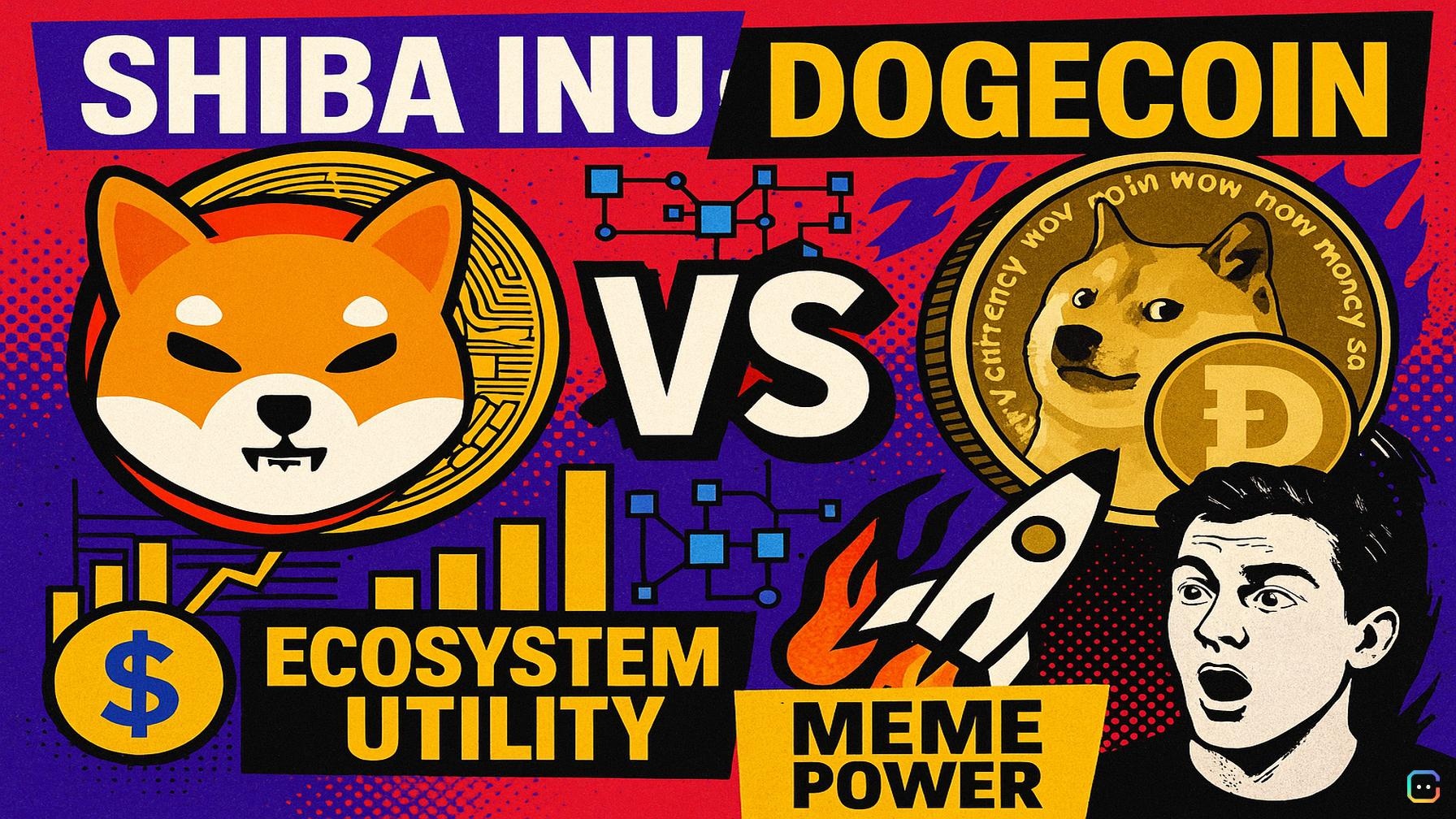
Shiba Inu vs Dogecoin: Ecosystem Utility vs Meme Power
The long-running showdown between Shiba Inu (SHIB) and Dogecoin (DOGE) is once again in the spotlight — but this time the comparison goes beyond memes and market caps. Dogecoin, the original memecoin, has the advantage of tenure: it launched in December 2013 and built a strong brand as the space’s pioneer. Shiba Inu, however, has spent the past few years evolving into a broader crypto ecosystem. Which approach matters more for long-term relevance? Here’s a sharper look. Networks and technology - Dogecoin runs on its own independent network, secured by a Proof-of-Work consensus that uses the Scrypt mining algorithm. Its focus has historically been simplicity and transaction utility. - Shiba Inu is built on Ethereum and has branched out with Shibarium, a layer-2 network that adds scalability and lower fees for projects in its ecosystem. Smart contracts and DeFi - Shiba Inu benefits from Ethereum-compatible smart contract infrastructure through Ethereum and Shibarium, enabling dApps, token launches and DeFi features. - Dogecoin’s ecosystem has very limited smart contract capabilities, which restricts its functionality relative to Ethereum-based memecoins. Products and ecosystem growth Shiba Inu has diversified into multiple verticals: - Decentralized exchange: ShibaSwap - Gaming and web3: several released titles and ongoing development - Metaverse projects - Multi-token structure: SHIB, BONE, LEASH, TREAT - Proposed stablecoin: SHI (initially floated with a $0.01 peg; rollout paused pending clearer regulatory guidance on stablecoins) Dogecoin, by contrast, has little development in DeFi or token-layer expansion and has not signaled plans for a stablecoin. Why DOGE still leads Despite SHIB’s technical and product-driven growth, Dogecoin remains the memecoin frontrunner — largely due to brand strength and cultural momentum. DOGE’s identity as the original memecoin continues to resonate with retail users and crypto enthusiasts, while Shiba Inu appears to be pivoting toward more conventional blockchain use cases. Bottom line Shiba Inu has built a more feature-rich ecosystem around its token, leveraging Ethereum and Shibarium to offer smart contracts, DeFi, gaming and metaverse projects. Dogecoin retains the edge in brand recognition and cultural cachet. Which is “better” depends on what you value: Dogecoin’s established name and simplicity, or Shiba Inu’s push toward broader utility and on-chain innovation. Read more AI-generated news on: undefined/news