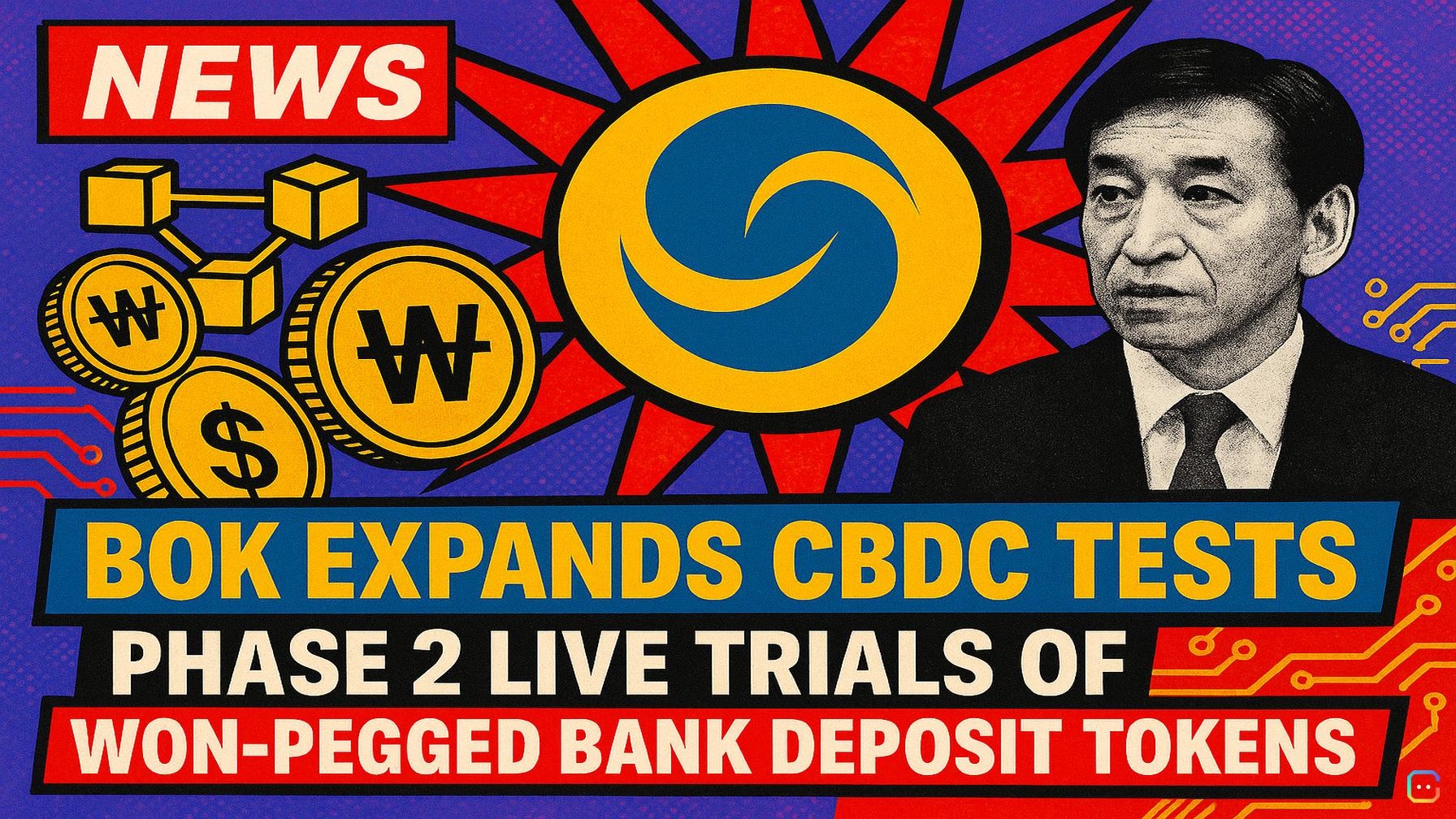
The Bank of Korea (BOK) has escalated its digital currency experiments: phase two of Project Hangang is now under way, with the central bank and nine commercial lenders beginning large-scale tests of won-pegged deposit tokens built on a wholesale CBDC layer.
The new stage adds Kyongnam Bank and iM Bank to the program’s original seven participants, expanding the scope of trials that aim to prove whether bank-issued deposit tokens—backed by central bank infrastructure—can support nationwide consumer transfers, payments and even government subsidy disbursements.
“Participating banks are actively securing diverse use cases, such as large businesses and small merchants with high public relevance and significant payment fee burdens, focusing on the potential for drastically reduced fees when using digital currency for payments,” said Kim Dong-sub, head of the BOK’s digital currency planning team, according to Chosun. Cutting transaction costs is a central objective: by routing payments through deposit tokens, the BOK hopes to provide a lower-cost alternative to credit card processing for both major companies and fee-sensitive small merchants.
Phase two also addresses technical gaps from the initial trial. Peer-to-peer transfers, which were difficult in Phase 1, will be enabled in the new tests, broadening real-world functionality. The BOK has signaled concrete near-term ambitions: Kim said the government aims to begin disbursing subsidies in digital currency in the first half of this year, with electric vehicle charging infrastructure subsidies expected among the first pilots.
The launch comes amid a regulatory standoff over stablecoin rules. South Korea’s proposed Digital Asset Basic Act (DABA), designed to consolidate crypto trading and issuance rules, has been delayed by disputes between regulators—most notably who should have the legal authority to issue KRW-pegged stablecoins. The BOK’s CBDC experiments could affect the broader debate about public vs. private digital money.
Beyond point-of-sale and subsidy use, the central bank is also exploring novel applications: officials have mentioned plans to enable digital currency as a payment method for AI agents—autonomous systems that search for and buy goods and services—which signals the BOK is testing both retail payments and machine-to-machine commerce scenarios.
Why it matters: Project Hangang’s phase two is a live stress test of a central-bank-backed token model that could lower payment fees, speed government transfers and offer an alternative to private stablecoins—potentially reshaping payments and crypto regulation in one of Asia’s most active digital-asset markets.
Read more AI-generated news on: undefined/news