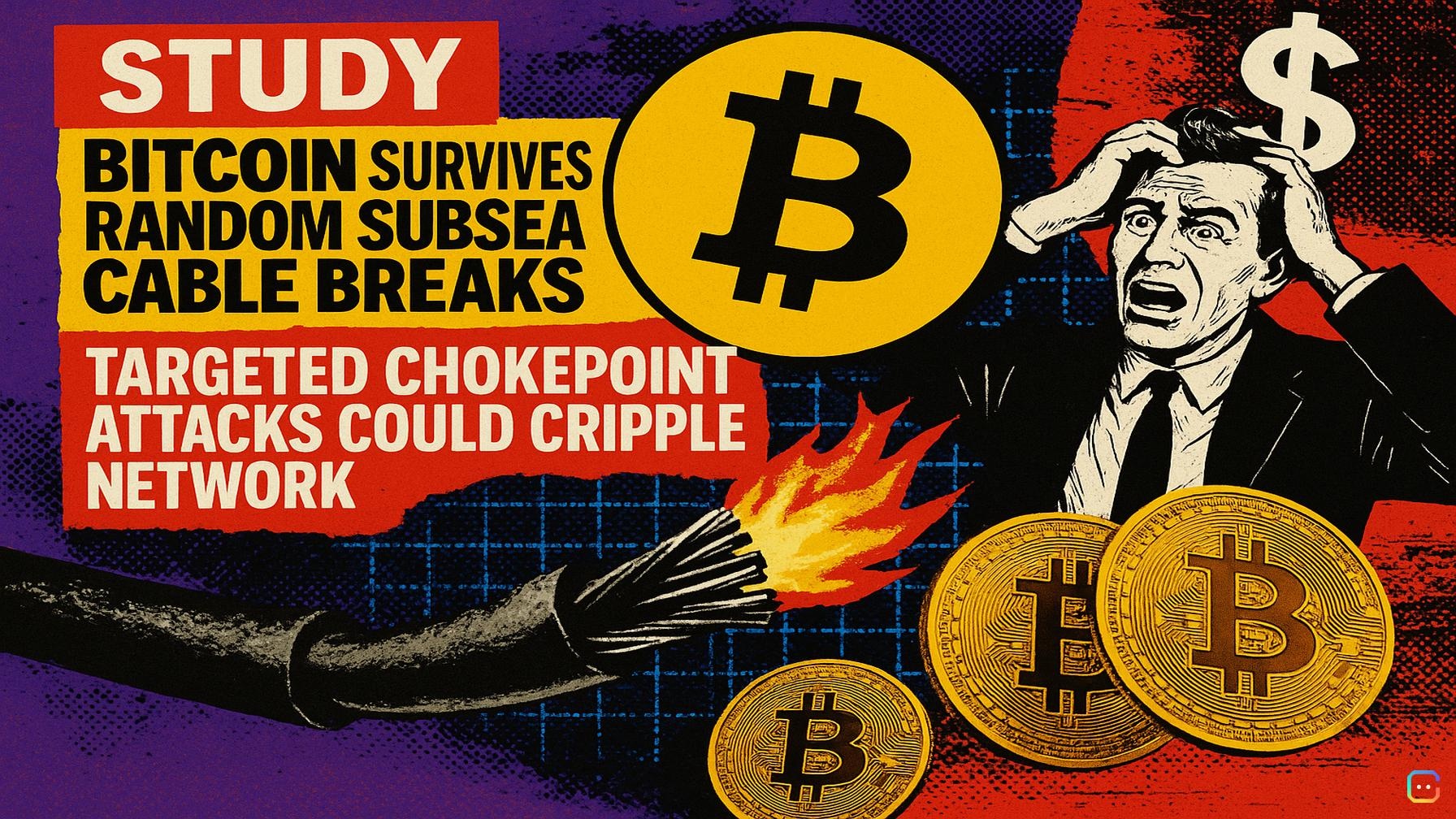
Headline: New Study Finds Bitcoin Resilient to Random Subsea Cable Breaks — But Vulnerable to Targeted Strikes
A new paper from the Cambridge Centre for Alternative Finance finds Bitcoin’s peer-to-peer network is largely unfazed by accidental undersea cable outages — unless those outages are deliberately aimed at key internet chokepoints.
What the researchers did
- Authors Wenbin Wu and Alexander Neumueller tracked 68 confirmed submarine cable fault events from 2014 through 2025.
- They used a country-level cascade model built on Bitcoin peer-to-peer network data to estimate how cable failures propagate and affect node availability.
Key findings
- Most outages caused almost no disruption: 87% of the cable-fault events took fewer than 5% of Bitcoin nodes offline.
- There was essentially no price effect: the correlation coefficient between cable failures and Bitcoin’s market value was −0.02, which the researchers call statistically insignificant.
- For random failures, Bitcoin is highly robust: between 72% and 92% of all submarine cables worldwide would have to fail before more than 10% of Bitcoin nodes go dark. (Subsea cables carry roughly 99% of international internet traffic.)
- Targeted attacks tell a different story: deliberately cutting high-traffic cable junctions could reduce the failure threshold dramatically — to between 5% and 20% of cables — making such strikes roughly an order of magnitude more disruptive than random outages.
Why this matters
- The study is the first long-term assessment of Bitcoin’s exposure to physical internet infrastructure and highlights a crucial asymmetry: accidental outages have proven minor, while coordinated attacks on specific links could produce outsized harm.
- Geographic diversification of mining after China’s 2021 crackdown hasn’t substantially changed the network’s exposure, because network resilience aligns with physical cable routes rather than miner locations.
- One mitigating factor: Tor adoption. The paper reports that about 64% of Bitcoin nodes are effectively hidden from outside observers through Tor, complicating mapping efforts and making some nodes harder to target.
Takeaways for the crypto ecosystem
- Bitcoin’s P2P topology and privacy tools lend it strong resilience to random infrastructure failures, but the network remains sensitive to strategic attacks on high-traffic physical links.
- Protecting submarine-cable chokepoints and improving network-level redundancies should be priorities for operators, node runners and policymakers concerned with national or systemic risks.
The report flags a clear trade-off: Bitcoin has weathered years of accidental cable outages with little impact, but real-world security depends on defending a relatively small set of critical physical connections.
Read more AI-generated news on: undefined/news