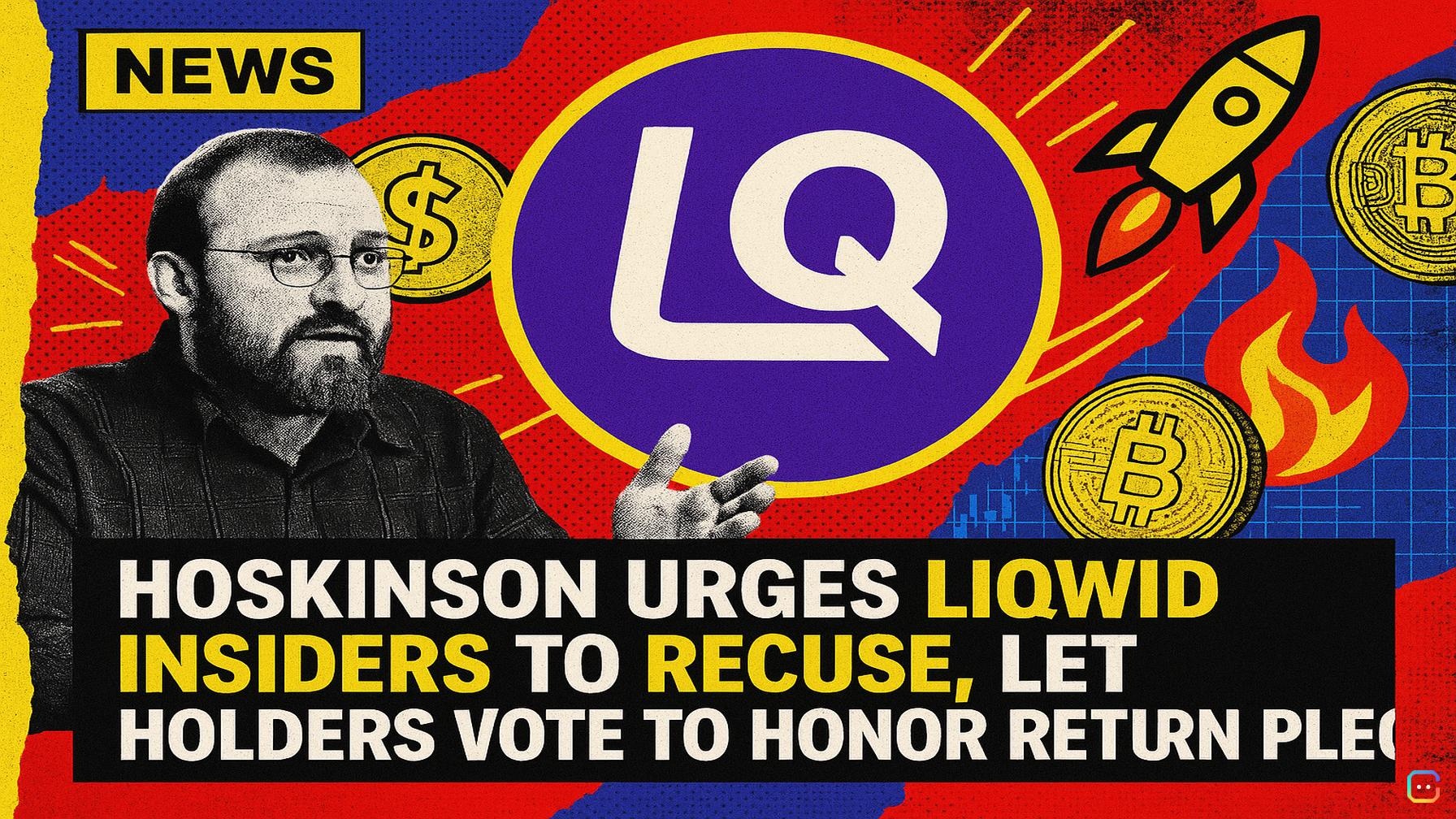
Cardano founder Charles Hoskinson has waded into a heated governance fight at Liqwid, urging protocol insiders to step back and let token holders decide whether prior public promises should be honored. His intervention spotlights a recurring weak point in DeFi governance: whether votes are legitimate when founding teams or core contributors stand to benefit directly.
Speaking from Wyoming during a livestream, Hoskinson said he normally steers clear of DeFi disputes on Cardano unless the community broadly requests his input. But he called the Liqwid episode a serious trust issue after October assurances that “100% of the assets in the smart contracts” tied to the protocol would be returned to their “rightful owners.”
At the center of the dispute is a sizable allocation of Midnight’s NIGHT tokens associated with Liqwid’s ADA market. Governance materials show about 18.81 million NIGHT were allocated — roughly a seven-figure position, currently worth just under $1 million — which helps explain why this is more than a symbolic governance quarrel: users say those tokens were supposed to be fully returned.
Hoskinson said the problem partly arose from an internal governance and legal snag: the team, he claims, lacked the authorization under their DAO’s user agreement to carry out the allocation. Even if that’s true, he added, the bigger concern is how the situation was handled afterward.
His remedy is simple and surgical: rerun the vote with clearer terms and a firewall between insiders and the decision. “If you have to go to the DAO for a vote, two things should be done,” he said: insiders who would directly benefit must recuse themselves, and the vote should be a straightforward yes-or-no on whether to honor the October marketing commitments.
That framing hits at the heart of his critique. Hoskinson argues people deposited funds into the relevant smart contracts on the explicit understanding that prior commitments would be honored. “Commitments were already made, people put money into the contracts understanding those terms and conditions and had no reasons to believe that such things would be violated,” he said, adding that those entrusted with the software and the protocol should have acted more responsibly.
He repeatedly emphasized legitimacy over mere procedure: DAOs don’t gain credibility just because they run votes, he said — legitimacy comes from broad participation and confidence that outcomes aren’t being driven by a small cluster of insiders. If holders believe votes are controlled by insiders, there’s “no path forward for a DAO to have governance legitimacy,” Hoskinson warned.
His practical recommendations: core entities publicly disclose their holdings, recuse themselves from the vote, and give token holders a single question to decide — honor the October commitments, yes or no. If the community votes to honor them, the protocol should carry that out; if not, a second-stage debate can consider alternative allocations.
Hoskinson was clear about his limits and the stakes. He has no authority to reverse outcomes, no control over assets already in smart contracts, and no formal governance power over the Cardano ecosystem. But perception matters: he warned that even the appearance of a trust breach could damage Liqwid’s ability to attract users and liquidity. “If people can’t trust what the core accounts are saying and when votes are taken, it creates a reality where people will just simply move to other options,” he said.
If Liqwid wants to restore credibility, Hoskinson argued, the path remains open — through disclosure, recusal, and a cleaner, narrower vote.
At press time, Cardano was trading at $0.29.
Read more AI-generated news on: undefined/news