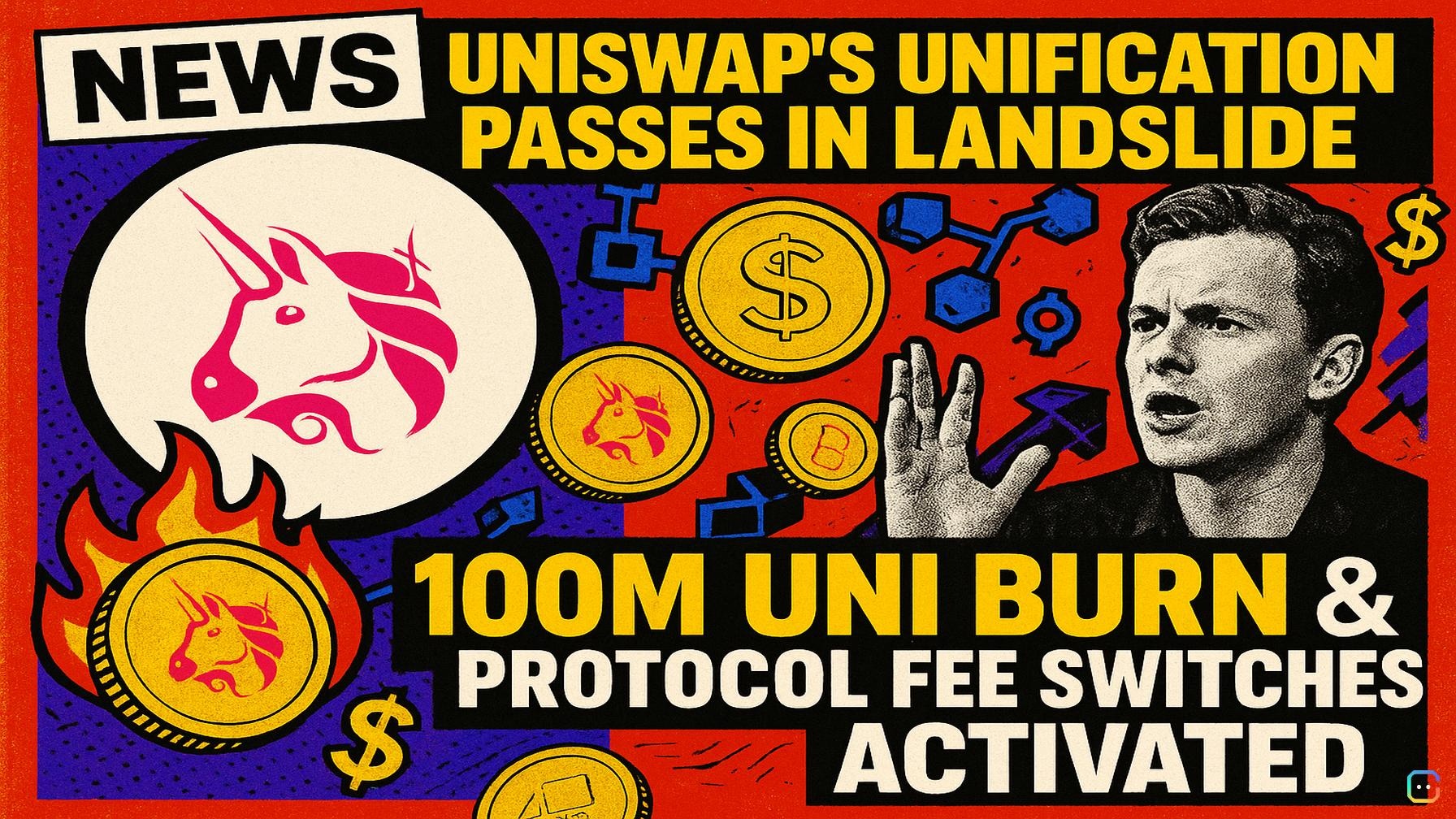
Uniswap’s UNIfication proposal has passed in a landslide, kicking off one of the most consequential governance moves in the protocol’s history and fundamentally reshaping how Uniswap captures economic value.
What passed
- The governance vote closed on 25 December and received overwhelming support: 125,342,017 UNI in favor versus just 742 against, well above the 40 million UNI quorum. Hayden Adams shared the final tallies on X.
- The proposal now enters a two-day on-chain timelock. Once that expires, the changes will be executed.
What changes
UNIfication redraws Uniswap’s tokenomics and value-capture model with two immediate, high-impact shifts:
- 100 million UNI one-time burn: Treasury-held UNI will be permanently removed from circulation. The burn is presented as a retroactive correction for protocol fees that were previously unaccounted for.
- Protocol fee switches activated: Supported pools will have protocol-level fee switches turned on so the protocol retains a portion of trading fees instead of routing all fees exclusively to liquidity providers. Importantly, fees will accrue at the protocol layer rather than through Uniswap frontends.
Related product and business changes
- Uniswap Labs will disable frontend (interface-level) fees, abandoning interface monetization and signaling a renewed focus on neutral protocol infrastructure and on-chain value capture.
Reaction and risks
Despite the decisive margin, UNIfication has faced pushback from experienced liquidity providers. Key concerns:
- Compressed LP returns: Activating protocol fees could reduce net returns for LPs, especially on Uniswap v3 pools where margins are already narrow.
- Migration or exit risk: Some LPs have warned they may move liquidity to v4 pools or other venues, or withdraw entirely, if net yields fall.
- Incentive runoff risk: If governance responds by flooding the market with UNI incentives to retain liquidity, protocol fee revenues could be offset by emissions — creating a circular system that limits benefits for passive UNI holders.
Two risk scenarios have been highlighted by critics:
1) Minimal intervention — LPs withdraw, liquidity and fee generation decline.
2) Heavy incentives — governance uses UNI emissions to prop up liquidity, neutralizing fee-derived value capture.
Mitigations such as protocol fee discount auctions were noted in discussions as possible tools to reduce friction, but critics remain cautious about long-term LP economics.
What to watch next
Once the timelock expires and the burn and fee switches go live, market observers will focus on:
- Liquidity flows across v3 and v4 pools and whether LPs migrate or return.
- Actual protocol fee revenue and whether it meaningfully accrues to the protocol.
- Governance choices around future incentive programs and how they interact with fee capture.
Bottom line
UNIfication moves Uniswap from an interface-fee model to direct protocol-level economic capture, with an immediate supply shock from a 100 million UNI burn and ongoing fee retention on trades. The measures aim to strengthen protocol value capture but introduce trade-offs for LP economics; how governance balances those tensions will determine whether UNIfication delivers on its long-term goals.
Disclaimer: This content is informational and not investment advice. Trading cryptocurrencies carries high risk; do your own research before making financial decisions. © 2025 AMBCrypto
Read more AI-generated news on: undefined/news