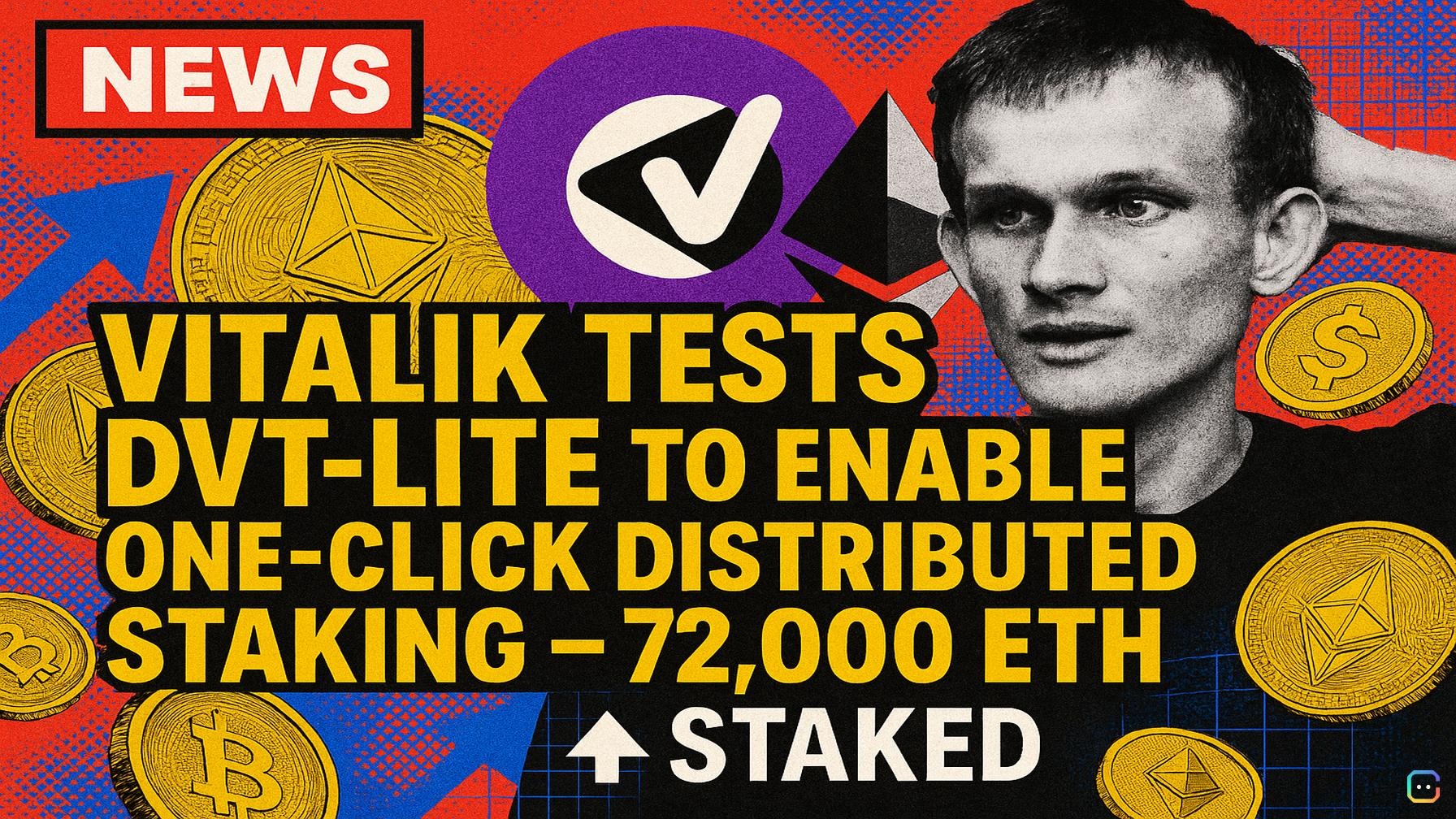
Vitalik Buterin and the Ethereum Foundation are experimenting with a streamlined form of distributed validator technology — dubbed “DVT-lite” — that could make staking far easier for large ETH holders and help decentralize Ethereum’s validator landscape.
In a post on X, Buterin said the foundation is using DVT-lite to stake 72,000 ETH. The goal: reduce the technical overhead of running distributed validators to something approaching a one-click experience. Operators would simply pick which machines will run validator nodes, launch the software, enter the same key on each machine, and the system would automatically connect the nodes and begin staking.
Why this matters
- Today, most Ethereum validators are single machines holding the signing key. If that machine fails or goes offline, the validator can stop and be penalized.
- Distributed validator technology (DVT) fixes this by letting multiple independent machines collectively act as a single validator; only a subset needs to sign for the validator to function, so the validator stays online even if some nodes fail.
- But real-world DVT deployments can be complex: operators must coordinate networking, key shares and inter-node communication, which tends to favor large, professional staking providers.
What DVT-lite promises
- Automation of the networking and key coordination that make current DVT setups cumbersome.
- A simple onboarding flow that lowers the bar for institutions and large ETH holders to run their own distributed validators without becoming staking “professionals.”
- Greater distribution of staking control across more operators, reducing concentration among a handful of big providers.
Buterin’s pitch is explicit: “My hope for this project is that we can make it maximally easy and one-click to do distributed staking for institutions,” he wrote, adding that the idea of running infrastructure as a high-skill gatekeeper is “awful and anti-decentralization, and we must attack it directly.”
If DVT-lite delivers on its promise, it could broaden participation among institutional ETH holders and help shift the network toward a more resilient and decentralized validator set — all by simplifying what is today a fiddly, technical process.
Read more AI-generated news on: undefined/news