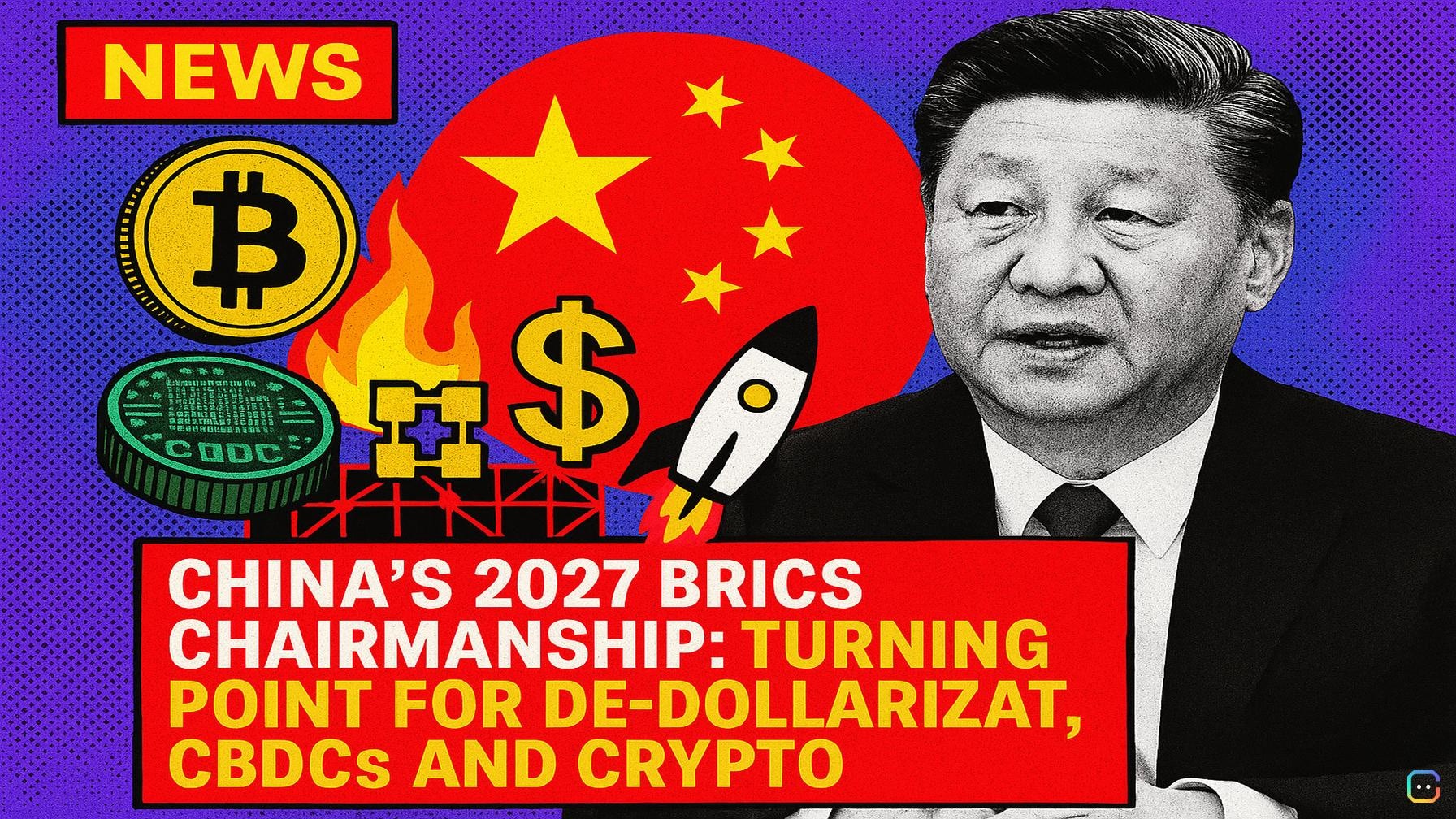
China’s upcoming BRICS chairmanship in 2027 is already being shaped — well before the calendar flips. In a sign of how consequential the next two years could be, Beijing and New Delhi quietly agreed to back one another’s leadership terms: India formally took the chair in January 2026, and China will follow in 2027. Analysts are calling this back-to-back sequence potentially the most important in BRICS history.
Why it matters now
- The BRICS grouping Beijing will lead in 2027 is far larger and more influential than the one it chaired in 2017. The bloc now has 11 full members (Indonesia joined in early 2025) plus several partner countries, together representing more than 40% of the world’s population.
- Conversations about reducing dollar dependence and building alternative payment systems have moved from niche policy debate to mainstream priority across member states, driven in part by US tariff pressure and broader geopolitical frictions.
- India kept de-dollarization off the front burner during its 2026 term to avoid friction with Washington. China, by contrast, faces fewer such constraints as it prepares to steer the agenda in 2027.
What Beijing is expected to push
At the 2024 Kazan Summit, Xi Jinping urged BRICS to “play a leading role” in reforming the international financial architecture, deepen financial cooperation, interconnect financial infrastructure, expand the New Development Bank, and ensure the international financial system better reflects global economic shifts. Under China’s chairmanship, long-running priorities that could return to the table include:
- A BRICS cross-border payment system or connected settlement infrastructure that reduces reliance on the dollar.
- Institutional pushes for expanded voting power and reforms at the IMF.
- Broadening and strengthening the New Development Bank to fund development and climate projects.
Politics and coalition dynamics
Former Indian diplomat Vidya Bhushan Soni has noted that China has come to realize BRICS cannot advance without India’s active participation. Expect Beijing to adopt a more consensus-driven playbook in 2027 to keep India — and other key democracies — inside the tent. The bloc’s Global South leadership is being framed as collective rather than purely China-led, a distinction Beijing appears to be emphasizing to preserve cohesion.
Beyond payments: the broader BRICS agenda
The 2027 chairmanship is also expected to foreground issues beyond finance, including AI governance, climate finance for developing nations, and further reform of the international monetary system. These are not overnight initiatives: they’re being drafted now through quiet diplomacy and bilateral talks across member capitals.
What this means for crypto and global finance
For crypto and digital-payments watchers, the stakes are high. A coordinated BRICS drive toward alternative cross-border rails could accelerate:
- CBDC interoperability efforts and regional settlement arrangements.
- Use cases for tokenized assets or stablecoins where existing rails are restricted.
- Pressure on dollar-denominated settlement practices, with implications for capital flows and reserve currency dynamics.
Bottom line
China’s 2027 BRICS chairmanship is shaping up to be a turning point: the bloc is larger, more assertive on de-dollarization, and better positioned to translate plans into institutional change. More than anything, the run-up to 2027 signals that the post–Cold War international order is being renegotiated — and Beijing intends to be one of the principal authors.
Read more AI-generated news on: undefined/news