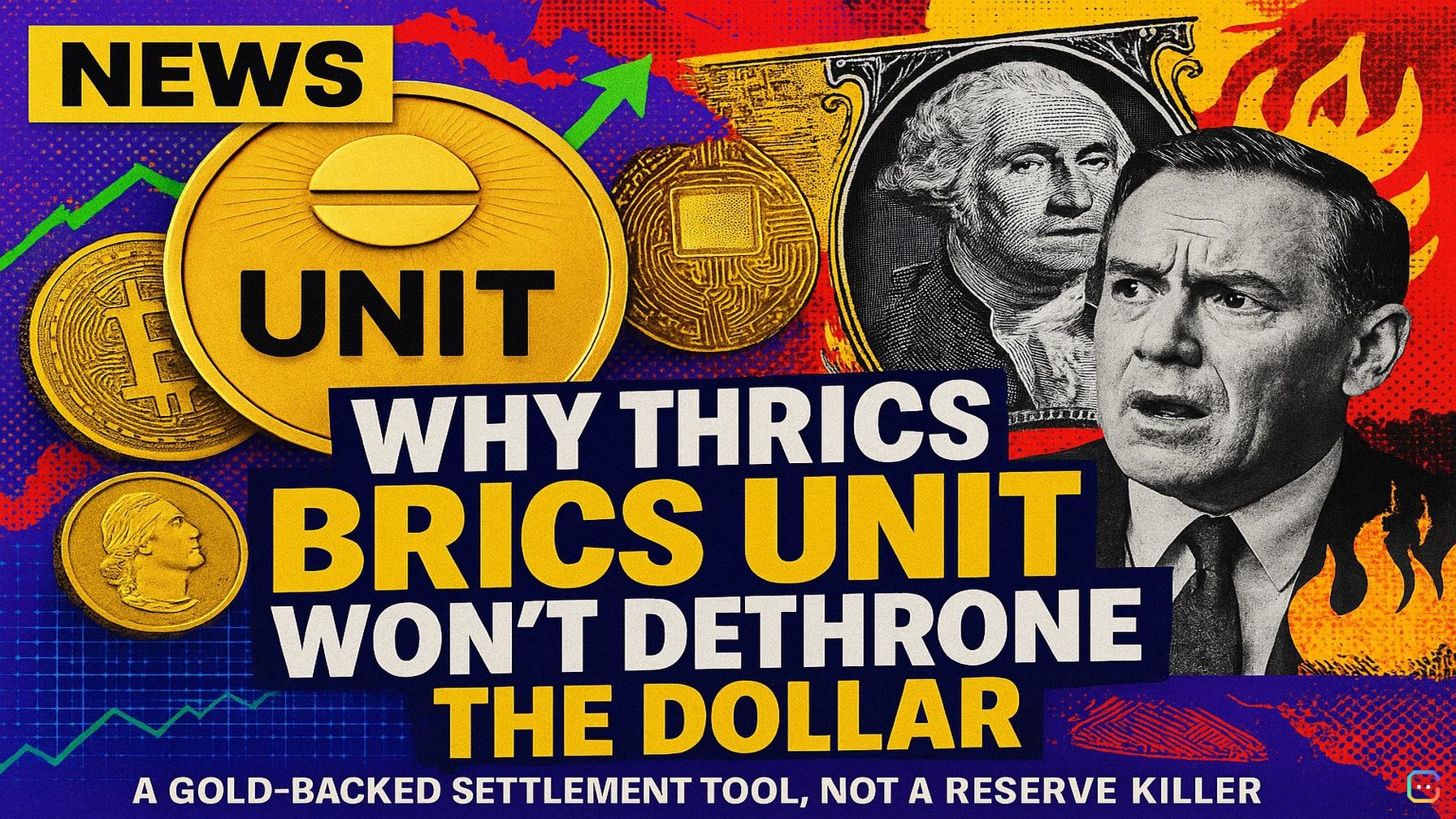
Headline: Why the BRICS UNIT won’t unseat the dollar — for now
Despite high-profile rhetoric and moves toward “de-dollarization,” the newly piloted BRICS UNIT faces steep obstacles before it could challenge the US dollar’s global dominance. Political fractures within BRICS, the sheer depth of US financial markets, and practical limits on adoption mean the UNIT looks more like a targeted settlement tool than a replacement reserve currency.
What the BRICS UNIT actually is
- Piloted on October 31, 2025, the BRICS UNIT is being positioned as a settlement instrument rather than an immediate global reserve. Its current composition: roughly 40% gold and 60% of a basket of BRICS currencies.
- At the July 2025 BRICS Summit, leaders confirmed there would be no joint currency launch in the near term — underscoring that the UNIT is an incremental step, not a headline-grabbing switcheroo.
Political divisions undercut the narrative
- Internal disagreements have surfaced publicly. India has said it isn’t seeking to replace the dollar but wants “workarounds” to protect trade and reduce sanction vulnerability. India’s External Affairs Minister S. Jaishankar told a London event in March 2025: “I don’t think there’s any policy on our part to replace the dollar. The dollar as the reserve currency is the source of global economic stability…”
- Brazil likewise softened calls for a common BRICS currency after political pressure, and other members show uneven enthusiasm. Those fractures limit the bloc’s ability to coordinate a unified alternative monetary system.
The dollar’s structural advantage
- The US dollar’s role remains entrenched: it’s estimated to be used in about 90% of international trade and accounted for roughly 57.3% of official global reserves as of early 2024.
- That dominance isn’t just about policy — it’s backed by the world’s largest, most liquid capital markets and deep institutional trust. Those are capabilities a new BRICS payment system can’t quickly replicate.
External pressure and rhetoric
- US political pressure has also entered the conversation. In early 2025, President Donald Trump warned of tariffs on countries aligning with anti-American BRICS policies and later dismissed BRICS as “dead,” citing his own tariff threats. Such rhetoric increases the geopolitical cost of fully embracing alternatives and complicates adoption for trade partners.
What the UNIT can realistically do
- The BRICS UNIT is likely to change trade in specific corridors and increase settlement alternatives for certain partners — not topple the dollar overnight.
- Its gold component and multi-currency backing point to demand for hybrid, stable settlement instruments. That has implications for payment infrastructure, gold-linked instruments, and potentially tokenized assets — but those are evolutionary shifts rather than systemic replacements.
Bottom line for crypto and markets
- For crypto markets, the UNIT underscores continued global interest in alternatives to dollar-dominated settlement — which could accelerate innovation in tokenized reserves, gold-backed tokens, and cross-border rails. But structural realities — political fragmentation, market depth, liquidity and trust — make a rapid displacement of the dollar unlikely.
- The BRICS UNIT is an important development to watch as a regional and corridor-focused settlement innovation, but the gap between the bloc’s ambition and its practical reach remains substantial.
Read more AI-generated news on: undefined/news