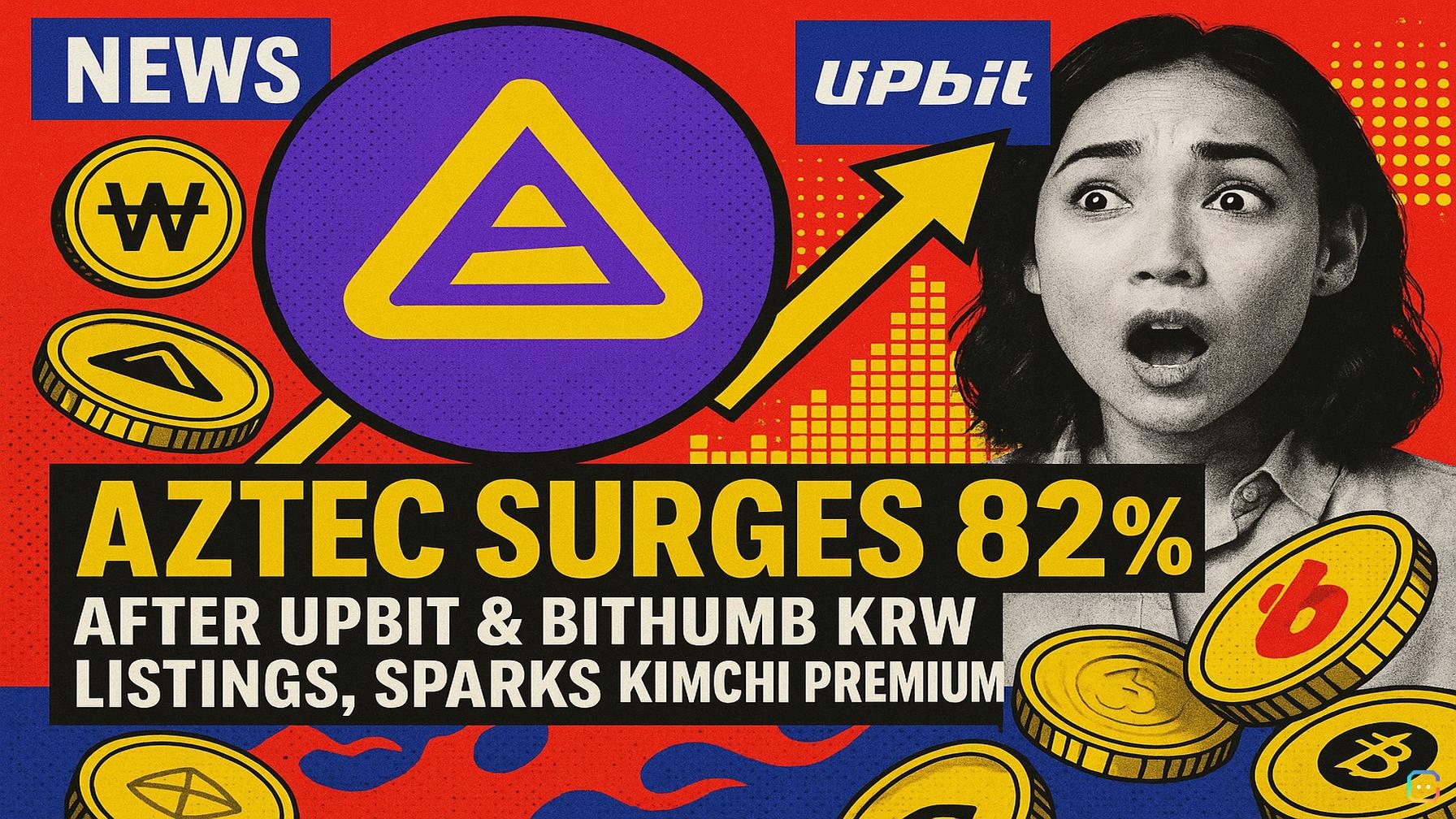
Aztec’s AZTEC token surged after South Korea’s biggest spot exchanges opened won trading pairs, sending prices sharply higher and volumes spiking into the hundreds of millions.
What happened
- AZTEC climbed roughly 82% in 24 hours to about $0.035 after Upbit and Bithumb added KRW pairs, briefly running as high as $0.038 before cooling back to the mid-$0.03s.
- Both exchanges began trading around the same time on Friday in Korea—Upbit listing AZTEC in KRW, BTC and USDT markets, and Bithumb adding an AZTEC/KRW pair. The near-simultaneous listings concentrated buying pressure and amplified the price move.
- Trading volume jumped to the hundreds of millions of dollars during the surge, far exceeding activity seen in the days after AZTEC’s broader exchange rollout.
Why prices moved so quickly
- AZTEC is still early as a transferable token: although it was already present on major global venues, order books were still establishing two-way liquidity. A sudden influx of KRW buyers can overwhelm thin sell-side depth, producing rapid price spikes.
- The initial rush was most pronounced on Korean venues, creating a kimchi premium — a temporary spread where local prices outpace offshore markets due to concentrated fiat demand.
- Arbitrageurs stepped in, buying AZTEC on non-Korean exchanges and selling into KRW demand, which quickly narrowed the gap between Korean and offshore prices as liquidity adjusted.
What AZTEC does
- Aztec is a privacy-focused Ethereum layer-2 that leverages zero-knowledge proofs. The AZTEC token functions as a staking and governance asset tied to the network’s sequencer set; operator docs also specify a minimum stake to run a sequencer.
- The token became broadly transferable after a February token generation event that followed an earlier on-chain sale and a community vote to unlock tokens.
What comes next
- Listings expand who can buy AZTEC but don’t instantly create durable liquidity. With KRW pairs now active on Upbit and Bithumb, the project has gained a new retail audience in Korea—but the market will need to absorb fresh supply and outlast the first wave of forced buyers and momentum traders before prices stabilize.
Bottom line: Dual listings on Korea’s top exchanges delivered a rapid repricing for AZTEC—supercharging volumes and briefly opening a kimchi premium—while arbitrage and incoming liquidity began to bring markets back into alignment.
Read more AI-generated news on: undefined/news