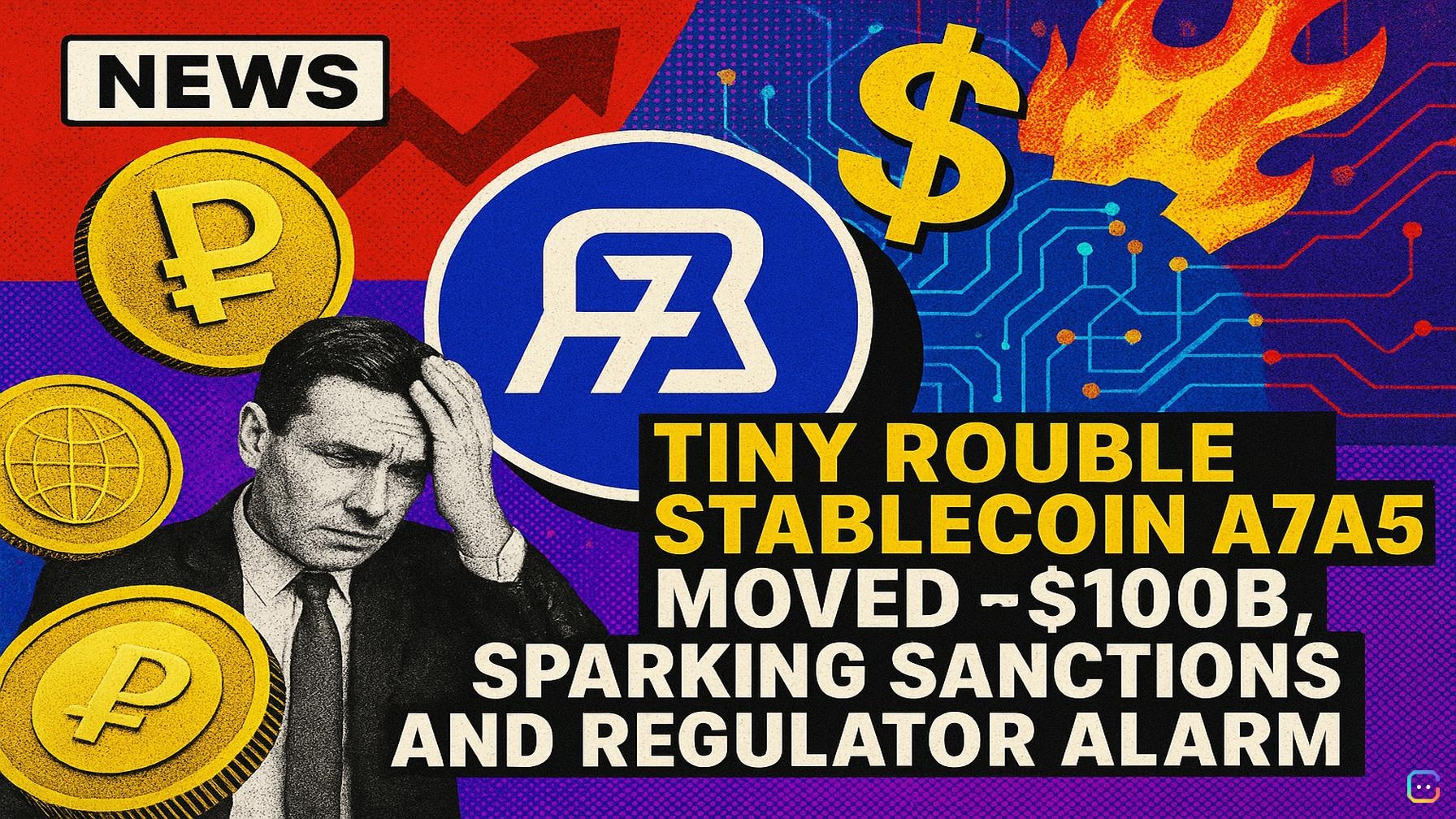
Headline: Tiny Rouble-Linked Stablecoin Moves an Estimated $100B — and Raises Red Flags for Regulators
A little-known stablecoin has quietly become a major transfer conduit, moving the equivalent of roughly $100 billion since it began operating at scale, according to blockchain analysis firm Elliptic. Launched as a rouble-linked token called A7A5, the coin rapidly became a favored settlement tool for firms that could no longer rely on conventional banking channels.
What the analysis found
- Rapid growth: A7A5’s transaction volumes climbed quickly after launch, with daily flows spiking into the billions and cumulative transfers hitting major milestones that together total about $100 billion.
- Rouble linkage and private ties: The token was structured to reflect rouble deposits and was connected to a small group of private entities embedded in Russia’s financial network.
- Concentrated on a few touchpoints: Most transfers passed through a handful of exchanges and on-chain corridors that made cross-border movement possible without normal banking rails.
- Functioned as a bridge: In practice, A7A5 was often used as an on-ramp into other stablecoins and broader crypto markets — keeping trade and settlements moving even when formal channels were closed to certain actors.
Regulatory and enforcement response
Authorities and analysts view the token’s flows as a potential means to evade sanctions. Reporting links A7A5 to a payments group and banking partners that had already attracted Western scrutiny; some individuals and firms associated with the project were later sanctioned by the US and UK. Regulators responded by blacklisting addresses and platforms and stepping up enforcement against named entities in the network.
Evasion tactics and market effects
Elliptic’s report highlights several features that complicated tracking: certain design choices hindered monitoring, and tokens were, at times, reissued into new wallets to obscure transaction trails. Markets reacted — A7A5’s market capitalization surged and exchanges processing the token saw sharply higher volumes. The timing of activity (concentrated on weekdays and business hours) suggested the flows were largely corporate or institutional, not retail-driven.
Why it matters
A7A5’s rise demonstrates how a single token can shuttle significant value across borders outside traditional finance, but it also underscores the regulatory risks that follow. Authorities’ countermeasures — sanctions, blacklisting, and enforcement — show those who rely on such channels can quickly draw legal and financial consequences. The episode has shifted how observers outside the region view crypto’s role as a payments and settlement tool.
Featured image: Pixabay; chart: TradingView.
Read more AI-generated news on: undefined/news