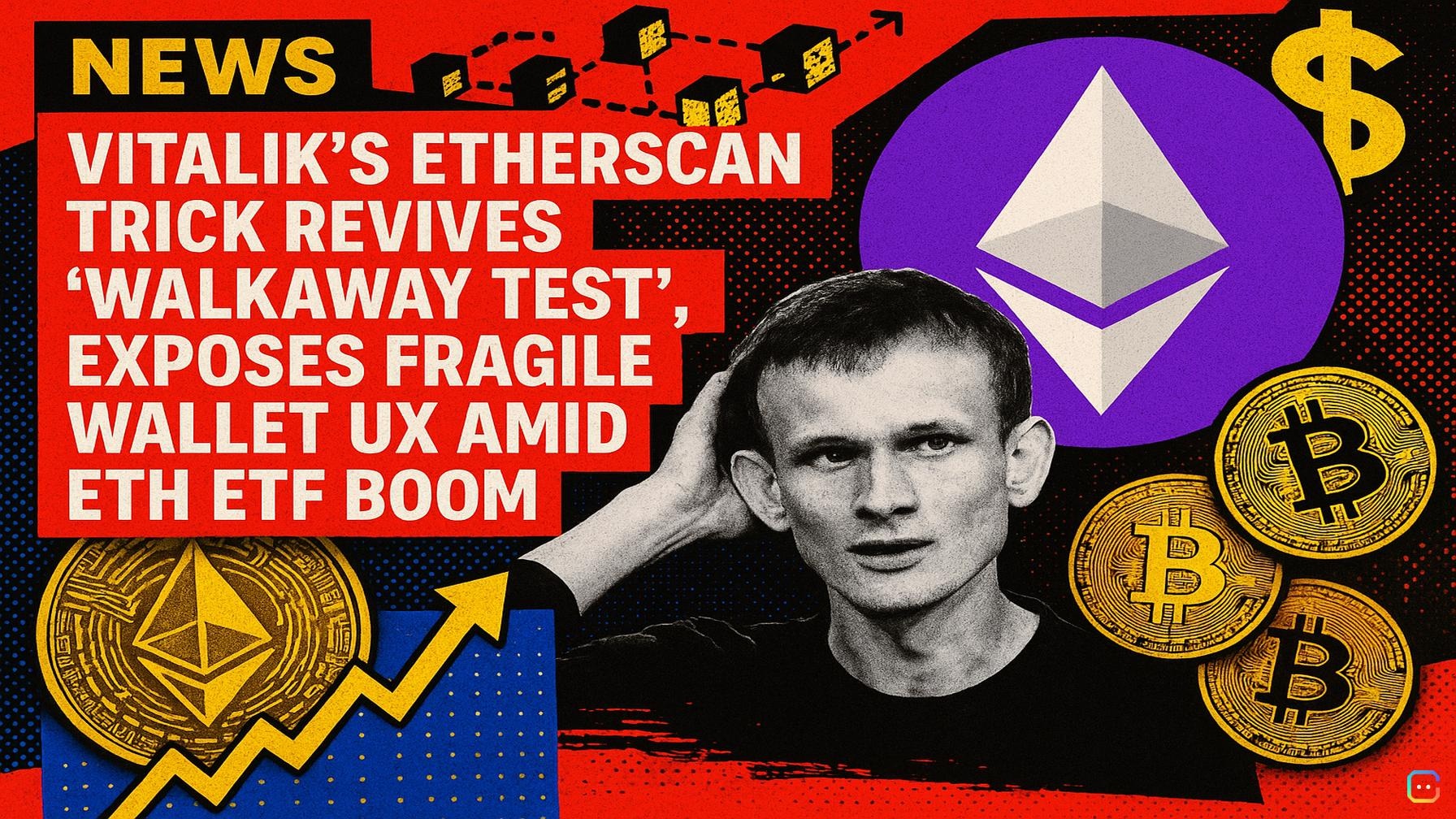
Headline: Vitalik’s simple multisig trick revives the “walkaway test,” exposing fragile Ethereum wallet UX as spot ETH ETFs reshape flows
Ethereum co‑founder Vitalik Buterin sparked a fresh debate about wallet usability this week after a routine multisig check laid bare a persistent weakness in many crypto wallets: they don’t pass the so‑called “walkaway test.”
What happened
- Vitalik needed to check which addresses were signers on a multisig while on his phone, but didn’t have the Safe app installed. Rather than reinstall the wallet, he turned to Etherscan’s “read contract” feature and pulled the signer list directly from the contract.
- He framed that workaround as a proof point for open infrastructure: if your app is open source and a front‑end disappears, neutral tools such as block explorers should still let users access core functionality. “These are the kinds of additional UX benefits you get if your wallet or application is open source and passes the walkaway test,” he wrote.
Why it matters
- The walkaway test is a blunt measure of resilience: can users still access essential features if a particular front‑end or app is gone? Vitalik’s example shows many products remain fragile—dependent on a single client UX rather than interoperable, open tooling.
- That fragility is becoming costlier as structural market shifts—most notably the arrival of U.S. spot ETH ETFs—concentrate liquidity and make design flaws more consequential. If a product can’t withstand a front‑end outage or poor UX, markets will price that risk.
Privacy trade‑offs and proposed fixes
- Vitalik warned the read‑contract approach can’t remain a long‑term solution because of privacy concerns. He floated an idea for a “viewing key”—an extended version of an address that contains extra private info and could be read client‑side by block explorers via URL hash fields.
- He acknowledged the trade‑off: encouraging users to paste any kind of secret into URLs or webpages is risky. Ultimately, he said, more functionality needs to be handled directly by wallets rather than through insecure workarounds.
Developer responses and experiments
- Community replies pointed to open‑source tools and new approaches: swissknifexyz was highlighted as an alternative, while Microchain Labs pointed to “microchain zk signers,” which replace explicit multisig signatures with a zk proof of authorization and store only a state root on‑chain.
- These experiments aim to balance usability, privacy and on‑chain minimalism—recognizing that wallet UX and wallet architecture must evolve as usage and market stakes grow.
Market backdrop: ETFs and liquidity shifts
- The timing of this UX debate is notable. Early weeks of spot ETH ETF trading saw inflows that concentrated liquidity at the front of the curve, echoing patterns once associated with Bitcoin products.
- Analysts warn persistent ETF demand could absorb a meaningful slice of circulating ETH supply; ETF issuers raced to scale, with ETH ETF assets approaching the $1 billion mark in their opening phase.
Prices and volumes (as reported)
- Bitcoin (BTC) hovered around $88,235, with a 24‑hour high near $90,476 and a low near $87,549, on roughly $32.8 billion in volume.
- Ethereum (ETH) was trading close to $2,953 with about $23.4 billion in 24‑hour turnover; spot quotes were reported clustered in the $4,500–$4,600 band on major exchanges earlier in the week.
- Solana (SOL) traded near $192 with deep liquidity across top venues.
Bottom line
Vitalik’s simple Etherscan trick is more than a Twitter anecdote—it's a reminder that open infrastructure and resilient UX are not fringe concerns. As ETFs and concentrated flows raise the economic stakes, wallets and products that fail the walkaway test face real market penalties. The industry is experimenting with open tools, zk approaches and viewing keys—but balancing usability, privacy and security remains the hard problem to solve.
Read more AI-generated news on: undefined/news