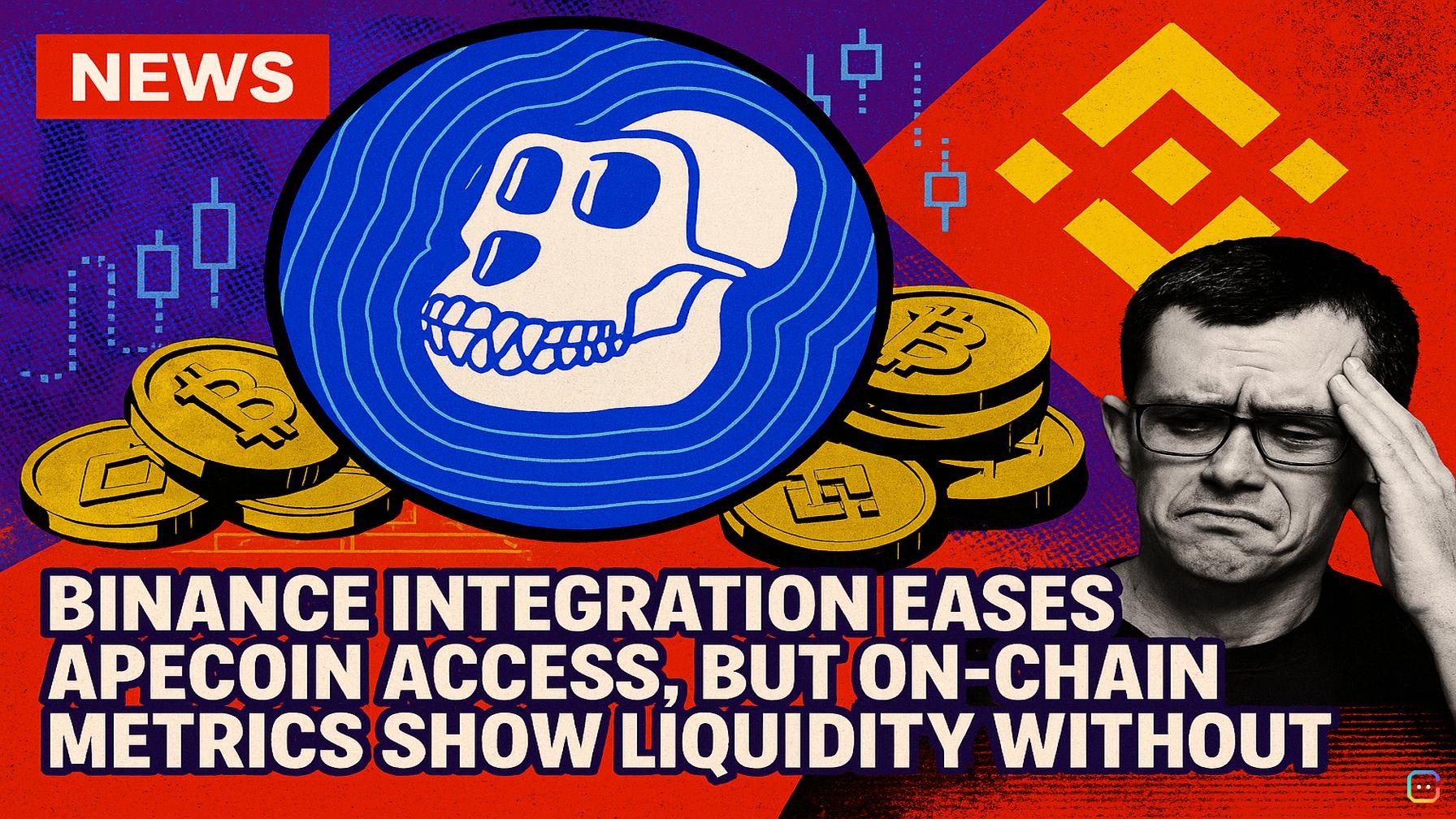
ApeChain’s jump to “exchange‑grade” infrastructure is no longer theoretical — Binance’s expanded native integrations have significantly lowered the friction for users to access ApeCoin (APE). But while access is improving, on‑chain metrics suggest the token is still struggling to turn that liquidity into sustained usage beyond its NFT roots.
Key on‑chain signals: stable but shallow
- Daily Active Addresses remain range‑bound around 10,100–10,700, and daily transactions sit near 71,400, keeping throughput under 1 TPS. (Source: DefiLlama)
- Daily network fees are tiny — roughly $145 — pointing to limited economic activity despite steady transaction counts.
- New address creation is slow, roughly 343 per day at press time, indicating weak organic inflow.
Growth that fizzled
ApeChain saw a burst of activity at launch in late 2024: active addresses briefly topped 50,000 and TVL peaked near $34 million. But that momentum did not hold. By 2025 TVL had dropped more than 80% to about $4.5–$5.7 million, and current DEX volumes average a little over $50,000 per day. New holder growth also decelerated — from roughly 54,000 late‑2024 to about 15,000 in Q2 2025.
Exchange flows point to reactionary liquidity, not conviction
Exchange activity around the October 2024 launch was marked by sharp inflows and outflows as APE rallied close to 100%, consistent with short‑term positioning rather than long‑term accumulation (Source: Santiment). Whale behavior tells a similar story: transactions above $100,000 spiked during the launch window then cooled, and wallets holding 1–10 million APE slipped from 175 to 166 — a sign of distribution rather than strategic buildup. Into early 2026, exchange flows remain episodic and non‑directional, and whales largely sit on the sidelines.
Regulatory overhang largely cleared, but adoption hasn’t followed
Regulatory risk that once clouded ApeCoin’s narrative has diminished. The SEC’s investigation into Yuga Labs (opened October 2022) concluded in March 2025 without enforcement, and a federal court ruled in October 2025 that ApeCoin and BAYC NFTs failed the Howey Test, removing a key structural legal concern. However, by the time clarity arrived, on‑chain activity had already stalled and TVL had collapsed.
What comes next
Binance’s integration reframes the story — it reduces access friction and signals renewed institutional confidence after the exchange resolved its own regulatory issues. But access alone won’t revive ApeChain. For durable recovery, the ecosystem needs:
- non‑NFT dApps that drive real utility and on‑chain demand;
- deeper, conviction‑driven liquidity rather than episodic inflows;
- renewed activity across user cohorts (retail and whales).
Bottom line
ApeChain is now easier to access and legally clearer, but the data show a project still searching for sustained product‑market fit beyond NFT liquidity. On‑chain stability today masks structural weakness: low fees, falling TVL, muted new‑holder inflows and sidelined whales point to liquidity without conviction. The next meaningful test will be whether new liquidity from exchanges like Binance translates into long‑term on‑chain usage and ecosystem growth.
Disclaimer: AMBCrypto's content is informational and not investment advice. Trading cryptocurrencies carries high risk; readers should do their own research. © 2026 AMBCrypto
Read more AI-generated news on: undefined/news