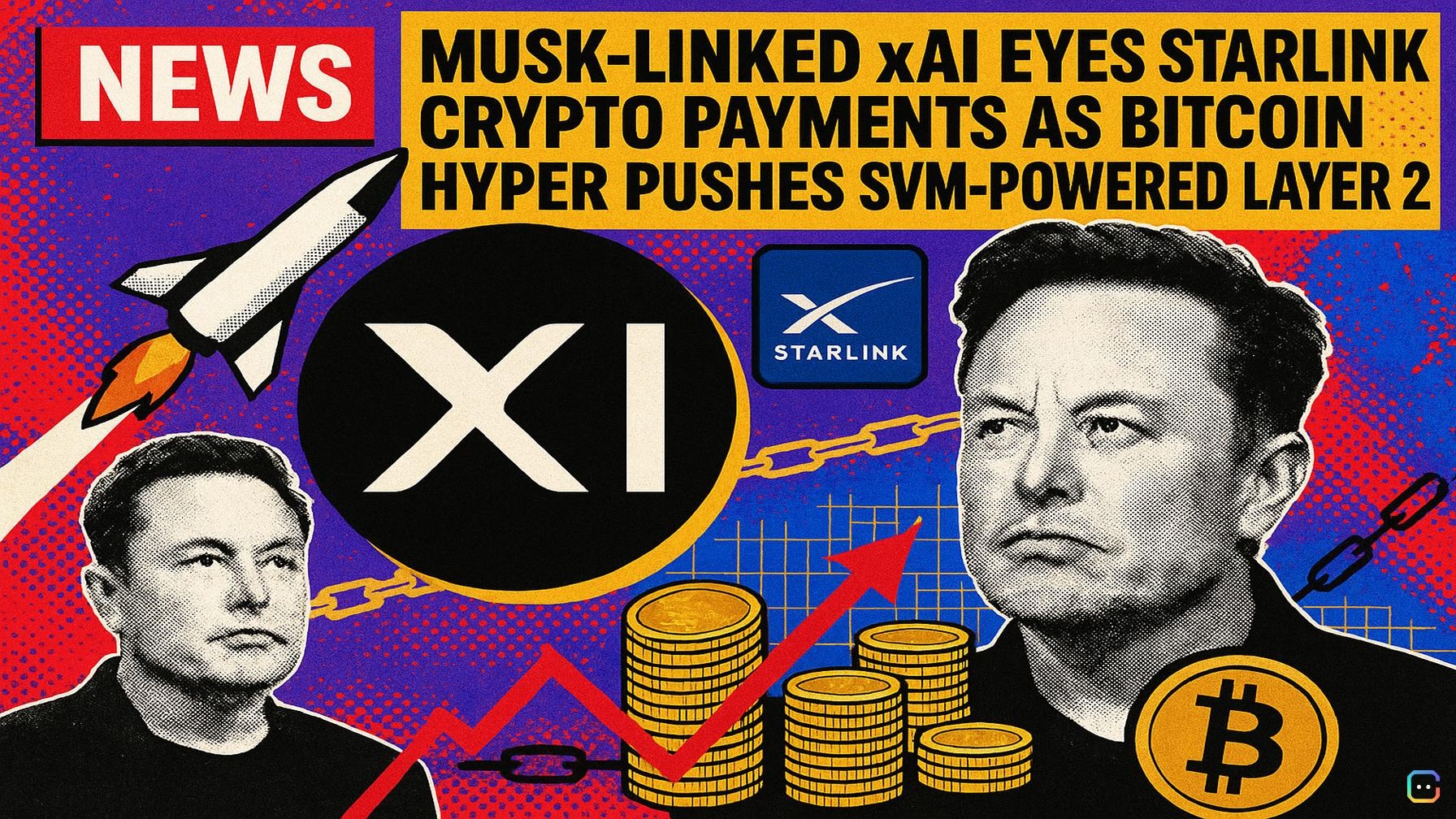
Headline: Musk-linked xAI spurs satellite-payments fever — while Bitcoin Hyper pushes “programmable Bitcoin” with SVM-powered Layer 2
The intersection of aerospace tech and crypto is drawing fresh attention. Recent reports say xAI — Elon Musk’s AI venture — is actively recruiting cryptography specialists to develop payment infrastructure that could integrate with SpaceX’s Starlink network. If accurate, that would mark a notable turn: satellite internet services exploring native blockchain settlements instead of relying solely on credit cards and fiat rails.
Why this matters
Putting decentralized payments directly on a satellite mesh could reduce latency and friction for global micro‑payments, remittances and machine-to-machine billing in areas with limited terrestrial connectivity. For infrastructure investors, the story is clear: projects that combine high-throughput networks with proven value rails are becoming priority bets.
But while headlines fixate on Musk-adjacent moves, an on-chain rotation is unfolding that could be equally consequential — one that pivots Bitcoin’s role from “digital gold” toward a more programmable, yield-bearing economy.
Enter Bitcoin Hyper ($HYPER)
A prominent protocol attracting trader attention is Bitcoin Hyper. The project proposes marrying Bitcoin’s security model with the Solana Virtual Machine (SVM) to provide a high-speed execution layer while using Bitcoin Layer 1 for final settlement. In practice, that means developers would write smart contracts in Rust (the same language used across much of Solana’s DeFi ecosystem) and execute them on a real-time Layer 2 that claims to deliver fast confirmation times unlike Bitcoin’s typical 10‑minute blocks.
How it’s designed to work (project claims)
- Modular architecture: heavy computation and execution happen off-chain/on a dedicated SVM runtime, with Bitcoin L1 reserved for ultimate settlement and security.
- Canonical Bridge: a decentralized bridge mechanism intended to facilitate seamless transfers of BTC into wrapped BTC on the Layer 2, supporting higher-speed payments without conventional bridge frictions.
- Developer tooling: Rust + SVM compatibility aims to lower the barrier for building DeFi, NFT, gaming and payment dApps that settle on Bitcoin.
The potential play: unlocking idle capital
Proponents frame this as more than faster transactions. With roughly $1 trillion in Bitcoin capital considered “dormant” by some estimates, Layer 2s that can safely tap into that liquidity could expand yield-bearing activity on the world’s most secure blockchain. Bitcoin Hyper positions itself as one such contender — arguing it can capture liquidity that older Bitcoin Layer 2 approaches (like Stacks or Lightning) have struggled to fully monetize.
Presale, token mechanics and retail focus
Bitcoin Hyper’s presale has reportedly passed a $31.2 million milestone. Tokens are being distributed at a presale price of $0.013675, a low per-token entry point that the project says is intended to broaden retail participation. Notable presale features being promoted include:
- Immediate staking for presale participants, allowing early buyers to earn APY rewards prior to mainnet launch.
- A short, 7-day vesting period for presale tokens aimed at limiting large immediate sell-offs.
- An emphasis on UX parity with fintech apps to attract retail users who’ve previously been priced or technically excluded from on-chain DeFi.
What to watch and the risks
- Claims vs. reality: Many of the technical and economic benefits above are framed by the project; timelines, security audits, bridge economics and mainnet behavior will ultimately determine whether the claims hold up in practice.
- Bridge risk: Even “canonical” or decentralized bridges have historically been a focus of security scrutiny. How the project secures cross-chain BTC flows will be critical.
- Tokenomics & market risk: Presales, vesting schedules, and reward mechanics can influence price action and risk for smaller holders despite anti-dump measures.
- Competition: Other Bitcoin-centric scaling approaches (Lightning, Stacks, sidechains) and cross-chain L2s will compete for developer and user attention.
Bottom line
Reports of xAI exploring blockchain-enabled payment rails for Starlink underscore a broader trend: infrastructure plays that combine speed, reach and settlement security are now in demand. On-chain, projects like Bitcoin Hyper are betting that bringing SVM-style execution to Bitcoin — with developer-friendly Rust tooling and retail-focused token economics — can turn Bitcoin into a much more active programmable economy. Whether that vision proves durable will depend on technical execution, security track record and real-world adoption.
This article is informational and not investment advice. Cryptocurrency projects and presales carry substantial risk. Always do your own research before investing.
Read more AI-generated news on: undefined/news