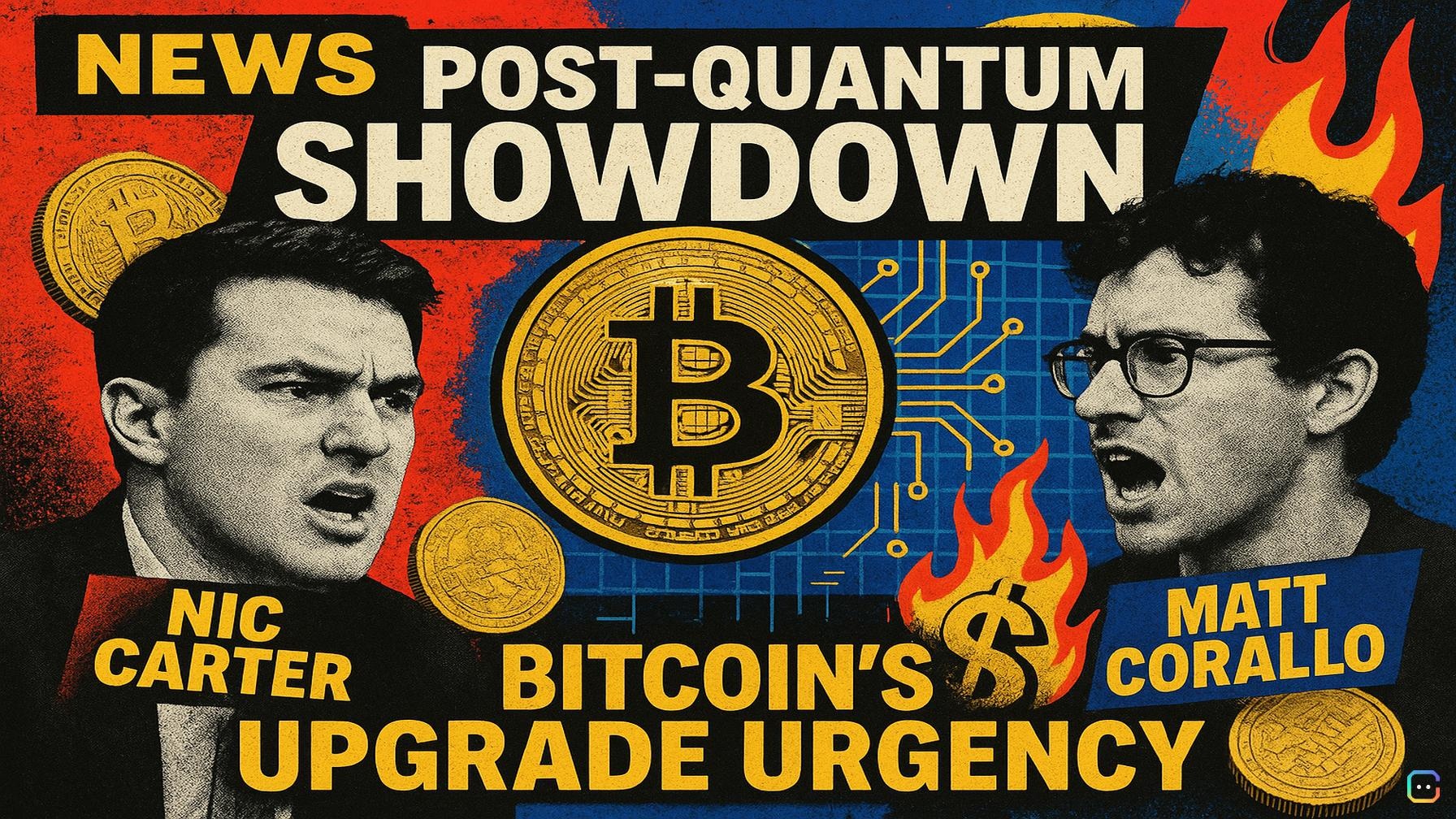
Quantum fears reignited on Bitcoin X Tuesday as Castle Island’s Nic Carter and veteran developer Matt Corallo clashed over whether post-quantum security is an urgent protocol priority or a speculative distraction — a debate that again highlights a familiar Bitcoin fault line: decentralized development culture versus the market’s demand for visible coordination and timelines.
How the dust-up started
The exchange began when Kellan Grenier urged a “Tier 1 custodian” to partner with Castle Island to “spin up a Quantum Resistance BTC dev tiger team,” warning of a “building wall of worry” that needs a reputable response. Corallo pushed back, saying prominent Bitcoin developers “have been hard at work on QC for a while,” and rejecting the idea the community is asleep at the wheel.
Carter: scattered work isn’t enough
Carter countered forcefully, arguing that individual research efforts fall short of the real bottleneck: social consensus among the relatively small group of developers and institutions who actually shepherd upgrades into shipped, adopted changes. He noted Bitcoin’s slow upgrade cadence — the last two major upgrades took “7–8 years from first proposal to meaningful adoption on chain” — and pointed out that the only named Bitcoin Improvement Proposal he cited as “pertaining to quantum,” BIP360, “has not been co-signed by any major dev,” calling it “only a first of many, many steps.”
His core point: you can’t wait until cryptographically relevant quantum computers (CRQCs) are demonstrably real. “You need to act with a 5–10 year lead time,” Carter wrote, warning the migration burden is asymmetric and slow. If quantum-capable machines threaten existing signatures, custodians, exchanges and individual holders could be forced to rotate keys across the entire network within a finite window — or risk catastrophic loss. He repeatedly linked to essays arguing quantum timelines are accelerating and urged proactive action.
Corallo: work is happening, tone is alarmist
Corallo rejected what he called alarmist framing and disputed Carter’s characterization of post-quantum work as “minuscule” or “scattered.” He said the top Bitcoin developer institutions — Blockstream Research and Chaincode — “each have several people working hard on what a post-quantum Bitcoin upgrade should look like.” Corallo added he hasn’t seen influential developers dismiss quantum concerns as mere investor-driven hype, and said research into new cryptographic primitives is underway even if it’s not being marketed on conference stages.
A rerun of the Taproot debate
The back-and-forth briefly revisited 2021 debates around Taproot. Carter said similar quantum concerns were raised then and downplayed; Corallo replied that the earlier discussion dismissed only the narrower claim that Taproot materially worsened the problem, not the existence of any long-term quantum risk.
Governance, transparency and accountability
Carter also criticized Bitcoin’s informal governance and culture of obscured influence, arguing turnover among core devs and deliberate opacity about who counts as a core developer make accountability hard when stakes are existential. Corallo’s answer: research and engineering often happen out of the public eye, and that is what it looks like “when devs take a problem seriously.”
Technical flashpoint: does everyone need to migrate?
A key technical disagreement emerged over whether post-quantum safety requires essentially every user to migrate their funds. Carter said migration would be “a lot more complicated than a simple patch” because “every user individually” would need to move funds in a finite period. Corallo disputed that, asserting that wallets derived from a seed phrase are “actually fine (assuming unsafe spend paths are disabled),” implying not every user must migrate immediately.
Outside voices weigh in
Christine D. Kim, founder of Protocol Watch, argued that Carter’s calls for councils and roadmaps overlook Bitcoin’s structure. “Bitcoin isn’t a company,” she wrote, and argued post-quantum topics already play out via the usual channels — mailing lists, IRC meetings, developer delves — while more centralized PR-style campaigns can look like marketing rather than genuine decentralised consensus-building.
Market context
At press time, BTC traded at $76,268.
Bottom line
The exchange lays bare two contrasting expectations inside Bitcoin: some market participants want visible, rapid, coordinated action to address a looming technical risk; many developers and institutions say serious work is underway, even if it’s slower and less public. The disagreement isn’t only about timelines or math — it’s about how a decentralized project should marshal collective action for an upgrade that could require years of preparation and broad social coordination.
Read more AI-generated news on: undefined/news