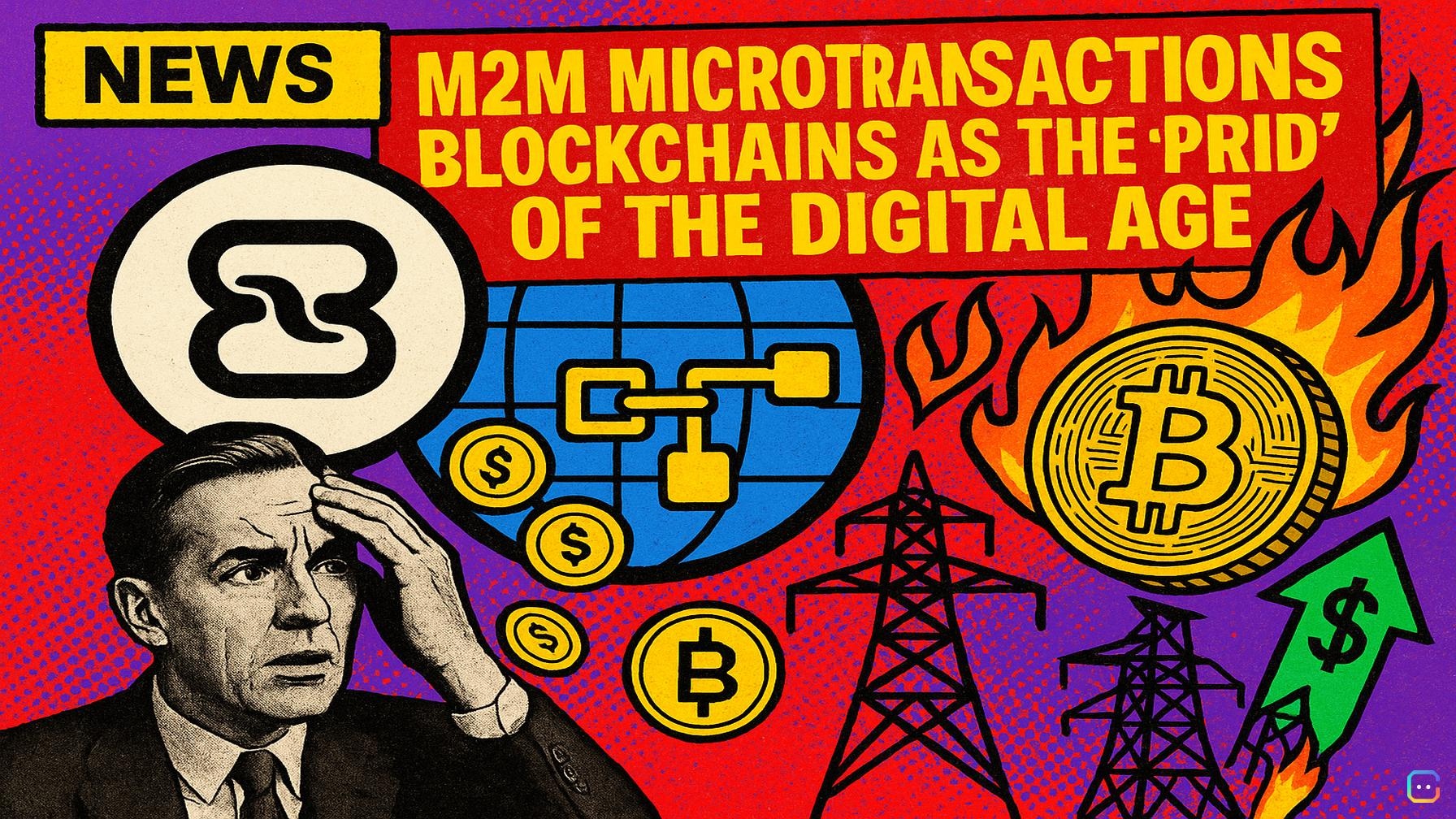
Why machine-to-machine payments could be the electricity of the digital age
Imagine a world where devices don’t just exchange data — they exchange value. Sensors sell live data streams by the second. Factories buy power in real time based on traffic on the grid. Supply chains reorder parts, schedule transport, pay customs and reroute shipments without a single human clicking “approve.” That world isn’t science fiction; it’s the machine economy enabled by continuous machine-to-machine (M2M) payments and microtransactions.
Why small, continuous payments matter
Today’s payments look a lot like pre-electric factories: episodic, manually mediated, and bundled into invoices, settlements and billing cycles. That model works for people but breaks the pace of machines. Machines need to transact at machine speed — billions of tiny transfers, often worth only cents or fractions of cents, executed autonomously and continuously. Only then do devices gain real economic agency: making trade-offs, coordinating with peers, and purchasing resources on demand.
Think of electricity: before reliable power distribution, factories were stuck with local steam engines and limited scale. Once electricity became standardized and ubiquitous, it stopped being a “feature” and became the substrate that enabled mass production, automation and whole new industries. Microtransactions and M2M payments promise an analogous transformation for digital ecosystems.
Blockchains as the new power grid
If continuous M2M payments are the new “electricity,” then blockchains are the rails — the power grid — that will carry those payments. Modern banking and legacy payment rails are simply not built for micropayments at scale: high fees, settlement delays and institutional frictions make per-second economic interactions impractical. Blockchain and crypto infrastructure change that calculus, enabling near-instant, near-zero-cost value transfers globally. Stablecoins and fast settlement rails are the plumbing that can make microtransactions economically feasible.
But building this future is less about one isolated app or token and more about building resilient transmission. Early electrification focused heavily on generators, but the real revolution came from building transmission networks that delivered cheap, predictable power everywhere. The lesson for M2M payments is the same: the underlying blockchain rails — low fees, ultra-low latency, predictable performance — matter far more than any single payment protocol (even protocols like Coinbase’s x402).
Neutrality, interoperability and decentralization
For M2M payments to function as pervasive infrastructure, the rails must be neutral and interoperable. Machines can’t negotiate bespoke payment systems any more than they can negotiate voltage standards. They need a common, trustable medium that spans vendors, jurisdictions and devices. That requirement points toward public, decentralized blockchains as a natural fit: they can provide neutral, widely accessible rails that minimize vendor lock-in and regulatory fragmentation.
Low friction payments built on neutral rails would become the coordination layer for autonomous systems in the same way electricity is the coordination layer for mechanical power. Once that layer is in place, innovation can move from solving payment frictions to inventing new machine-driven industries.
What this could unlock
The possibilities are broad and concrete:
- Autonomous supply chains that continuously reorder materials, book transport and pay fees without human intervention.
- AI services billed by milliseconds of inference, enabling fine-grained pricing models and pay-as-you-go compute marketplaces.
- Global data markets where sensors and satellites monetize data streams on a per-byte or per-second basis.
- Infrastructure that dynamically prices access — charging stations, roads or parking spaces that bill vehicles in real time as they use resources.
A parallel from electricity’s business model is instructive: paying per kilowatt-hour allowed businesses to scale without renegotiating contracts or investing in fixed capacity. M2M payments promise the same economic flexibility for software and device ecosystems.
The path forward
The machine economy won’t arrive because a single startup invents a clever protocol. It will arrive when payments become ambient — continuous, autonomous and invisible — and when the rails underneath are robust, cheap and neutral. That puts the onus on builders to prioritize transmission: blockchains designed for near-zero fees, low latency and predictable throughput, and governance models that support interoperability and neutrality across borders.
When devices can pay each other as easily as they consume power, we won’t just add a feature to existing systems. We’ll unlock new business models and entire industries that are impossible under today’s payment constraints. In that sense, M2M payments are not merely a component of the future — they are its electricity.
Read more AI-generated news on: undefined/news