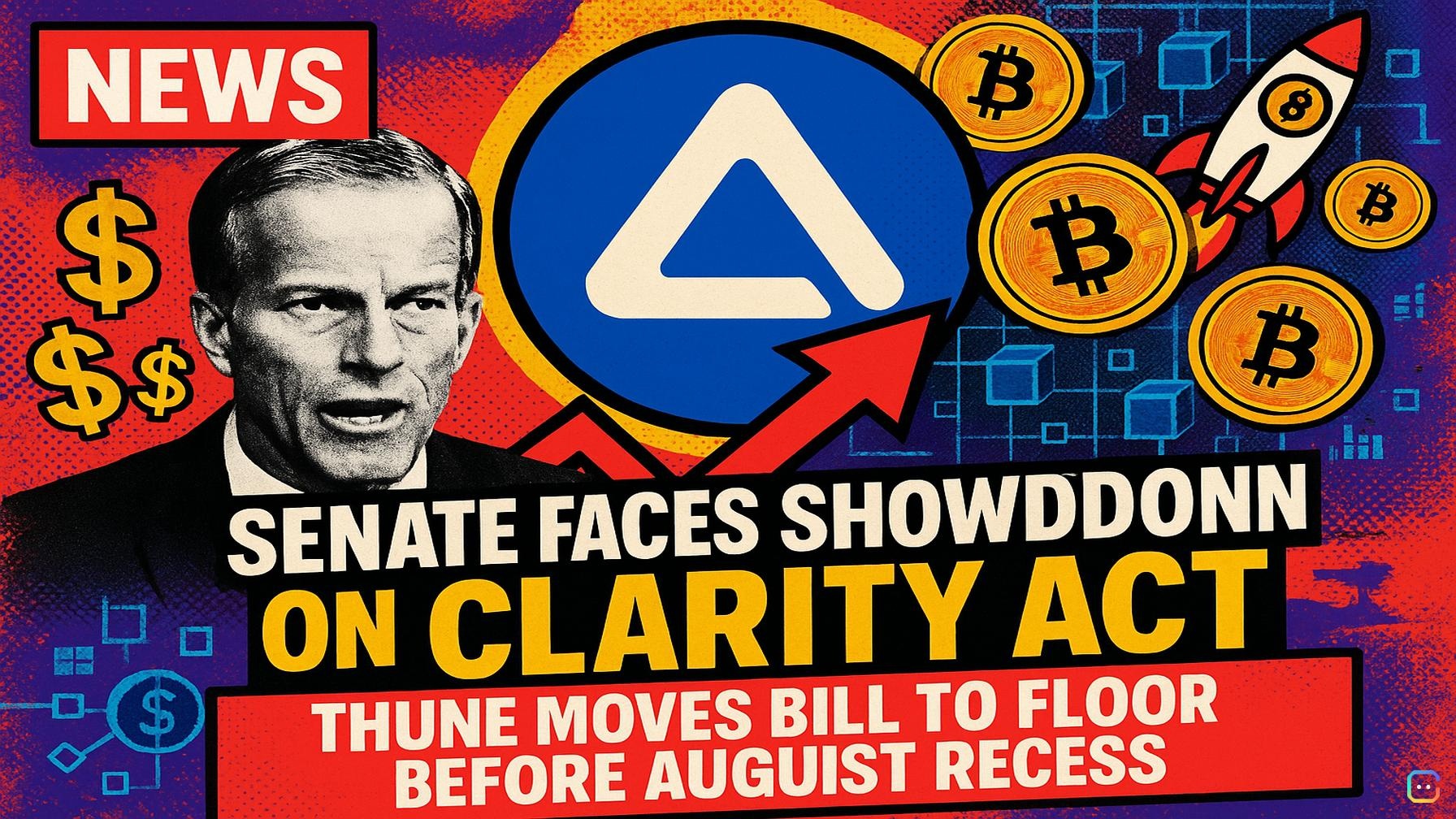
Senate Majority Leader John Thune is maneuvering to bring the CLARITY Act to the Senate floor before lawmakers break for August, a move that could force senators to publicly stake out positions on a high-stakes crypto bill even if it still can’t clear a filibuster.
“I would like to at least get Clarity started. We’ll see where the votes are,” Thune told Punchbowl News, signaling an intent to begin formal consideration of H.R. 3633 — the Digital Asset Market Clarity Act — while the Senate remains in session through Aug. 7.
What’s at stake
- The bill, branded by supporters as a much-needed market-structure fix, would aim to sharpen boundaries between the SEC and CFTC, set rules for digital commodities and cover certain noncustodial blockchain developers. For U.S. crypto firms and investors, passage would resolve lingering questions about token classification, exchange oversight and federal jurisdiction that currently depend on agency guidance.
- If the bill fails, those questions would remain subject to agency rulemaking and the next administration’s priorities — a far less durable outcome than statutory law.
Legislative status and timeline
- The House passed the CLARITY Act in July 2025 with bipartisan support. The Senate Banking Committee advanced its version in May 2026 on a 15-9 vote.
- Senator Cynthia Lummis released an updated hybrid text on July 22 that merges proposals approved by the Senate Banking and Agriculture committees. The Senate’s short window before recess limits time for amendment votes and debate.
The math and political hurdles
- Republicans hold 53 Senate seats. To overcome a filibuster, the bill needs roughly 60 votes, meaning it requires support from around seven Democrats assuming full Republican backing.
- A bloc of seven Democrats led by Maryland’s Angela Alsobrooks has objected, arguing the current draft lacks sufficient consumer protections, stronger anti-illicit-finance safeguards and tougher ethics rules for senior officials. An unresolved ethics package — and worry about losing White House backing — complicates negotiations, Lummis and Senator Thom Tillis have acknowledged.
Key policy flashpoints
- The revised bill contains a temporary restriction barring federal officials, including the president and vice president, from issuing or sponsoring digital assets; that restriction would expire in 2029.
- Ethics rules for senior officials and protections around stablecoin incentives remain sticking points for reluctant Democrats.
Support and opposition dynamics
- Law-enforcement concerns have softened: the National Fraternal Order of Police — representing more than 382,000 members — reversed an earlier opposition and now endorses the updated bill, saying it preserves police and prosecutor authority to investigate digital-asset crimes and includes safeguards on kiosk fraud, AML and sanctions obligations.
- Industry heavyweights including Ripple CEO Brad Garlinghouse, Coinbase CEO Brian Armstrong, Fidelity and various trade groups have pushed for passage. Goldman Sachs CEO David Solomon has also expressed support for market-structure legislation, even amid broader banking-sector worries about stablecoin yields.
- Still, the police union’s backing clears one hurdle but doesn’t resolve the larger disputes over consumer protections, ethics and stablecoin reward structures.
Why Thune’s planned floor vote matters
- Holding a floor vote would create a public record and make each senator’s position visible — a politically powerful outcome as the midterms approach. It could increase pressure on undecided Democrats to pick a side.
- But if Thune can’t marshal the ~60 votes, the bill will be stalled and negotiations risk losing momentum heading into a contentious midterm cycle with less Senate floor time.
Market odds and outlook
- Prediction markets reflect the uncertainty: Polymarket places the CLARITY Act’s chances in 2026 at about 33%, and Galaxy Research has put its estimate at roughly 30%.
- Thune’s push for a vote could either accelerate bargaining toward a deal or push the measure into a longer, more uncertain fight that spills into the midterms.
Bottom line: The push to start debate may not be enough to clear a filibuster, but it will crystallize where senators stand — and that political clarity, for better or worse, will shape how quickly the U.S. crypto rulebook gets written.
Read more AI-generated news on: undefined/news