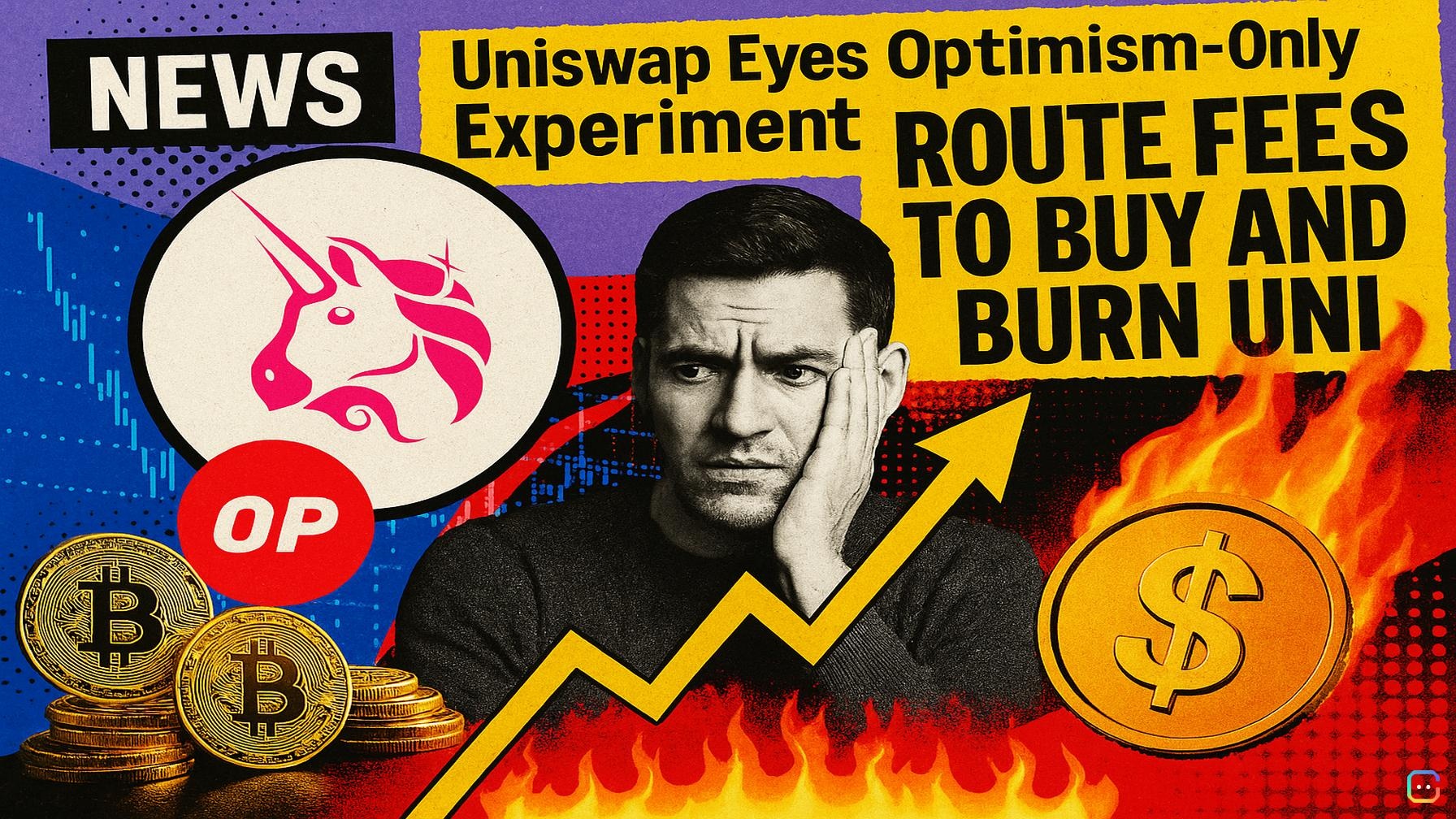
Uniswap governance is weighing a focused experiment: route protocol fees from selected Optimism pools to buy and burn UNI. If approved, the move would create a more direct, deployment-level link between trading activity and token supply — but only on Optimism, not across all Uniswap deployments.
Why the Optimism-only approach matters
- This is deliberately narrow. Rather than rewriting fees and token mechanics protocol-wide, governance would test the model on one deployment. That lets the DAO examine mechanics, economics and edge cases in a contained environment.
- Different chains behave differently. Fees, liquidity, user behavior and incentives vary across Ethereum mainnet, Optimism, Arbitrum, Base, Polygon and others. Optimism offers a manageable laboratory for a chain-specific trial.
What’s at stake
UNI holders have long debated how Uniswap’s huge trading volume should benefit the token. A fee-routing-and-burn mechanism makes that connection visible: fees routed to buybacks and burns mechanically reduce supply, a straightforward narrative markets often reward. But the real impact depends on the size, consistency and transparency of the fee stream.
Key governance questions
- Which Optimism pools would be included?
- What share of fee revenue would be routed to burns?
- How will buybacks and burns be executed and audited?
- What are the legal, regulatory and governance implications?
- Could the model be extended to other deployments if it succeeds?
Why implementation and scale matter
A token burn is easy to explain — fewer tokens, potentially higher value — but symbolism isn’t the same as substance. Small, intermittent burns from a handful of pools may be economically modest. A larger program could shift supply dynamics, but also raises tougher governance, liquidity and regulatory questions. The Optimism scope helps keep risks limited while testing real-world effects.
What to watch
UNI holders should focus on operational details and transparency, not just headlines. If fees are routed transparently and burns are reliably executed, the proposal could gain traction. If the financial impact is negligible or the process introduces complexity, governance may opt for caution.
Bigger picture
Uniswap enjoys deep product-market fit and enormous trading footprint, yet its token economics haven’t always captured that activity clearly for UNI holders. This proposal represents a pragmatic experiment in aligning protocol revenue, chain-specific activity and token supply mechanics without upending the whole system. It’s not guaranteed to pass or to scale, but it offers a concrete test case for a long-running governance debate.
This article is based on the Uniswap governance proposal for Optimism pool fee routing. Written by the News Desk; edited by Samuel Rae. Report compiled from disclosures and primary source documentation.
Read more AI-generated news on: undefined/news