Headline: CZ squares Bitcoin’s inflation case off against Wall Street’s $725B AI spending wave
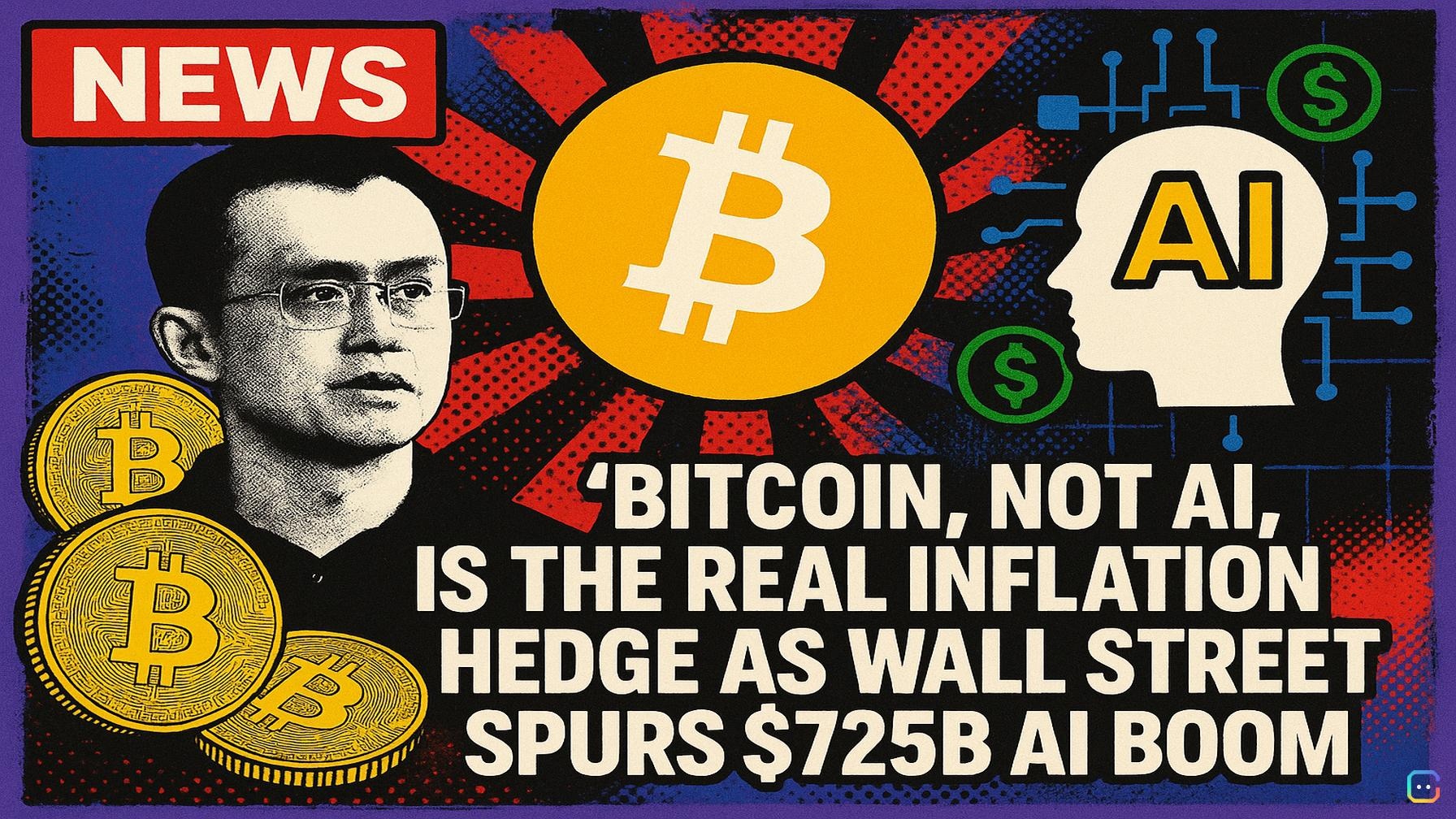
Binance co-founder Changpeng “CZ” Zhao sparked fresh debate about Bitcoin’s role in portfolios, framing the asset as an inflation hedge that artificial intelligence cannot match. Posting on X, CZ summed up the contrast in one line: “AI is great, but it does not protect you against inflation. Bitcoin does.”
Why CZ’s comments matter
- Wall Street is pouring capital into AI. JPMorgan CEO Jamie Dimon projects about $725 billion in AI investment this year, a spending surge many expect to reshape tech and enterprise computing.
- At the same time, Bitcoin proponents point to the cryptocurrency’s fixed supply as a bulwark against monetary debasement — something CZ and several asset managers say AI-focused investments don’t offer.
BlackRock, ETFs and macro drivers
- BlackRock executives have flagged rising government debt and currency risks as factors that could strengthen Bitcoin’s long-term case. Robert Mitchnick, BlackRock’s head of digital assets, noted that investors recently dialed back attention to Bitcoin amid heavy outflows from spot-Bitcoin ETFs — but he suggested that fear over U.S. borrowing and money printing could reverse that trend. “And the more fear there is over the borrowing level and the risk of money printing, that is ultimately the most important, I think fundamental driver ahead,” Mitchnick said.
- Bitcoin was trading near $65,000 after recovering from an earlier dip, though still well below its October 2025 peak above $126,000 reached during strong ETF inflows.
AI exuberance — and the risks
- Not everyone buys the relentless AI-upgrade narrative. Former Fidelity manager George Noble warned that an AI crash could be far worse than the dot-com bust — possibly inflicting up to 17 times the damage of the roughly $5 trillion wiped from the Nasdaq in the early 2000s.
- Prediction markets reflect some of that anxiety. Polymarket contracts recently put the chance of an AI bubble bursting in 2026 at just over 17% for one settlement rule, with other contracts showing probabilities between roughly 16% and 24%. Earlier odds had fallen from about 30% to 14% before climbing again.
Policy and portfolio shifts
- Some prominent economists and strategists have also cautioned about froth. Former White House economists Jared Bernstein and Ryan Cummings described the AI bubble as “still inflating,” warning that heavy corporate AI spending is draining cash reserves and taking a larger share of GDP than tech investment did during the dot-com era.
- Asset managers are adjusting. BlackRock’s Rick Rieder signaled plans to trim exposure to companies directly spending on AI and instead increase stakes in firms positioned to benefit from AI demand. That tilt helps explain interest in companies like Bitcoin miner TeraWulf, which recently signed a 20-year deal to host AI data-center infrastructure for Anthropic — a company that could benefit from surging AI compute needs.
The takeaway
The debate frames two competing investment narratives: a high-growth AI spending cycle that could fuel returns (but also carries concentration and valuation risk), versus Bitcoin’s scarce supply and anti-inflation narrative. CZ’s one-liner crystallizes the crypto camp’s view: AI may drive innovation and profits, but only a fixed-supply asset like Bitcoin is presented as a direct hedge against monetary inflation. How investors weigh those trade-offs will shape flows into both AI infrastructure and digital-asset markets in the months ahead.
Read more AI-generated news on: undefined/news