Headline: How Trump’s crypto windfall — at least $1.4bn of a $2.2bn year — intersected with Justin Sun’s money, influence and lawsuits
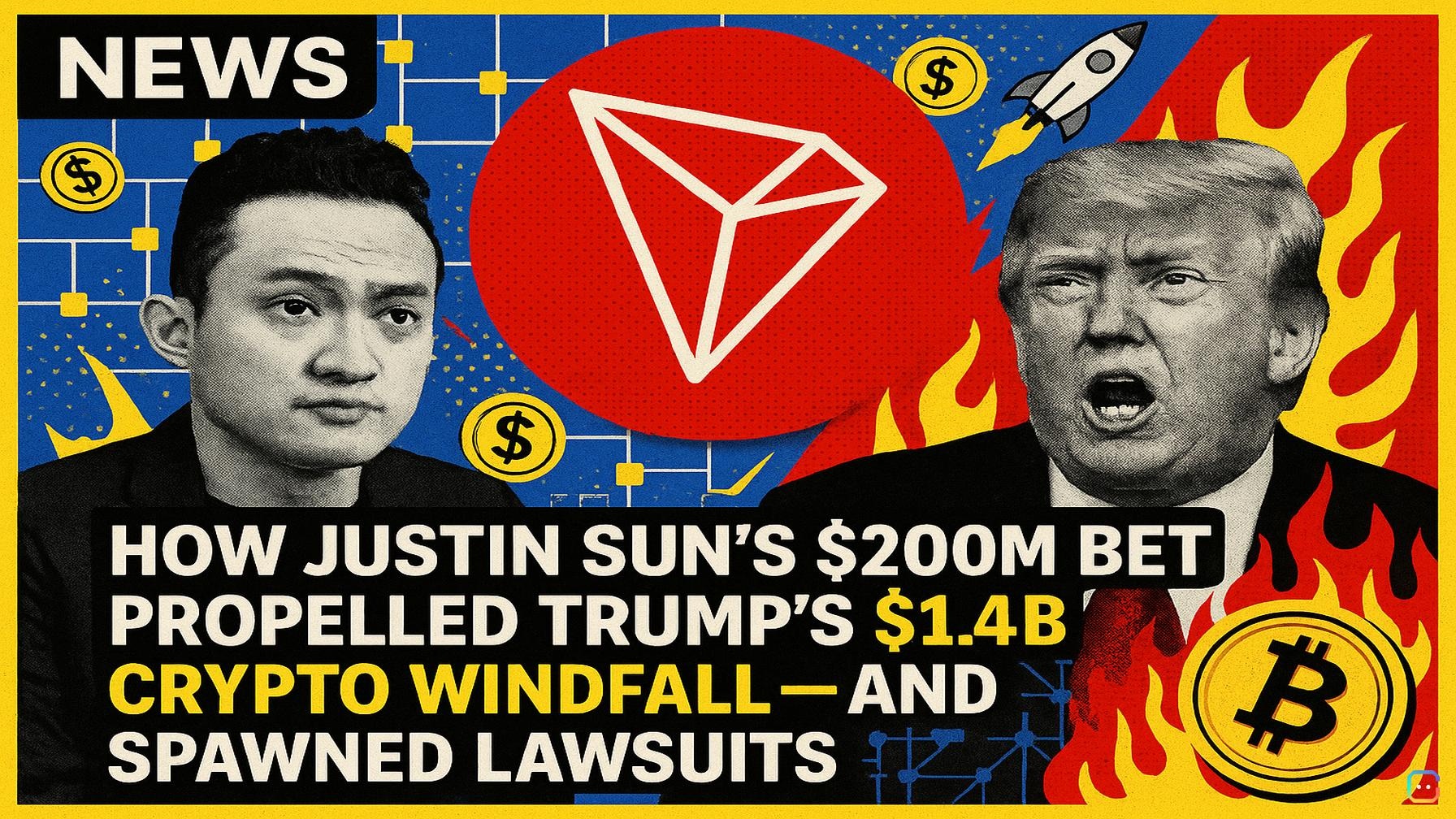
Lead: Donald Trump’s extraordinary single-year haul — roughly $2.2bn, including at least $1.4bn from crypto ventures — has refocused attention on how a president with no crypto background built such a revenue stream. Central to that story is Justin Sun, the controversial Chinese crypto billionaire behind Tron (TRX), who pumped roughly $175–200m into Trump-branded crypto projects and whose involvement both legitimized and later tangled with the Trumps’ digital-asset empire.
Quick timeline and key facts
- Trump’s 2024 reported income: about $2.2bn; roughly $1.4bn of that reportedly came from crypto-related businesses.
- The Trump family’s main crypto vehicles: World Liberty Financial (founded Sept 2024) and the $TRUMP memecoin.
- World Liberty’s governance token: $WLFI — structured so 75% of token-sale profits flow directly to the Trump family trust; initial fundraising target was cut from $300m to $30m before a big injection of capital.
- Justin Sun’s pitch-in: Sun bought $75m of $WLFI shortly after Trump’s election and later purchased more than $100m of $TRUMP memecoin, putting roughly $175–200m behind the ventures and helping trigger about $550m in token sales overall.
- Legal fallout: Sun sued World Liberty Financial in U.S. federal court (April 21) for freezing his tokens; World Liberty countersued (May 4) alleging shorting and defamation. Both suits are ongoing.
Who is Justin Sun — and why his money mattered
Justin Sun founded Tron and launched TRX in 2017, pitching blockchain as a new, low-fee way to move value. He’s a showman — once paid millions for a banana-on-wall artwork and then ate it — and has cultivated a public persona as “crypto’s billionaire barker.” But Sun’s businesses have drawn scrutiny: independent reporting and investigators have tied significant illicit activity — from darknet laundering to sanctioned actors — to transactions routed through Tron, and critics say Sun frequently pushed the boundaries of regulation.
The SEC charged Sun and related entities with market manipulation and illegal token sales in 2023, alleging he ran fake trades to inflate TRX volumes and hid celebrity promotion payments. Several celebrities later settled with the SEC for failing to disclose paid promotions. Sun denied wrongdoing; during the investigation he largely avoided the U.S. The prosecution stalled: courts and regulators later dismissed or settled remaining allegations, including a Rainberry Inc. payment of $10m that resolved some claims.
Why World Liberty Financial needed a crypto heavyweight
World Liberty’s $WLFI token model was unconventional. It promised governance rights, but the token’s economics funneled most proceeds to the Trump family trust rather than into a reinvestment ecosystem typical of decentralized projects. Early investor skepticism left the venture strapped for momentum until Sun’s $75m tranche was announced. His involvement gave the project crypto credibility, attracted more buyers, and helped generate hundreds of millions in sales — which critics call a “bailout” that funneled large sums to the Trump family.
Questions about timing and influence
Critics and some lawmakers flagged the timing: Sun’s major purchases coincided with a pause in enforcement actions by the SEC. Senator Richard Blumenthal asked why a top SEC enforcement official left before allegations against Sun were dismissed, calling the sequence “a clear example” of how political influence could warp enforcement. Trump’s representatives deny conflicts; Sun and the Trumps say his purchases were independent of regulatory decisions. Public filings show some related corporate moves (including a Nasdaq listing via reverse merger) involved advisers with Trump family connections.
From partner to plaintiff: the split and the technical “gotcha”
The relationship unraveled when it emerged that $WLFI’s governance was an illusion. Code changes and privileged admin keys allowed a small group to exercise sweeping control — including freezing wallets. In August, the project unlocked a tranche of tokens that delivered massive gains to the Trumps (reports estimate billions in paper value), while Sun says his holdings were later frozen when he tried to move around $9m in tokens. Sun alleges World Liberty used a “backdoor blacklisting function” to block withdrawals; World Liberty says Sun signed the token-unlock agreement that authorized freezing power. Sun’s frozen position lost an estimated $60m by December, he says.
The lawsuits
- Sun sued World Liberty Financial (April 21, California) claiming the freezing was unlawful and accusing the company of treating him like a “personal ATM.”
- World Liberty countersued (May 4, Florida), accusing Sun of shorting the project and defamation.
Both suits remain unresolved.
What this episode says about crypto, governance and retail risk
- “Decentralized” branding can mask centralized control. White papers promising governance don’t guarantee on-chain democracy; private admin keys and upgradeable code can concentrate power.
- High-profile endorsements and deep-pocket investments can rapidly re-price projects and create massive retail exposure — even when the project’s mechanics heavily favor insiders.
- The Sun–Trump saga highlights regulatory gaps and political risk: timing, influence and enforcement shifts all factor into how crypto disputes and prosecutions play out.
Voices from the story
- Justin Sun: positions himself as a crypto evangelist who believes blockchain empowers individual sovereignty, and denies that his purchases influenced the SEC.
- Critics and investigators (e.g., Verge reporter Chris Harland-Dunaway): argue Tron has been heavily used for illicit flows and that the Sun–Trump deals illustrate how rule-bending entrepreneurs can bend token ecosystems for profit.
- Senator Blumenthal and others: emphasize possible pay-to-play optics and national-security implications of opaque crypto ties at the presidential level.
Bottom line
Whether viewed as a savvy bet, a strategic payoff, or a risky entanglement, Justin Sun’s involvement was pivotal to turning Trump-branded tokens from an underfunded idea into a multi-hundred-million-dollar business. The split and ensuing litigation expose the thin line between crypto marketing and centralized control, and underscore how retail investors can be left holding tokens when project governance favors insiders. As the legal fights play out, the episode will likely be studied as a cautionary tale about governance design, political influence, and the real-world consequences of conflating celebrity brands with decentralization.
Additional note: This report is adapted from reporting made for the BBC documentary “The Tech Billionaire Takeover” (available on BBC iPlayer in the UK and BBC Select globally), which included interviews with Justin Sun and investigative reporting on Tron and World Liberty Financial.
Read more AI-generated news on: undefined/news