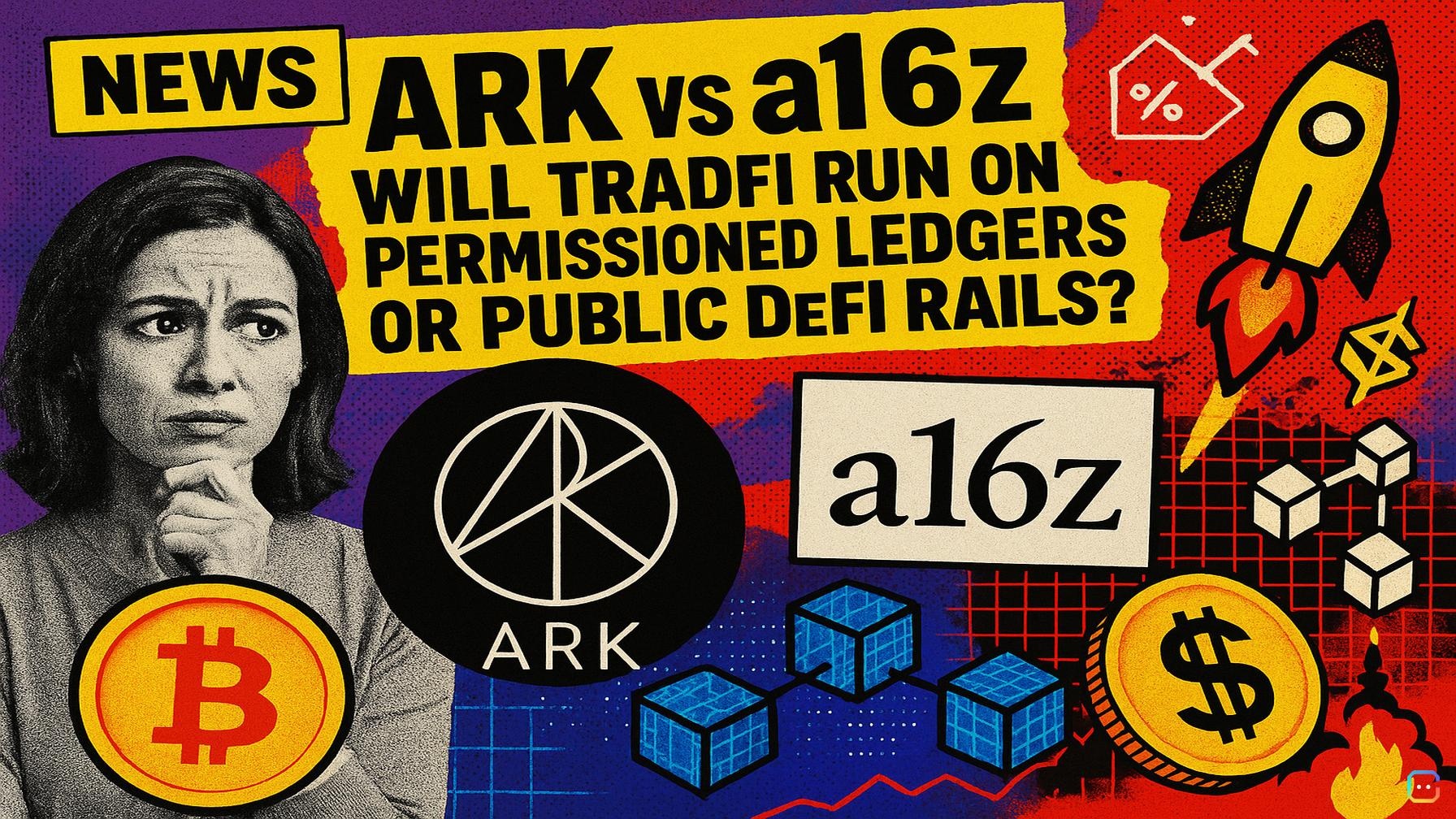
ARK Invest has pushed back against a16z crypto’s recent argument that traditional finance will favor controlled, permissioned blockchains over permissionless DeFi — calling the view “overly bearish and simplistic.”
The spat began after a16z published an essay titled “TradFi doesn’t want DeFi. It wants blockchains.” The venture firm argued banks and asset managers will adopt blockchain features that cut costs, speed settlement or widen distribution — but only if those features come with familiar controls (KYC, governance, regulatory guardrails). Under that thesis, institutions would embrace tokenization, programmable money and atomic settlement while limiting open access and pseudonymous participation. A16z explicitly acknowledged that public networks and crypto-native DeFi wouldn’t vanish — instead, they’d coexist and supply technology that regulated firms later adapt.
ARK’s director of research Lorenzo Valente fired back on X, saying the picture is already more complex. He pointed out that public blockchains have outpaced earlier private-led experiments and argued institutional finance is increasingly building on crypto-native infrastructure rather than isolated private ledgers.
The data ARK points to is hard to ignore. Tokenized real-world assets had surpassed $29 billion by April 2026, with roughly $13.4 billion in tokenized U.S. Treasury products alone. More than 40 major financial institutions have launched or developed products using public-chain infrastructure. Those projects often run on Ethereum and similar networks — even when firms add restrictions on investors, wallets, custody and transfers. In other words: shared public rails can be used without fully embracing every permissionless attribute of DeFi.
That hybrid reality blurs the line between DeFi and TradFi. Standard Chartered estimates up to $4 trillion in stablecoins and tokenized assets could migrate on-chain by the end of 2028, and it named established DeFi protocols such as Aave, Compound and Morpho as likely infrastructure beneficiaries. BlackRock’s BUIDL fund has already found DeFi utility by serving as collateral and linking with on-chain markets.
At the same time, infrastructure aimed squarely at institutional needs has traction. Canton Network offers permissioned access and privacy-focused settlement tools and has drawn banks and market utilities. XRP Ledger developers are experimenting with permissioned trading and lending features while preserving on-chain settlement. These examples illustrate that some institutions prefer dedicated, permissioned tooling even as they experiment with public rails.
So the debate between ARK and a16z isn’t about whether TradFi will use blockchain — both sides agree that it will. The core disagreement is which infrastructure will carry the volume: will institutions primarily reshape blockchain tech around tight controls, or will the liquidity and protocols already thriving on public chains become unavoidable building blocks for institutional markets?
Bottom line: TradFi is testing multiple models. Public-chain liquidity and DeFi primitives are growing into real, institutional-grade plumbing, but permissioned networks and hybrid solutions are also advancing. The likely outcome looks less like a single winner and more like a competitive ecosystem where firms choose the rails that best match regulatory, privacy and liquidity needs.
Read more AI-generated news on: undefined/news