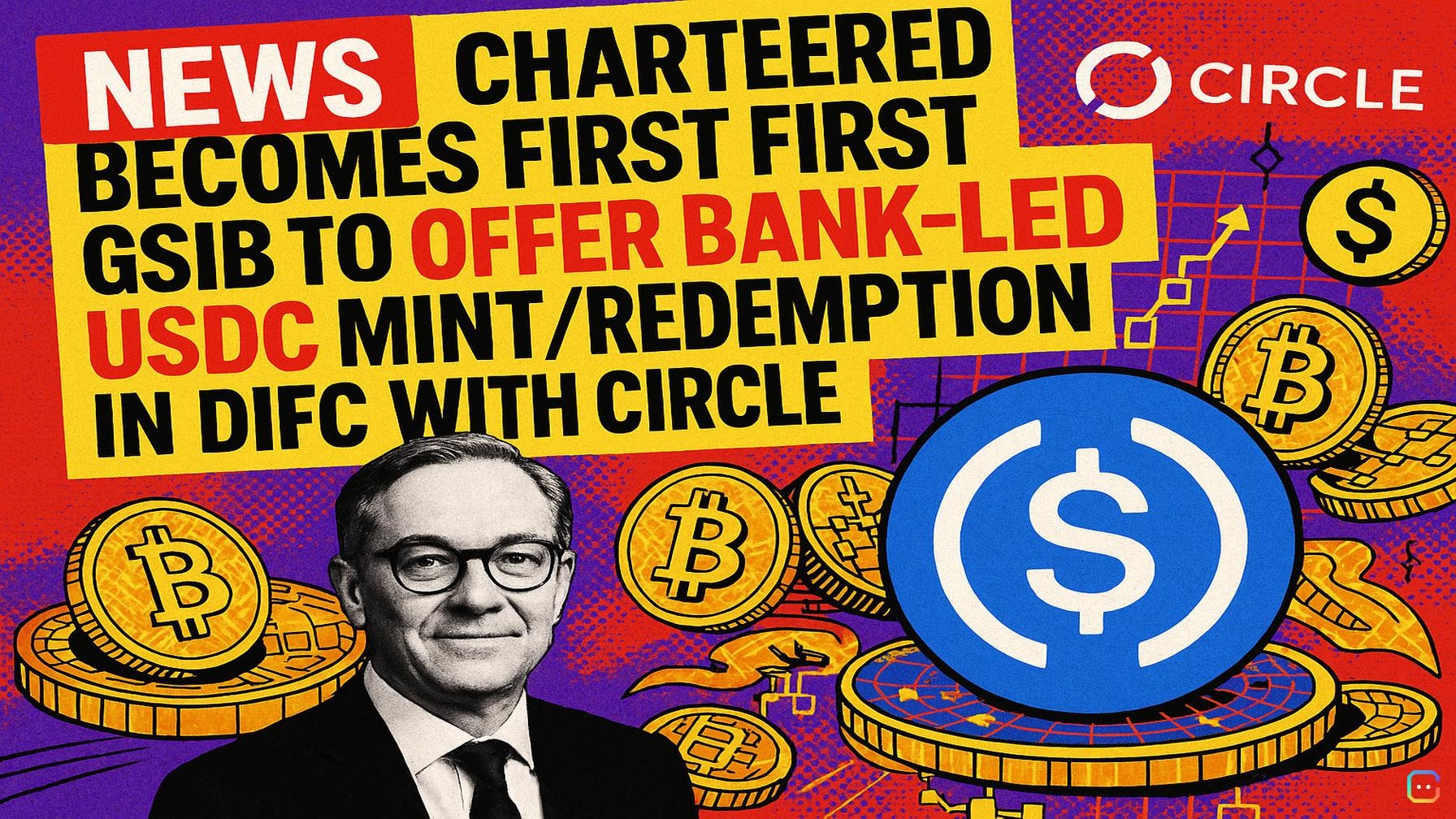
Standard Chartered has rolled out a bank-led USDC minting and redemption service for eligible institutional clients, built in partnership with Circle. The new offering lets clients convert fiat into USDC and redeem USDC back to dollars via Standard Chartered’s own banking platform — without needing direct accounts at Circle — and bundles fiat banking, custody, digital-asset infrastructure and public blockchain connectivity into a single on‑ramp.
Key details
- Launch region: The service begins in the Dubai International Financial Centre (DIFC) and the bank said it will expand to other markets as local approvals and market readiness allow. DIFC’s large institutional client base across the Middle East, Africa and Asia makes it a strategic starting point.
- Regulatory position: With this product, Standard Chartered becomes the first Global Systemically Important Bank (GSIB) licensed to offer institutional clients integrated USDC minting and redemption access.
- Client experience: Institutions get one onboarding and service experience through the bank rather than opening direct Circle accounts; Circle confirmed clients can use the service without holding direct Circle accounts.
- Use cases: The product targets on‑chain settlement, treasury operations and liquidity management, and positions the bank to support payment-related workflows as stablecoin infrastructure becomes more integrated into institutional finance.
Why it matters
Standard Chartered’s move brings a traditional-bank wrapper around USDC activity, reducing the operational friction for institutions that want blockchain-native settlement and stablecoin liquidity but prefer banking-grade custody, governance and service channels. Roberto Hoornweg, CEO for Corporate and Investment Banking at Standard Chartered, framed it as part of the broader trend: “Digital assets are becoming an increasingly important component of global financial infrastructure,” and clients expect the trust and governance standards of traditional markets.
Circle’s view and network moves
Circle — issuer of USDC — said the integration helps financial institutions access stablecoins and blockchain markets for payments, settlement and treasury work. The announcement follows other bank-linked USDC initiatives: BNY recently enabled USDC minting and redemption within its platform, and Circle has been expanding its institutional rails via the Circle Payments Network, which offers managed USDC settlement for banks and fintechs without forcing them to run custody or blockchain operations.
Regional and market context
Standard Chartered emphasized the launch as reinforcing the UAE’s role as a regulated hub for digital-asset activity. The UAE has been building local stablecoin frameworks and even unveiled a central bank–approved dollar-backed stablecoin, which could compete with USDC in some institutional use cases. Standard Chartered has also been active expanding digital-asset payment rails across the region, working on cross‑border settlement and multi‑currency payment services across Middle East–Asia corridors.
Competitive backdrop
The bank-led USDC service arrives amid growing competition around stablecoin access and infrastructure. Circle itself has faced recent market pressure — its shares fell after index removals and the emergence of rival stablecoins such as Open USD — while other players and startups are building bank-friendly stablecoin tooling (for example, Checker raised $8 million to help banks and fintechs launch stablecoin products via a single API).
Bottom line
Standard Chartered’s offering packages bank-grade onboarding, custody and fiat rails with direct USDC mint/redemption capability, lowering operational barriers for institutional adoption. Starting in DIFC, it could accelerate use of stablecoins for settlement, treasury and liquidity management across institutional workflows — and signals increasing mainstream financial-institution participation in the stablecoin ecosystem.
Read more AI-generated news on: undefined/news