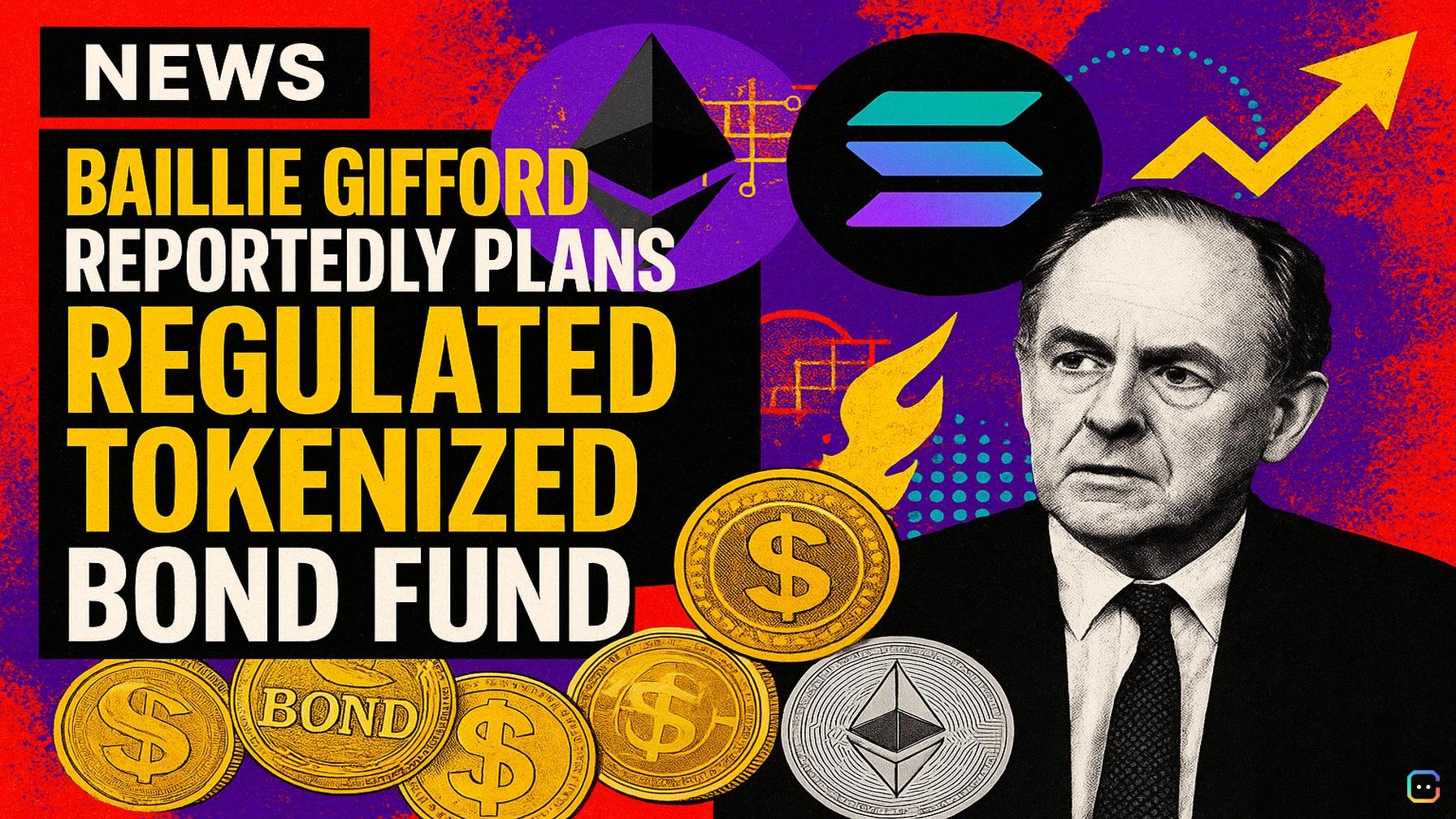
Baillie Gifford is reportedly planning a regulated tokenized bond fund built on public blockchain rails — another heavyweight traditional asset manager stepping into the race to bring regulated funds onto distributed ledgers.
According to institutional communications from the firm, the proposed structure would use public chains such as Ethereum and Solana, with institutional custody support provided by BNY. The move highlights a growing, practical intersection between traditional finance and crypto infrastructure: tokenized funds are less about speculation and more about real-world utility for institutional investors.
Why bonds make sense for tokenization
- Bonds and other fixed-income instruments already live within complex settlement and custody systems, so tokenized fund units are a natural fit.
- Tokenization can simplify transfers, speed settlement, increase transparency, enable programmable distribution and support more automated collateral workflows.
- That doesn’t mean legacy systems vanish overnight, but tokenized structures can make specific operational workflows materially more efficient.
Chains as a strategic choice
Public blockchains are competing to host these regulated products. Ethereum brings institutional familiarity and mature tooling; Solana offers faster throughput and lower transaction fees. An asset manager’s choice of rails can therefore signal how it weighs credibility, tooling and performance.
Why this matters now
Real-world asset (RWA) tokenization — from treasuries to private credit and bonds — has proven more durable than many hype cycles because it ties directly into existing financial demand for yield, settlement efficiency and institutional-grade products. Baillie Gifford’s reported plans add another data point to that trend, reinforcing that traditional assets are slowly being made compatible with blockchain settlement.
But one announcement doesn’t decide the market. What matters is the pattern: more specific regulation, institutional products inching closer to conventional financial rails, and rapid market responses when liquidity tightens. For traders and market structure observers, these developments belong in the broader context of weaker liquidity, policy uncertainty, new institutional offerings and episodic stress in high-beta tokens.
Practical takeaway
Treat the news as incremental confirmation of a larger shift rather than a guaranteed catalyst for price moves. Its real significance lies in how it changes infrastructure choices for asset managers, custody arrangements for institutions, and the practical availability of regulated crypto-native products for investors.
This coverage is based on information from Baillie Gifford institutional communications. Story produced by the News Desk; edited by Samuel Rae.
Read more AI-generated news on: undefined/news