Cory Doctorow: “Reverse centaurs”, the AI bubble and why bosses are betting on automation — even if it hurts people
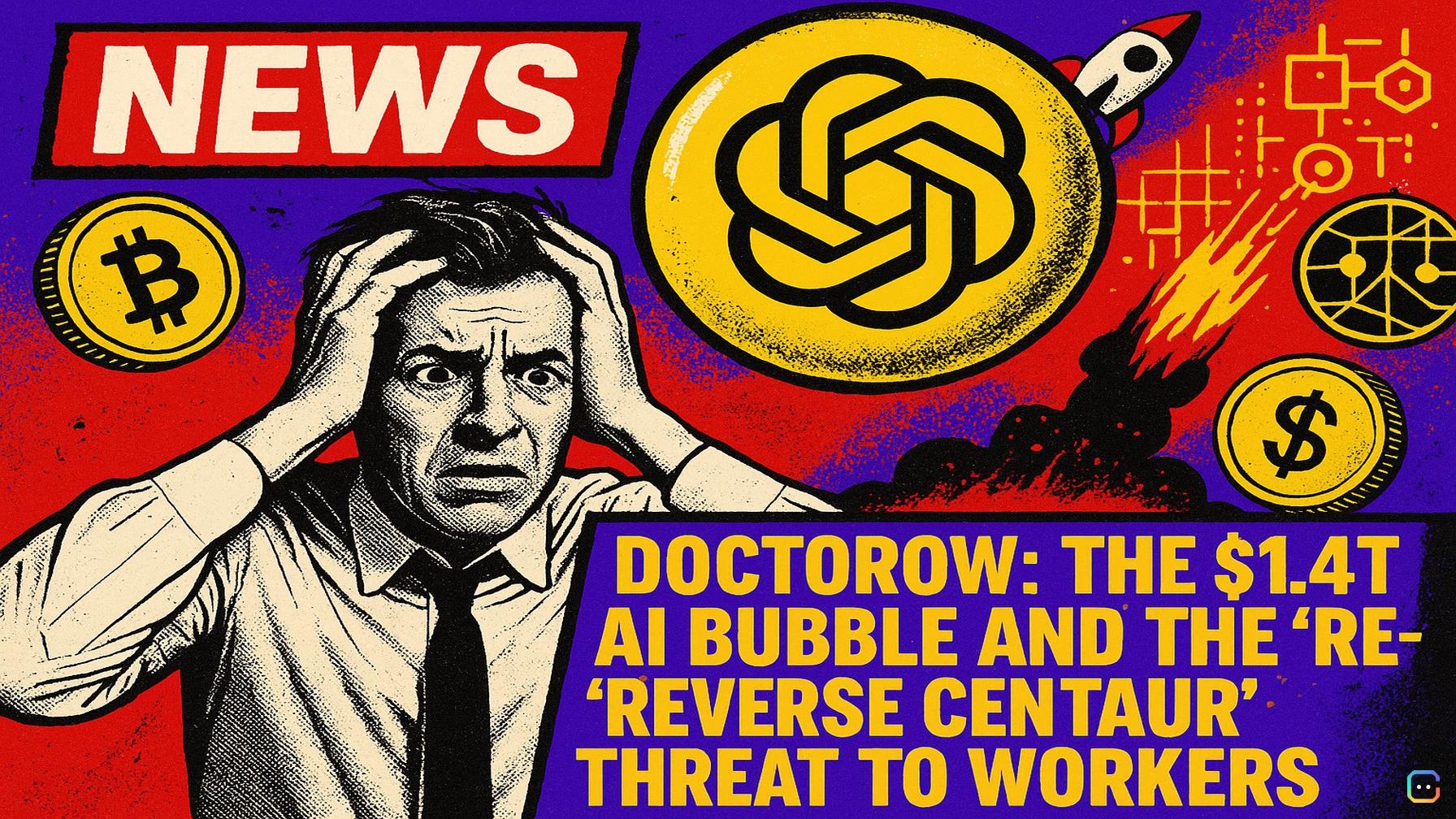
Cory Doctorow’s new book, The Reverse Centaur’s Guide to Life After AI, reframes a familiar tech fear in blunt, human terms. A “centaur” in automation theory is a human helped by a machine. A “reverse centaur”, Doctorow warns, is the worker forced to become the machine’s assistant — the reality for warehouse pickers who pee in bottles to hit algorithmic targets, drivers riding in semi-autonomous trucks for minimum wage, lawyers double-checking AI’s precedent-finding, or musicians reduced to performing covers of AI-generated hits.
That’s the practical, near-term threat: not sentient robots overthrowing humanity, but systems that hollow out meaningful work while making bosses feel safer and investors richer.
AI: hype, hubris and a word-prediction trick
Doctorow — tech novelist, activist, long-time Boing Boing editor and author of last year’s viral Enshittification — is skeptical of the grand metaphors surrounding AI. He calls modern large-language models “conjuring tricks”: systems that excel at predicting the next word in a sentence, to which we impute intent, meaning and consciousness. The result is a mixture of dazzlement when models “get it right” and a willful blindness to frequent, sometimes dangerous errors — the so-called “hallucinations,” which Doctorow says are really our habit of assigning authorship to meaningless word salad.
That doesn’t mean AI is harmless. Far from it: the risk is less science-fiction apocalypse and more financial and social wreckage driven by investor mania and managerial appetite for automation.
A trillion-dollar AI bubble — and who pays the price
Doctorow puts hard numbers on the frenzy. When he wrote his book, he estimated the AI investment bubble at $700 billion; it’s now around $1.4 trillion, and he worries it could swell much further. A handful of tech giants — nine US firms account for roughly 35% of the entire US stock market valuation — concentrate the market in ways that insulate equities from some geopolitical shocks but create enormous systemic risk elsewhere.
Doctorow invokes two blunt rules of finance: Stein’s Law (“anything that can’t go on forever eventually stops”) and Keynes’s aphorism (“the market can remain irrational longer than you can remain solvent”). Predicting when a bubble pops is impossible; predicting that bubbles pop is easy. When they do, the damage isn’t spread evenly: capital allocators and founders may be insulated, while workers, public services and entire economies bear the fallout — often used as cover for austerity.
Why so much money keeps flowing into AI
If AI is largely a fancy word-prediction engine, why are investors pouring trillions into it? Doctorow argues the motivation isn’t pure technophilia but the same promise that has driven automation for centuries: bosses want to replace workers. It’s not only about cutting costs. Automation offers managers the dream of workplaces without co-determination — systems that keep running without employees who can withhold labor. AI is sold as a way to wire a “toy steering wheel” straight into the drivetrain: products made without designers, workplaces without workers, hospitals without nurses.
This promise feeds both investor enthusiasm and worker insecurity. Public rhetoric — from ministers touting “time and money” saved through automation to high-profile panic about AI ending civilization (Elon Musk called it “the single greatest threat to human civilisation,” Sam Altman said it “most likely” could end the world, and Dario Amodei warned AI might view humans like livestock) — amplifies a feedback loop Doctorow calls “criti-hype”: critique that both rides and feeds the hype, making dystopian scenarios feel more plausible.
Failures, narratives and the persistence of belief
History shows automation projects often fail or require more human oversight than advertised. Amazon’s cashier-less grocery experiments, for example, still needed staff monitoring shoppers to make the system work. Yet failures rarely deflate the narrative: companies and investors keep retelling the same story because the story itself—of a post-worker future—sells.
Doctorow also ties the pattern to other tech fads that didn’t deliver: cryptocurrency replacing global finance, the metaverse replacing real-world experiences. “We have such poor object permanence,” he says — meaning we forget how many grand promises go unrealized and keep betting on the next one.
Personalities, power and the human cost
Beyond market mechanics, Doctorow highlights how immense wealth and insulation from consequences warp behavior and empathy. “You cannot make billions of dollars without hurting lots of people,” he says. He points to Elon Musk’s public behavior and language — including calling critics “NPCs” — as an expression of a broader solipsism among some ultra-wealthy founders. He links anecdotes about Musk’s ketamine use to a metaphorical disconnection from other people’s reality.
Doctorow stresses the political dimension: this is less about robotic rivals and more about class dynamics. Bosses are intent on eroding co-determination; investors want growth narratives to justify capital. If policymakers and the public want to limit harms, Doctorow argues the lever is economic: make it clear to investors that certain harms don’t translate into profit. For instance, banning child sexual exploitation by design is necessary — but it won’t change investment behavior unless investors believe such practices will harm returns.
What to watch next
For readers in crypto and web3 circles, Doctorow’s critique should sound familiar: cycles of extreme optimism, concentrated market power, narrative-driven funding and the social fallout when bubbles burst. The difference is scale. The AI bubble, he warns, is already big enough to shape policy, labor markets and global finance — and its blast radius will hit those with the least insulation first.
The Reverse Centaur’s Guide to Life After AI: How to Think About Artificial Intelligence Before It’s Too Late (Verso, £16.99) lays out these arguments in more detail. Whether you agree with every line, Doctorow’s core point is worth taking seriously: AI’s real threat may not be that it becomes conscious, but that it becomes an economic power tool that accelerates inequality, replaces co-determination with managerial control, and leaves vast social harm in the wake of speculative investment.
Read more AI-generated news on: undefined/news