Binance races the clock on MiCA — exploring other EU routes if Greece stalls
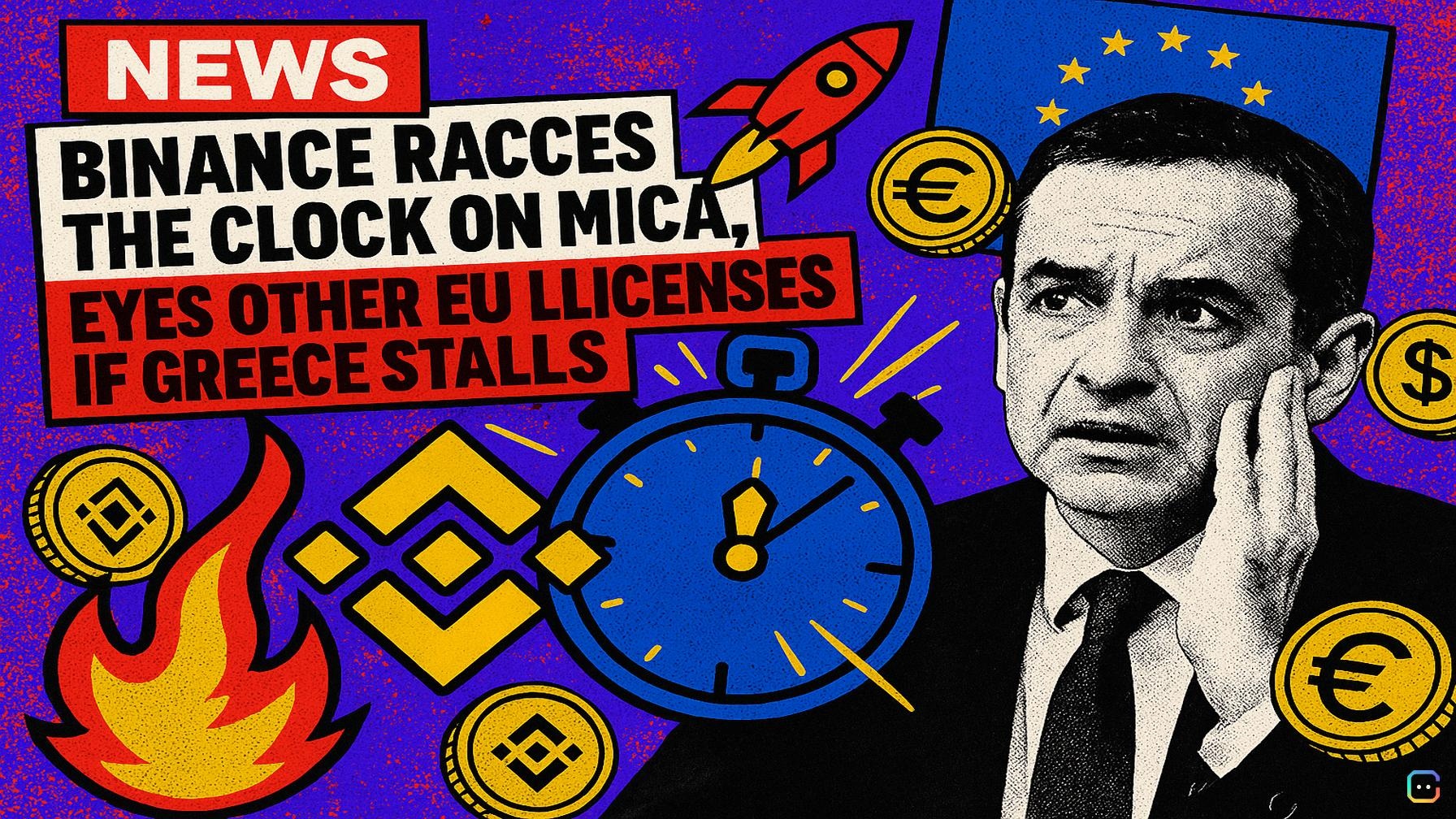
Binance says it will try another European Union jurisdiction if its licensing bid in Greece doesn’t clear the pipeline before the Markets in Crypto-Assets (MiCA) compliance deadline, Reuters reports — a move that underscores the mounting pressure on the world’s largest crypto exchange as MiCA’s transition period ends on July 1.
Why this matters now
- The European Securities and Markets Authority (ESMA) has warned that crypto-asset service providers without MiCA authorization must take “immediate” steps to wind down operations across the EU after the transition expires. That leaves a narrow window for firms seeking approval.
- Binance has submitted a formal authorization application only in Greece so far. If that route doesn’t deliver, the exchange says it will pursue alternatives elsewhere in the bloc.
Regulatory sticking points
According to people familiar with the matter cited by Reuters, regulators in Greece, Ireland and Latvia have held talks with Binance but raised red flags about:
- Past anti-money-laundering (AML) penalties
- Binance’s complex international corporate structure
- Backgrounds of senior executives
- A perceived risk-taking culture
Binance pushes back
Gillian Lynch, head of Binance Europe and the U.K., told Reuters the exchange remains committed to Europe, has invested heavily in compliance and internal controls, and currently employs roughly 1,500 compliance staff. Lynch said Binance has no unresolved issues tied to its application and didn’t understand why authorization had not yet been granted.
Binance has publicly disputed reports that EU regulators were preparing to reject its MiCA filing. On June 16 the company said Greece’s Hellenic Capital Market Commission had completed its review and considered the filing compliant with MiCA, subject to ESMA’s further examination.
Political and reputational hurdles
A June 18 report from The Big Whale suggested Binance’s Greece pathway had stalled before the June 30 deadline, citing political concerns around stablecoins and Binance’s influence in Europe — and identified France as the most realistic alternative for a timely approval. Reuters also reported that some regulators remain wary of continuing influence from founder Changpeng Zhao after his February podcast comments asserting he remained the exchange’s ultimate beneficial owner; Lynch denied that characterization and said Zhao is “100% removed” from the company.
Historical context
Binance’s regulatory history continues to weigh on its European push. In 2023, Zhao pleaded guilty as part of a $4.3 billion settlement with U.S. authorities over violations of AML laws. U.S. prosecutors said the exchange failed to report more than 100,000 suspicious transactions tied to groups designated by Washington as terrorist organizations.
User footprint and the wider MiCA picture
Reuters cited Sensor Tower estimates showing Binance recorded more than 4 million app downloads across the EU last year, with France, Germany and Spain accounting for the largest shares — a reminder of the potentially large impact of any market disruption.
MiCA’s reach also extends to token issuers. Ryan King, creator of the EU Crypto Register, posted on LinkedIn that at least 380 of 867 white-paper notifications his tracker recorded were filed by third parties rather than the token issuers themselves. He noted that Kraken, LCX, OKX and Bitstamp submitted 271 notifications — about 31% of entries — highlighting the growing role of authorized exchanges in preparing and notifying MiCA white papers for assets listed on their platforms.
What’s next
With the MiCA deadline looming and ESMA urging unlicensed providers to cease activity, Binance’s next moves — whether an expedited approval in Greece, a pivot to another EU regulator, or a managed wind-down in parts of the bloc — will shape how Europe’s new regulatory regime takes hold and how exchanges adapt to stricter, unified rules.
Read more AI-generated news on: undefined/news