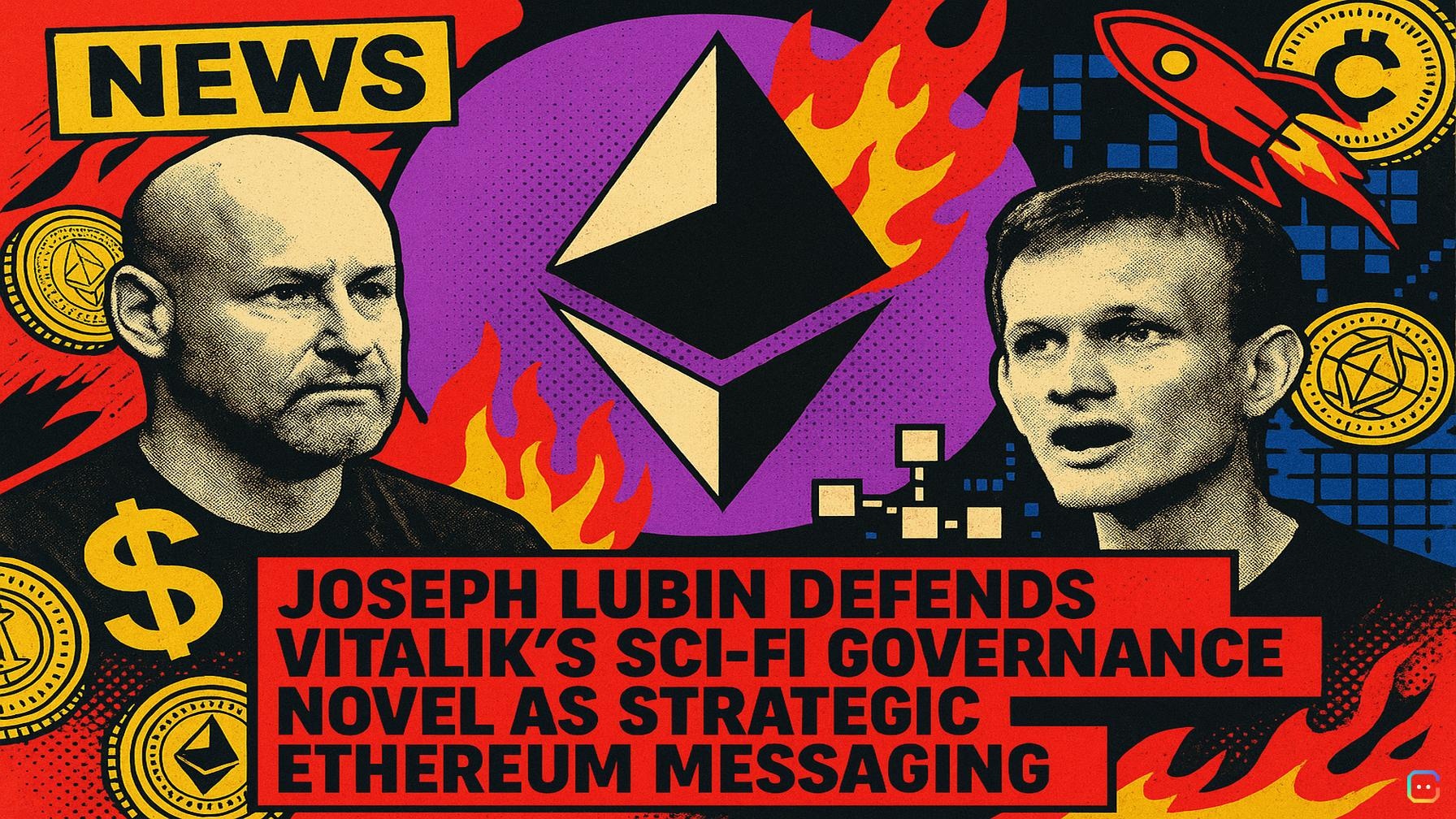
Joseph Lubin has stepped forward to defend Vitalik Buterin after parts of the Ethereum community questioned the co‑founder’s decision to write a science‑fiction novel about decentralized governance.
Calling Buterin “an enormously effective communicator” and “the most important contributor to and steward of the Ethereum ecosystem,” Lubin pushed back on critics who see the fiction project as a distraction. Posting on X, he argued that storytelling can be a powerful way to communicate Ethereum’s values—sometimes more effective than technical essays. “Anyone who thinks that by writing fiction Vitalik isn’t choosing the most effective way he can think of to further the growth and adoption of Ethereum is missing the point,” Lubin wrote, likening the idea to Cory Doctorow’s Little Brother and proposing a cypherpunk tale of people navigating a dark digital future using Ethereum tech.
Buterin announced in May that he would pause regular long‑form research posts to try writing sci‑fi centered on decentralized governance. He has posted the first two chapters on his personal website, and the draft reportedly explores governance topics—quadratic voting, AI‑assisted decision‑making, and the limits of decentralized autonomous organizations—through fictional narrative rather than formal papers.
Reaction in the community has been mixed. Some users questioned the timing, given current concerns around ETH price weakness, privacy, and the Ethereum Foundation’s direction. Others welcomed the change of format, saying a story can make complex governance concepts more accessible. One user writing as “12” noted that the early chapters already reference open source and privacy, even pointing out an in‑story “Veridian Privacy Robe” and proposing a community signal—“HOOD UP = Privacy”—as a solidarity gesture.
Lubin tied Buterin’s fiction to themes that sit at the heart of Ethereum culture—open source development, privacy, censorship resistance and credible neutrality—framing the novel as part of a broader communication strategy rather than a retreat from technical leadership. That context matters: privacy has been a recurring focus for Ethereum builders, who in recent months have been working on tools for private money, private identity, private voting and private messaging—areas Buterin himself has urged developers to prioritize.
The fiction project doesn’t alter Ethereum’s technical roadmap, but it has shifted public discussion about governance, privacy and Buterin’s role in the ecosystem into a new medium. With ETH price action soft and calls for clearer progress ongoing, debate over the merits of the novel is likely to continue. For now, Lubin’s public backing gives the project cover and underscores a broader belief in diverse approaches to advancing Ethereum’s adoption and values.
Read more AI-generated news on: undefined/news