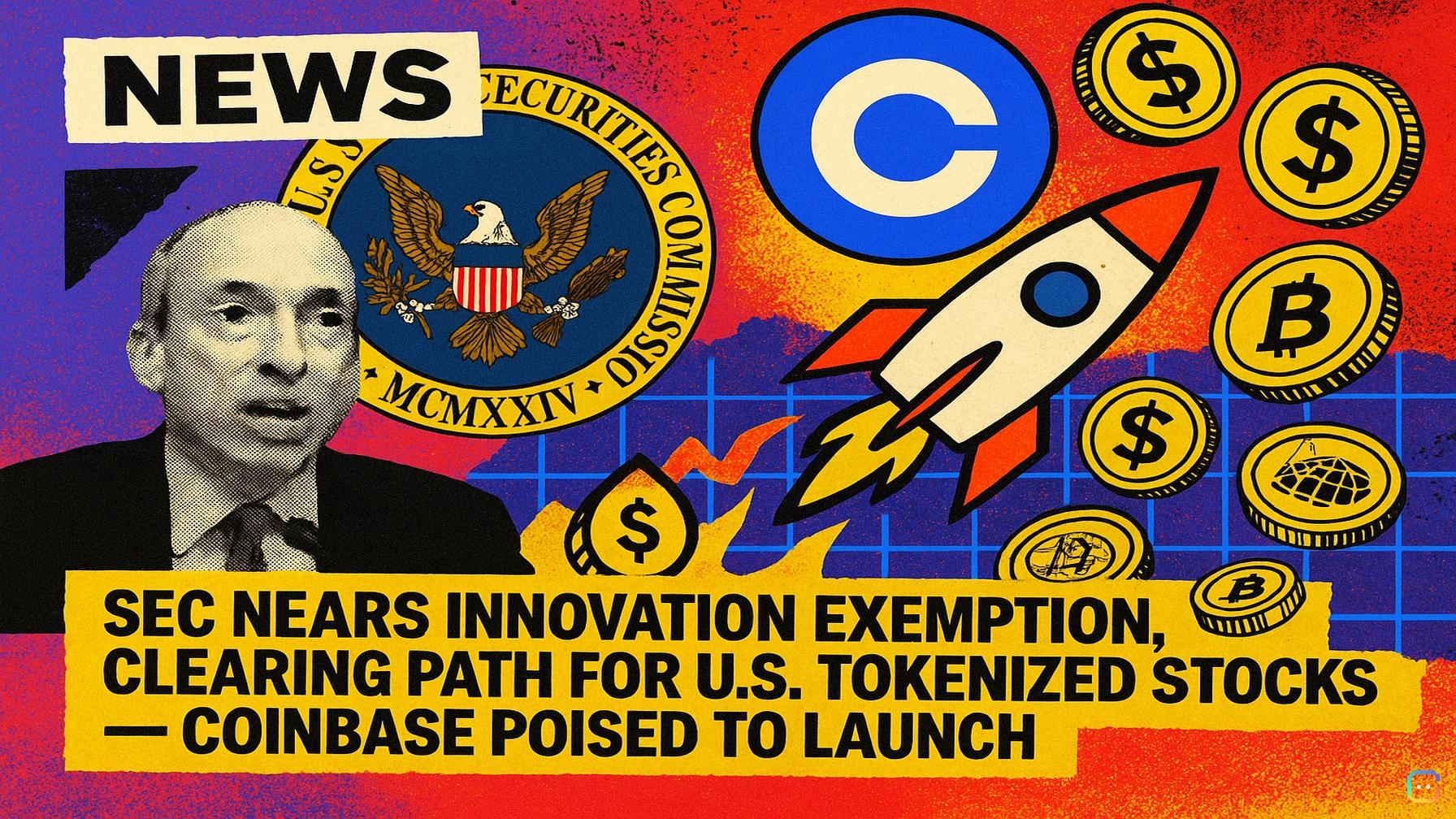
The U.S. Securities and Exchange Commission is edging closer to a regulatory path for tokenized stocks — a move that could unlock U.S. launches from major crypto players, including Coinbase.
What’s happening
- According to Reuters, SEC Chair Paul Atkins is expected to propose an “innovation exemption” that would let companies pilot blockchain-based financial products under a lighter regulatory regime. The goal: allow experimentation without forcing firms to meet every existing disclosure and investor-protection requirement up front.
- That approach would support tokenized equity products that crypto firms have been developing — tokens backed one-for-one by underlying shares that promise near-instant settlement and 24/7 trading. Coinbase has already disclosed plans to offer such tokenized stocks in the U.S., while Binance and other exchanges expanded similar products outside the country.
How tokenized shares would work
- Under the framework being discussed, tokenized shares could carry the same economic rights as traditional equities, including dividends and voting privileges, while enabling continuous trading and faster settlement.
Why the SEC shifted course
- The agency previously stalled efforts to permit tokenized equities amid concerns over investor protection and custody standards. Insiders now say the SEC is moving toward a revised, experimental approach that balances innovation with oversight — allowing pilots without full compliance with every existing rule.
Related market-structure changes
- Separately, the SEC advanced a market structure proposal that could reshape how equities — tokenized or traditional — trade in the U.S. The agency proposed rescinding Rules 611 and 610(e) of Regulation NMS, which have governed execution quality and locked/crossed quotes since 2005, and removing related definitions from Rule 600. The proposal opens a 60-day public comment window once published in the Federal Register.
- Chair Atkins argued that two decades of experience justify re-evaluating Rule 611 because it may have produced unintended consequences that hurt competition and added complexity to equity markets. While this proposal doesn’t directly authorize tokenized stock trading, it signals the SEC’s broader rethinking of market infrastructure in the crypto era.
Momentum and market signals
- Interest in tokenized equities has exploded. CoinGecko data show tokenized stocks ballooned from 14 assets on Jan. 31, 2024, to 478 by May 31, 2026 — a gain of more than 3,300% — making tokenized equities the fastest-growing crypto category in that span. Real-world asset projects also surged, from 64 to 1,282 listings (about a 1,900% increase).
- Institutional players are also moving in. The Wall Street Journal reports Citigroup is preparing tokenized shares tied to private companies such as OpenAI and Anthropic for international investors, with possible later expansion to U.S. clients. The New York Stock Exchange has likewise disclosed work on infrastructure to enable 24-hour trading through tokenized market systems.
Why it matters
- Taken together, the SEC’s innovation-exemption deliberations and market-structure review bring blockchain-based stock trading closer to the U.S. regulatory mainstream than ever before. If implemented, the changes could usher in more liquid, around-the-clock markets and faster settlements — but they’ll also raise fresh questions about custody, investor protections, and how traditional market rules adapt to tokenized infrastructure.
Sources: Reuters, crypto.news, CoinGecko, Wall Street Journal.
Read more AI-generated news on: undefined/news