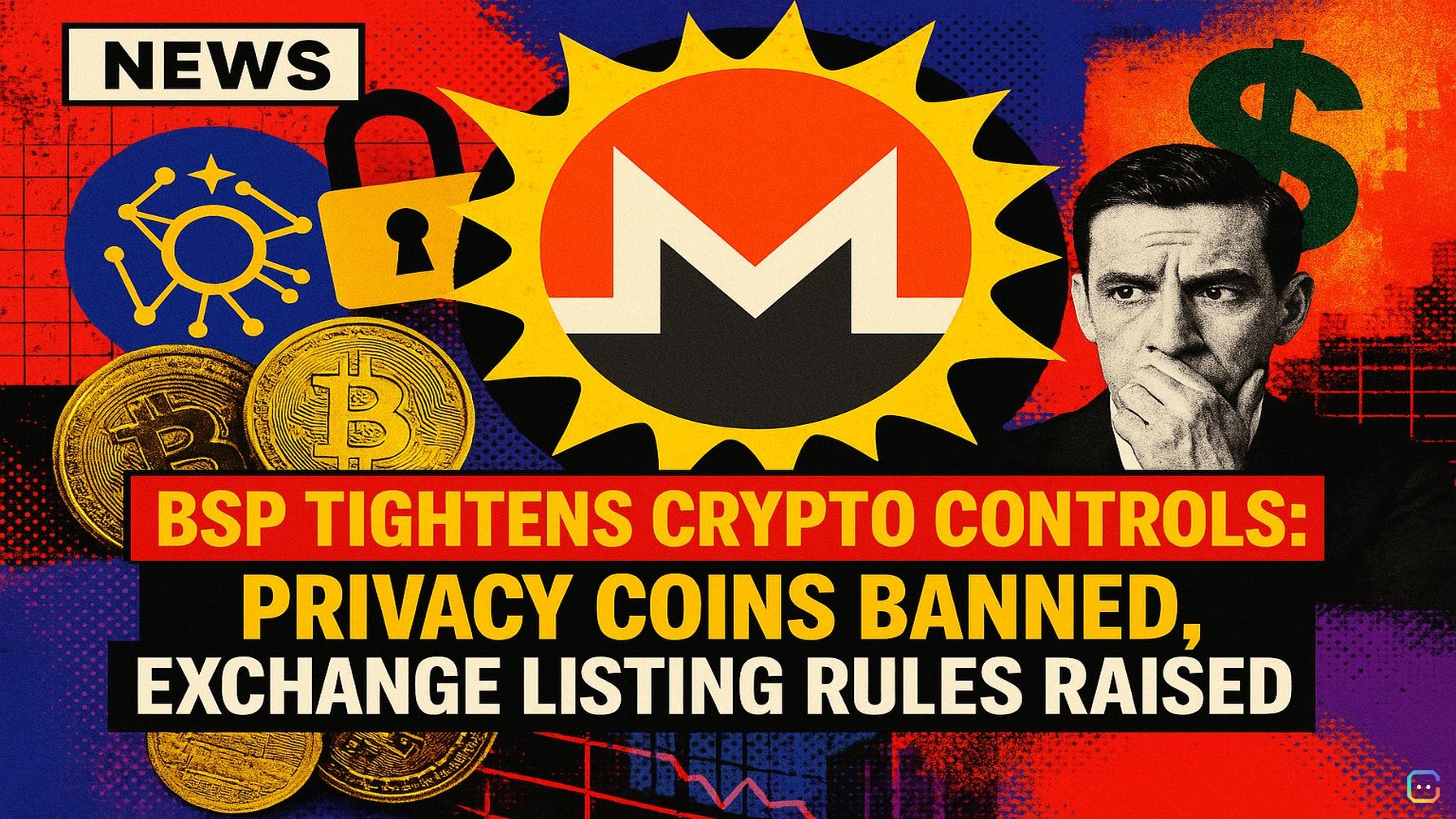
The Philippines has tightened crypto controls again, rolling out tougher listing rules for licensed exchanges and outright banning privacy coins — moves the central bank says are meant to strengthen consumer protection and financial stability as local adoption surges.
What the new rules say
In a memorandum signed by Bangko Sentral ng Pilipinas (BSP) Deputy Governor Lyn Javier, the central bank requires all licensed Virtual Asset Service Providers (VASPs) to implement strict due diligence and asset accreditation processes before offering tokens to customers. Platforms must perform ongoing monitoring of listed assets and set clear thresholds that would trigger suspensions or delistings.
The memo also bars anonymity-enhancing cryptocurrencies — commonly known as privacy coins such as Monero and Zcash — from being listed or supported by VASPs in the Philippines.
Why regulators say it’s needed
The BSP framed the guidance as a consumer- and stability-focused measure, saying higher listing standards reduce risk for retail users and help ensure crypto services operate in a “safe, sound, and consumer-centric manner.” The rules explicitly identify events that should prompt remedial action, including loss of liquidity, issuer insolvency, involvement in scams or scandals, de-pegging, material security breaches, or misleading disclosures.
Industry reaction
Some in the industry welcomed the tighter standards as overdue. “This is long overdue, and I think this is the right call. I don't think this is bureaucratic red tape; this is the minimum bar any responsible platform should already be applying before listing an asset to retail users,” said Alden Yburan, head of crypto at GCash. He added that stronger listing standards would raise product quality, though he expressed ambivalence about the privacy-coin ban: privacy, he said, “is a foundational value in crypto,” but the Philippines’ remittance-heavy economy complicates the picture.
Luis Buenaventura, President of the Blockchain Council of the Philippines, has previously argued that tighter rules create “a competitive advantage for licensed players,” nudging users toward compliant services over time.
How this fits into the wider regulatory picture
The new BSP memo sits inside a dual-regulator framework. The Securities and Exchange Commission (SEC) oversees crypto-asset service providers on the securities side, while the BSP licenses VASPs for payment and transaction rails — and firms must meet both sets of requirements independently.
Last June the SEC issued Memorandum Circular No. 5, forcing crypto-asset service providers (CASPs) to register locally, hold ₱100 million (about $1.8 million) in paid-up capital, store customer data within the country, and report to both the SEC and the Anti-Money Laundering Council. By August the SEC had blocked access to ten offshore trading platforms, including OKX, Bybit, Kraken, and KuCoin, citing noncompliance.
Adoption and policy context
The Philippines ranks ninth globally on Chainalysis’s 2025 Global Crypto Adoption Index, part of an APAC bloc that grew 69% year-over-year — underscoring why regulators are moving to tighten oversight as grassroots usage expands.
Political momentum has also pushed crypto policy into novel territory. Lawmakers are considering Senate Bill 1330, which would place the national budget on-chain — a proposal that gained traction after public outcry over roughly $9.2 billion in flagged public works spending.
Binance, BlockShoals and licensing friction
Global exchange Binance has been trying to re-enter the Philippines via local partner BlockShoals Technologies Inc., which received initial SEC clearance in November under the StratBox regulatory sandbox. But the BSP has made clear that sandbox participation “doesn't substitute for central bank licensing,” and states that neither Binance nor BlockShoals holds a VASP license.
The SEC has since adjusted its terminology, labeling Binance a “global crypto-asset service provider” rather than a global VASP, and it has required BlockShoals to integrate with a licensed domestic VASP within 90 days before onboarding any users through Binance infrastructure.
Bottom line
The BSP’s new listing guidelines raise the regulatory bar for exchanges operating in the Philippines, reinforcing ongoing efforts by both the central bank and the SEC to shift activity toward licensed, local platforms. For users and platforms, the rules mean stricter vetting of tokens, active monitoring for trouble signals, and a clear ban on privacy coins — a contentious trade-off between consumer protection, compliance, and privacy-oriented design in crypto.
Read more AI-generated news on: undefined/news