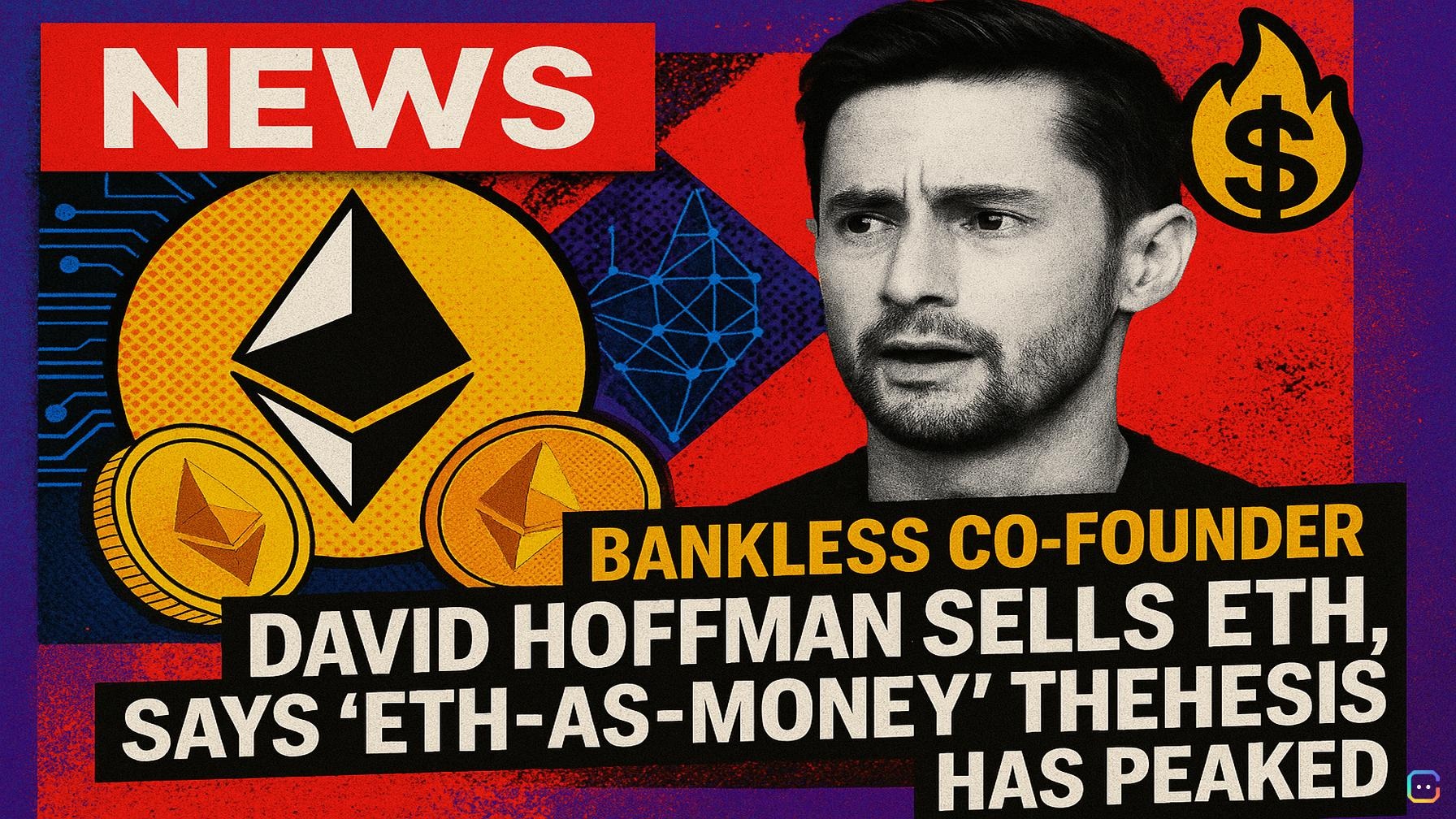
Bankless co-founder David Hoffman — long one of Ethereum’s most visible public champions — says he’s sold his ETH. The move marks a striking shift: Hoffman remains “massively bullish” on Ethereum the network, but argues the “ETH is money” thesis has largely played out and sees little chance for a structural rerating of ETH as an asset.
“This choice does not come lightly,” Hoffman wrote, noting he built a career, community and business around Ethereum. But, in his view, Ethereum “got the ETH price it deserves,” and further revaluation of ETH up or down now looks unlikely.
Why he sold
Hoffman frames Ethereum as a multi-layer coordination game. For ETH to become the dominant form of internet money, a long list of things had to align simultaneously: decentralized leadership, responsive governance, fast technical execution, coherent Layer-2 incentives, and clear market dominance. That narrow path, he says, largely played out — but didn’t deliver the maximal monetary premium for ETH that many bulls once expected.
A different design choice than Bitcoin
He contrasts Ethereum’s architecture with Bitcoin’s: Bitcoin stripped the base layer to prioritize BTC’s monetary role; Ethereum deliberately added programmability to maximize blockspace utility. That design unlocked massive adoption and developer activity, but it also made ETH’s monetary upside dependent on success across technology, culture, governance and market structure — all at once.
Fees, rollups and the asset-capture problem
Central to Hoffman’s argument is the asset-capture issue. Chains that tie token value directly to on-chain fees and revenue have seen market reward: he points to ETH’s dominance in 2021, Solana’s resurgence in 2024, NEAR’s 2026 rerating alongside revenue and burn growth, and long-running fee engines like BNB and TRX. By contrast, Ethereum’s roadmap intentionally funnels execution and margins outward: rollups scale execution, applications retain user-facing margin, and Ethereum provides low-cost, secure settlement.
“At its heart, Ethereum is a giver, not a taker,” Hoffman wrote — supplying the world’s most secure blockspace “at cost” and enabling tokenization of global assets without capturing those economics for ETH itself. The rollup-centric vision, he argues, leaves the majority of value with L2s and applications rather than the base token.
Ethereum as settlement for other monies
Hoffman also highlights a striking statistic: stablecoins on Ethereum grew from roughly $3 billion in 2020 to about $163 billion today — a 54x increase. That growth, he says, underlines how Ethereum’s success has expanded tokenized dollars and other external monies, not necessarily ETH’s role as money.
Cultural timing and the waning monetary narrative
He questions whether the cultural and economic context that briefly propelled ETH as “internet money” ever formed a stable equilibrium. The clearest moment for that thesis coincided with a pandemic-era spike in online activity and crypto interest; as public sentiment shifted back toward skepticism about scams and speculation, the social foundation for ETH as a dominant store of value weakened.
Not bearish on the network
Importantly, Hoffman isn’t bearish on Ethereum’s technology or long-term relevance. He’s “massively bullish” on Ethereum as infrastructure; his decision is a capital-allocation call based on the view that the “ETH is money” thesis has matured and that further asset-level upside is limited. At press time, ETH traded around $2,080.
What this means for holders
Hoffman’s move crystallizes a core debate for crypto investors: can a programmable, application-centric base layer both power a broad ecosystem and retain dominant monetary value for its native token? If Ethereum continues to prioritize low-cost settlement for rollups and apps, additional value capture by ETH may remain constrained — even as the network itself grows more indispensable.
Read more AI-generated news on: undefined/news