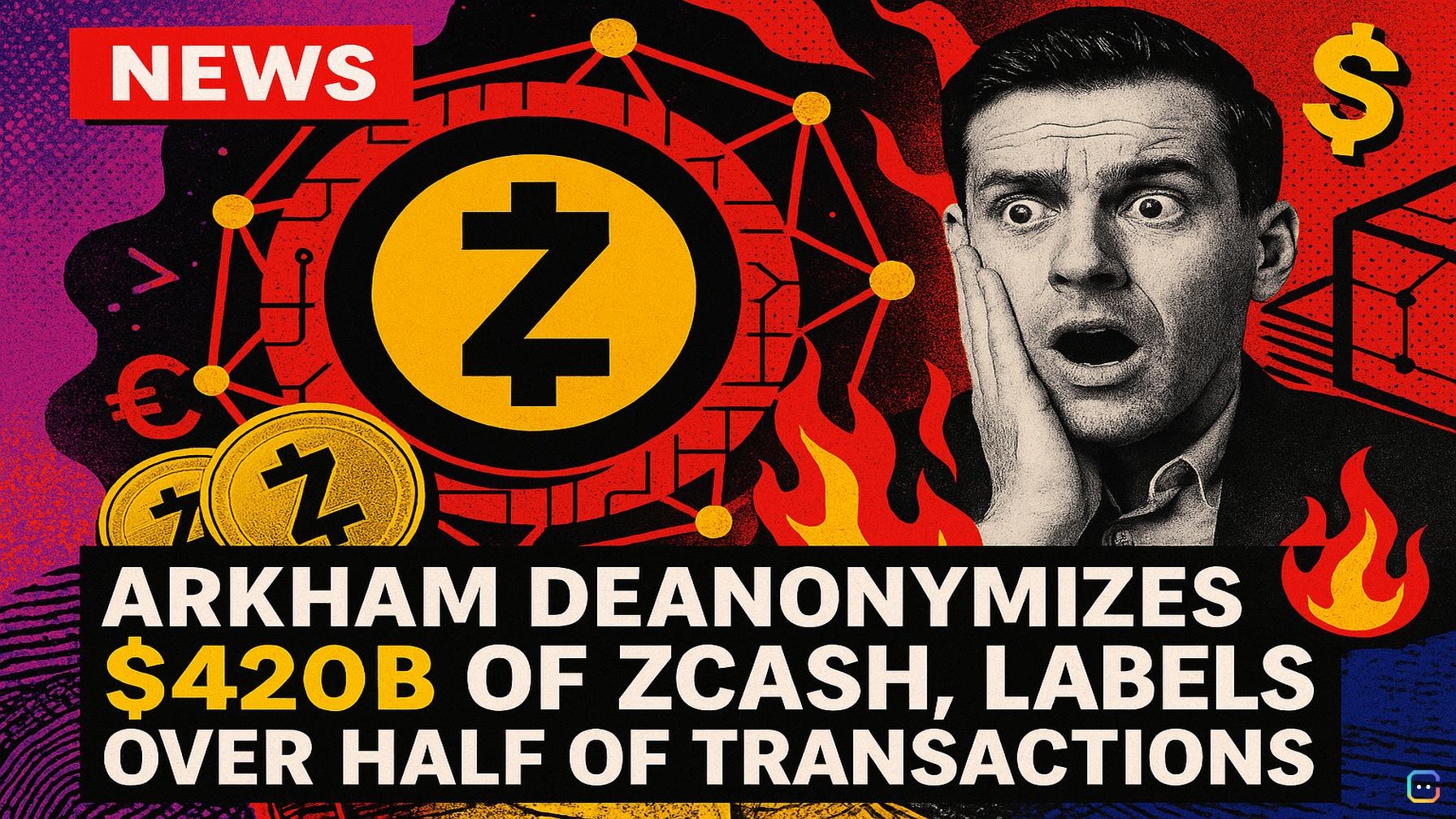
Blockchain intelligence firm Arkham Intelligence has published research showing it can deanonymize a surprisingly large share of Zcash activity — attributing roughly $420 billion in ZEC volume to known individuals and institutions, and labeling more than half of the network’s transactions on its platform. The finding lands as a stark rebuke to Zcash’s core selling point: financial privacy.
Arkham’s May 21 report is careful to distinguish technical limits from practical exposure. It does not claim Zcash’s cryptography is broken — the zero-knowledge zk-SNARKs that underpin fully shielded z-to-z transactions remain mathematically sound and, in theory, opaque. The practical problem is how the coin is used in the real world.
Zcash supports two address types. Transparent “t-addresses” behave like Bitcoin addresses, with all activity publicly visible on-chain. Shielded “z-addresses” hide sender, receiver, and amount inside a private pool. In practice, however, many exchanges, custodians and institutional actors default to transparent t-addresses for compliance and operational reasons. That choice makes a disproportionate share of Zcash’s transaction history readable on-chain. Even when funds move into or out of the shielded pool, those entry and exit points are visible — allowing investigators to map behavior around otherwise private transactions.
Using these observable traces and on-chain intelligence techniques, Arkham says it has successfully labeled over 50% of Zcash activity in its dataset, and tied $420 billion in flow to identified entities. The firm highlights a high-profile example: a U.S. government wallet on Arkham’s platform holding seized ZEC, underscoring that the world’s most active financial surveillance actors are already tracking and confiscating this privacy coin.
The timing matters. ZEC recently saw a price surge of more than 40% in a week, and BitMEX founder Arthur Hayes has disclosed ZEC as one of his two largest non-Bitcoin positions — even setting a $10,000 long-term target. Some analysts, including Ali Martinez, warned of an overheated technical setup even as the market re-evaluates Zcash’s investment case. Arkham’s research injects fresh scrutiny into that reassessment.
For the broader privacy-coin sector, the report is a wake-up call. This is not purely theoretical: a blockchain intelligence firm publicly attributing hundreds of billions in Zcash volume to known actors demonstrates how real-world practices can erode privacy guarantees. For users who hold ZEC primarily for anonymity, the central question is now unavoidable — if most activity on the chain is already traceable, what practical privacy remains?
Arkham’s findings don’t negate the cryptographic capability of shielded transactions, but they do highlight a gap between design and deployment. How Zcash projects, exchanges, and users respond could determine whether the coin preserves meaningful privacy or becomes mainly a partially shielded ledger with a privacy label.
Read more AI-generated news on: undefined/news