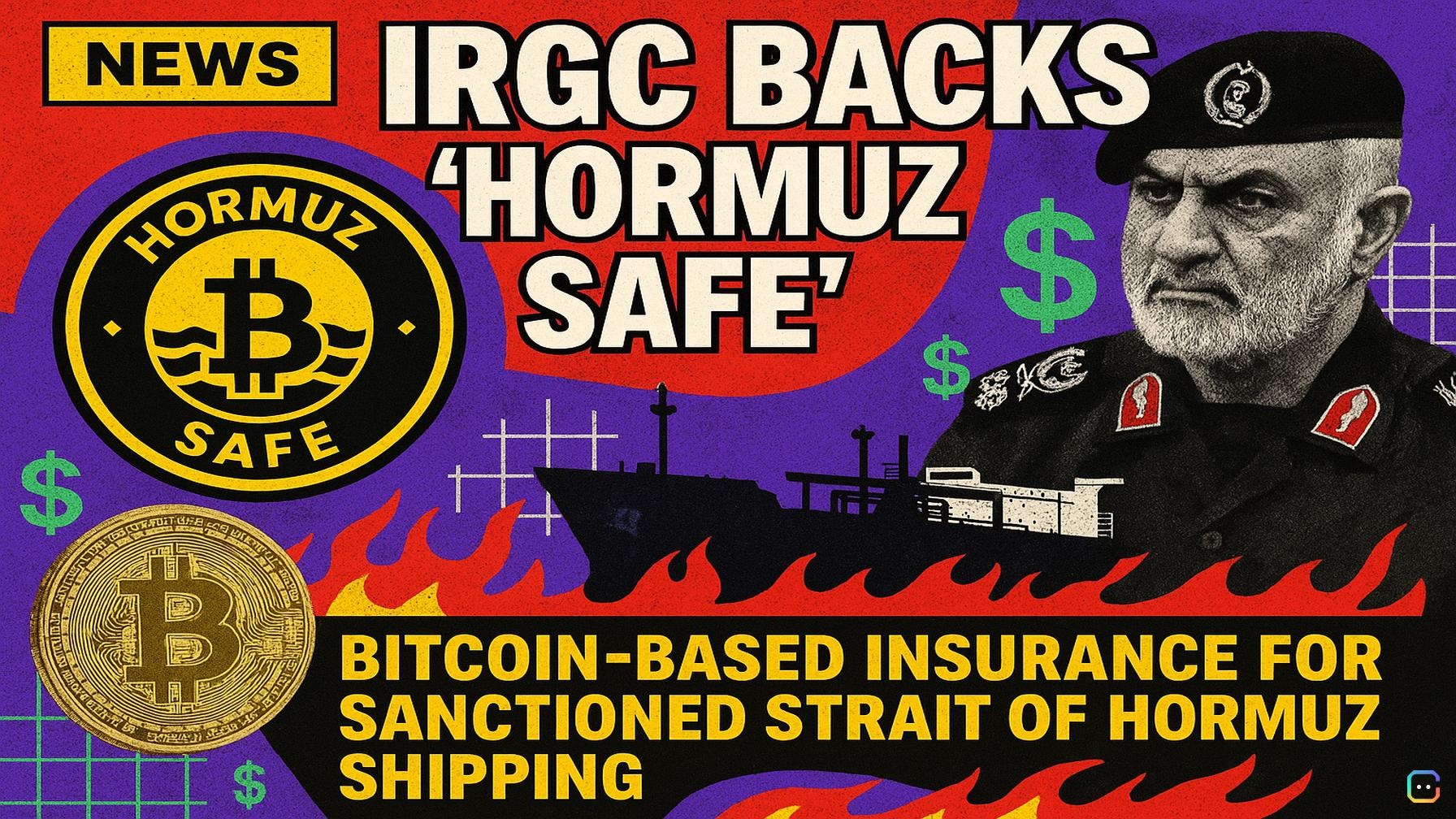
Iran’s Revolutionary Guard Corps is backing a bold, Bitcoin-based plan to insure cargo transiting the strategically vital Strait of Hormuz — a move that could reshape how sanctioned trade is financed, if it ever scales.
What is “Hormuz Safe”?
- According to state-affiliated Fars news agency, Iran’s Economy Ministry has been exploring “Hormuz Safe” since late April. The platform reportedly issues marine insurance policies and financial-responsibility certificates for cargo moving through the Persian Gulf, the Strait of Hormuz and nearby waters.
- Platform rules describe the product as providing “fast and cryptographically verifiable insurance policies” with payments “settled in Bitcoin” and coverage starting at the moment of confirmation. Officials estimate the scheme could generate more than $10 billion.
Context: previous Bitcoin tactics and scams
- This plan follows earlier reports that Iranian authorities sought Bitcoin payments from oil tankers seeking passage through the strait, arguing crypto fees would be harder to trace or seize under sanctions. Those outreach efforts were quickly mimicked by scammers who began impersonating officials and demanding Bitcoin or USDT from ships seeking transit clearance.
Market reactions and geopolitical forecasts
- Traders on Myriad, a prediction market owned by Dastan (Decrypt’s parent company), placed a 20% chance that a Trump announcement would end the Hormuz blockade before June. They gave Iran’s regime a 12% chance of collapsing before October and put the odds of Iran closing its airspace before June at 46.5%.
Feasibility: possible but narrow in scope
- Analysts tell Decrypt the idea is technically possible but unlikely to scale beyond sanctioned or niche trade channels. Dominick John, an analyst at Zeus Research, said Bitcoin-settled insurance “is possible in niche, sanctioned-trade workarounds,” but not practical for mainstream shipping because of sanctions risk, volatility, limited legal recognition and lack of insurer support. He added that liquidity limits, traceability and fiat off-ramps still create exposure, and crypto doesn’t solve counterparty trust or enforceable reinsurance.
Sanctions and visibility risk
- Ryan Yoon, senior analyst at Tiger Research, called the platform’s technical and legal viability “highly doubtful,” noting there are no confirmed users despite the reported launch. He argued any shipping company that openly uses Hormuz Safe would risk “immediate expulsion from the global financial system” because of U.S. secondary sanctions, which likely explains the absence of visible customers.
Blockchain transparency: mixing blessing and curse
- Proponents of the plan argue crypto can move funds faster than banks Iran struggles to access, but critics note Bitcoin’s public ledger may make the scheme easier to monitor. Agne Linge, a board advisor at Wefi, observed that transactions on Bitcoin’s blockchain are public — Iran-linked wallet addresses could be exposed and related coins “tainted.” Blockchain analytics firms would likely flag those flows, even if payments are quicker than traditional banking rails.
Law enforcement angle
- The reports arrive as European authorities increase pressure on IRGC-linked online activity. Europol said investigators identified some 14,200 links tied to what it described as the group’s propaganda ecosystem. Andy Yajin Zhou, associate professor at the Chinese University of Hong Kong and co-founder of BlockSec, told Decrypt that state-linked actors increasingly rely on “interconnected digital infrastructure” — mixing social media, hosting, messaging platforms and crypto payment channels. He noted blockchain data can provide useful investigative signals, but on-chain traces alone rarely yield definitive attribution because sophisticated actors can use one-time wallets, mixers or informal settlement networks.
Bottom line
- Hormuz Safe illustrates how sanctioned states may try to weaponize crypto to preserve revenue streams. While the concept is feasible in narrow, sanctioned-trade corridors, analysts say legal exposure, sanctions risk, liquidity constraints, insurer reluctance and blockchain visibility make broad adoption unlikely — at least without new legal or financial workarounds.
Read more AI-generated news on: undefined/news